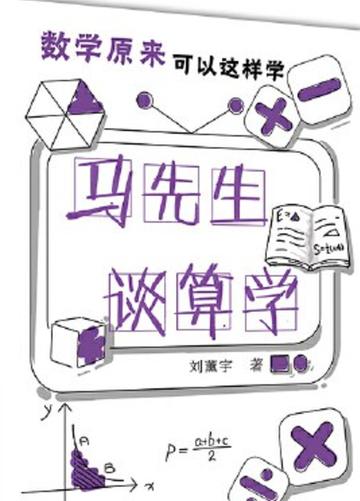
"Mr. Ma Talks about Arithmetic" is a mathematics science popularization classic written by the famous mathematics educator Liu Xunyu for primary and middle school students. This book fictionalizes a character named "Mr. Ma" and narrates it from Mr. Ma's perspective. It mainly explains how to solve four arithmetic problems using graphic methods. It has compiled more than 100 questions and explains mathematical problems from the simplest to the deeper.
Reader comments
"'Mathematics can train us and make us smarter.'" The so-called training in the first half of this sentence is to let us develop some good habits in learning and career: such as concentration, consistency, patience, order, etc.; The second half of the sentence will make us smarter. In fact, when people first learn arithmetic, it is very difficult to think about the solution to a problem, but the more you learn, the more solutions you can think about from different angles, and people will think that this person is very powerful. In fact, many times the smart knowledge that others perceive on the surface is mostly the result of proficient practice behind the scenes.
The four arithmetic operations, addition, subtraction, multiplication and division have their own knowledge. This popular science book dedicated to primary and secondary school students is not easy but fortunate for the author himself and for that era. In order to enhance the Chinese people's interest in arithmetic, the originally lifeless algorithm is injected with infinite vitality, making use of Using diagrams to directly explain algorithmic problems is not only intuitive and easy to observe, but also makes the subject of arithmetic closer to reality. Whether you are a beginner or a reader in the advanced stage, the value of this book cannot be denied. I would like to dedicate this book to all friends who truly love science.
Worth recommending! This book will help your children change their inherent perceptions of mathematics and make them willing to learn mathematics. Mathematics has always been a subject that my children are unwilling to work hard on. After buying this book to read to my children, they really like mathematics! Be willing to use mathematical thinking to think about problems encountered in life. This book makes up a fictional character named "Mr. Ma" and narrates it from Mr. Ma's perspective. It explains how to use graphic methods to solve four arithmetic problems. It has compiled more than 100 questions and explains mathematical problems from simple to profound. The questions selected in the book are both representative and interesting.
Some are like detailed explanations of difficult problems, but I have always been opposed to books of this type. Although there are hundreds and dozens of questions collected here to explain, I don't want anyone to read it just to find the algorithm of a certain question. This may be disappointing. The author's motivation for writing this book is to enhance arithmetic students' interest in arithmetic. Regarding my attitude toward learning arithmetic, my approach to thinking about problems, and my exploration of the relationships and changes between topics, I carefully selected and planned out their methods. I hope that I can inject a little life into this lifeless mathematical problem. Using graphic methods to directly solve arithmetic problems not only facilitates observation and thinking, but also makes arithmetic closer to reality. Diagrams originally bridged algebra and geometry and became the backbone of analytic arithmetic. Therefore, if we fully use it from the beginning of arithmetic, I think it will not only be of great help to learn other departments in arithmetic, but also be beneficial to learning science, engineering, and even statistics.
The writing form of supplementary teaching materials for primary and secondary school students may have been innovative, getting rid of the rigid form of blindly instilling knowledge in the early years. This book is a concrete manifestation of this change. The author uses a fictional character, Mr. Ma, to systematically and clearly describe the boring and complex mathematical knowledge in a lively and interesting way through a classroom drama from a third-person perspective, so that young readers will first feel familiar with mathematics instead of unfamiliar, and then develop an affinity for mathematics and master the concepts of mathematics unconsciously.
"A chicken and a rabbit in the same cage" used to be a nightmare for me when I was in school. Every time I took an exam, I looked forward to not having this kind of question. Mr. Ma also explains this problem in the book. He calculates and analyzes it from multiple perspectives and methods, and compares these algorithms to see which one is more interesting. The book also collects more than a hundred and dozens of topics and explains them. It is a book suitable for science students to study. As a liberal arts student, I found it a bit obscure. However, the graphical method is very helpful for learning other departments in mathematics, and is beneficial for learning science, engineering, and even statistics.
This book is very interesting. It uses the virtual "Mr. Ma" to explain the four arithmetic problems using diagrams, making mathematics vivid and easy to understand. I like the design of topics in the book from easy to deep. Just like chatting with Mr. Ma, I learned a lot of knowledge without knowing it. Moreover, seeing the author insist on writing a book under such difficult circumstances, I admire his spirit. This book not only teaches mathematics, but also makes me feel the power of persistence.

"'Mathematics can train us and make us smarter.'" The so-called training in the first half of this sentence is to let us develop some good habits in learning and career: such as concentration, consistency, patience, order, etc.; The second half of the sentence will make us smarter. In fact, when people first learn arithmetic, it is very difficult to think about the solution to a problem, but the more you learn, the more solutions you can think about from different angles, and people will think that this person is very powerful. In fact, many times the smart knowledge that others perceive on the surface is mostly the result of proficient practice behind the scenes.
The four arithmetic operations, addition, subtraction, multiplication and division have their own knowledge. This popular science book dedicated to primary and secondary school students is not easy but fortunate for the author himself and for that era. In order to enhance the Chinese people's interest in arithmetic, the originally lifeless algorithm is injected with infinite vitality, making use of Using diagrams to directly explain algorithmic problems is not only intuitive and easy to observe, but also makes the subject of arithmetic closer to reality. Whether you are a beginner or a reader in the advanced stage, the value of this book cannot be denied. I would like to dedicate this book to all friends who truly love science.
Worth recommending! This book will help your children change their inherent perceptions of mathematics and make them willing to learn mathematics. Mathematics has always been a subject that my children are unwilling to work hard on. After buying this book to read to my children, they really like mathematics! Be willing to use mathematical thinking to think about problems encountered in life. This book makes up a fictional character named "Mr. Ma" and narrates it from Mr. Ma's perspective. It explains how to use graphic methods to solve four arithmetic problems. It has compiled more than 100 questions and explains mathematical problems from simple to profound. The questions selected in the book are both representative and interesting.
Some are like detailed explanations of difficult problems, but I have always been opposed to books of this type. Although there are hundreds and dozens of questions collected here to explain, I don't want anyone to read it just to find the algorithm of a certain question. This may be disappointing. The author's motivation for writing this book is to enhance arithmetic students' interest in arithmetic. Regarding my attitude toward learning arithmetic, my approach to thinking about problems, and my exploration of the relationships and changes between topics, I carefully selected and planned out their methods. I hope that I can inject a little life into this lifeless mathematical problem. Using graphic methods to directly solve arithmetic problems not only facilitates observation and thinking, but also makes arithmetic closer to reality. Diagrams originally bridged algebra and geometry and became the backbone of analytic arithmetic. Therefore, if we fully use it from the beginning of arithmetic, I think it will not only be of great help to learn other departments in arithmetic, but also be beneficial to learning science, engineering, and even statistics.
The writing form of supplementary teaching materials for primary and secondary school students may have been innovative, getting rid of the rigid form of blindly instilling knowledge in the early years. This book is a concrete manifestation of this change. The author uses a fictional character, Mr. Ma, to systematically and clearly describe the boring and complex mathematical knowledge in a lively and interesting way through a classroom drama from a third-person perspective, so that young readers will first feel familiar with mathematics instead of unfamiliar, and then develop an affinity for mathematics and master the concepts of mathematics unconsciously.
"A chicken and a rabbit in the same cage" used to be a nightmare for me when I was in school. Every time I took an exam, I looked forward to not having this kind of question. Mr. Ma also explains this problem in the book. He calculates and analyzes it from multiple perspectives and methods, and compares these algorithms to see which one is more interesting. The book also collects more than a hundred and dozens of topics and explains them. It is a book suitable for science students to study. As a liberal arts student, I found it a bit obscure. However, the graphical method is very helpful for learning other departments in mathematics, and is beneficial for learning science, engineering, and even statistics.
This book is very interesting. It uses the virtual "Mr. Ma" to explain the four arithmetic problems using diagrams, making mathematics vivid and easy to understand. I like the design of topics in the book from easy to deep. Just like chatting with Mr. Ma, I learned a lot of knowledge without knowing it. Moreover, seeing the author insist on writing a book under such difficult circumstances, I admire his spirit. This book not only teaches mathematics, but also makes me feel the power of persistence.