Stats
9.4Score
26Chapters
Tags
Synopsis
Reader comments
In booklists 2
Nobel Prize for Literature, Mao Dun Literature Prize, Lu Xun Literature Prize and Other Literary Works
I want to read a book similar to "One Sentence is Worth Ten Thousand Sentences: Collector's Edition".
122.5MViews725Books2dUpdated

Foreign Masterpieces, Preferably Classical and Romantic Ones!
I want to read a book similar to "A Tale of Two Cities (Classic World Masterpiece)".
1.1MViews340Books15dUpdated
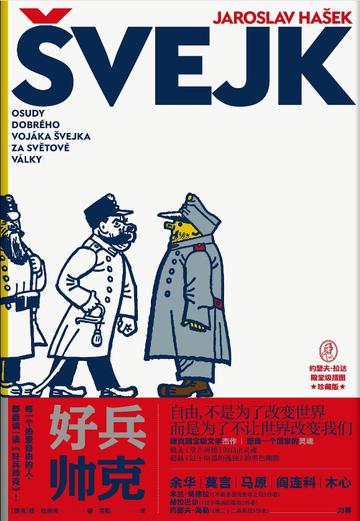
What is it that makes a veteran become more and more crazy? What has he been through! An idiot veteran who is mentally and physically disabled. Resisting the oppression of the Austro-Hungarian Empire and resisting the World War, from his home in Prague, the Czech capital, to the Eastern Front battlefield of World War I, Schweik performed a journey of resistance that was filled with laughter and tears. In the novel, the war becomes more and more cruel, and Schweik's behavior becomes more and more crazy. In all of Shuike's words and deeds, the Shuike we see may be stupid and crazy, but he is brave, wise and holy in the face of life. Schweik despised authority and rebelled throughout his life. Use such an idiot Shuike to satirize the darkness and pedantry of that society.
The author passed away in 1923 before the book was finished.
His straightforwardness and naivety always exposed the ugly side of hypocritical officers and bureaucrats. This reminds me of Don Quixote in "Don Quixote". They all have their own unique persistence and views on the world. Moreover, this book is very ironic, like a mirror, allowing us to see the weaknesses of human nature and the absurdity of society. I think everyone can learn something from Sveik, such as optimism, kindness and not being afraid of power. All in all, this is a book worth reading and I recommend it to everyone!
The protagonist, Schweik, is a very emotional person and a great little man. Although he does not have the overall perspective of leadership, he is better than his delicate mind. When others are talking about how Archduke Ferdinand was assassinated, he thinks of the archduke with the same name. When I read Ferdinand, I couldn't help but sigh. This character is like a mirror. While reading about Shuike's life, I can always think of my small self. If I were also in that war era, would I be as free and strong as him? In Shuike's eyes, the cruel war has nothing to do with him. He just wants to live a good life, so what's wrong?
Among the more well-known Czech writers are Milan Kundera, and the other is the author of this book, Jacek Hasek, who is a Czech humorist, satirist and social anarchist. This book is about the farce-like encounter of a soldier during World War I, and a satirical novel that satirizes the stupid and rigid authorities at the time. It looks at World War I from the perspective of an "officially certified idiot" and profoundly depicts the incompetence and stupidity of the officers of the Austro-Hungarian Empire. It uses dramatic techniques to write about their evil and stupidity. Readers who like it can find it and read it.
This book tells the story of a humble dog trader who was drafted into the army when the First World War broke out. This unfinished masterpiece is a helpless regret for readers, but the lack of an ending may also be another ending. The author Hasek refuses to see a great tragedy in the massacre. This statement is vividly reflected in the protagonist Shuike. Although Shuike is a small and insignificant person, the noble things that others flock to in the eyes of others are just vulgar waste in his eyes. The character Shuai Ke tells readers that under authoritarianism, we can also show its absurdity through "cynicism".
A long political satirical novel written by the outstanding Czech writer Hasek. The author refined it from a large amount of material he obtained while serving in the Austro-Hungarian Army. The novel takes the protagonist Szeke's experience in World War I as the main plot, vividly describing the incompetence, stupidity and ugliness of the officers, policemen, and priests of the Austro-Hungarian Empire, and profoundly exposes the vicious tyranny of the rulers of the Austro-Hungarian Empire and the corruption and depravity of the army. The work uses vivid brushstrokes to create an honest, humorous, and endearing image of a handsome soldier.
Shuike, he was a good man and a good soldier, but in his time, his kindness was just stupid in the eyes of others. Shuike's innocence and kindness seem beautiful and pure compared with the selfishness and greed of those who interact with him. The author borrows Schweik's perspective to vividly reflect the ugliness within the Austro-Hungarian Empire in the story, including the arbitrary and unreasonable police organization, the greedy, selfish, and fooling priests, and the arrogant, lustful and arbitrary officers. The existence of these people vividly depicts the image of a backward country that is fanatical, ignorant, and militaristic.
It is a pity for history that Hasek's novel ended abruptly and became its swan song. Can you believe it? As an ordinary Austro-Hungarian soldier on the cruelest battlefield of World War I, he repeatedly missed fierce battles by accident, being sent from the front to the rear, and then from the rear to the front. With his absurd behavior and experience, and a unique perspective, Shuai Ke revealed the various farces in the war from the side, showing scenes of black humor. The lines are full of humor and irony, which makes people laugh but also makes them think deeply about history. The storyline is even more exciting. When Shuai Ke stabs Lou Zi again, you will be concerned about his next fate, and you will always have the premonition that "if nothing happens, something will happen."
The first time I came into contact with Shuai Ke was a little book. Shui Ke was wearing a big hat, an outrageously large military uniform, a belt, and a fat jacket that hugged his buttocks. One leg of his trousers could hold the entire Shui Ke. He also had a pair of tattered big leather shoes with the front of the shoes tilted up. Shui Ke was neatly dressed and walked in a standard manner toward his superiors. With a military salute, a pious expression, and a smile as pure and innocent as a baby, even the freckles on his face shone with a holy light, he said, as long as I have one breath... The officer in front of him was furious with his idiotic smile... He and another soldier passionately discussed what the brakes on the train were? Can the train stop? So, the train stopped... His cook used a wheelchair to push Szeke, whose leg was in a cast, to join the army. Szeke waved his crutches and shouted loudly: Fight to Belgrade! He dragged the priest out of the carriage and threatened loudly: Believe it or not, I will beat you! ... There are too many childhood memories. The Good Soldier Shuai Ke has brought me too many good memories. I haven't read this novel for many years. The above scene appears in my memory. I can't help but laugh. Let's read it again and laugh again!
It's witty, humorous, exaggerated and interesting, which makes people read it involuntarily.
Very good, worth sharing❗I have watched it for the second time now
He's so good at talking, and it's so cool to talk!
I read a paper book with my father when I was young. I suddenly remembered it and came to Tomato🍅 to look for it. I found it. I was very happy.
Good book, very interesting It's a pity that it stopped suddenly
Very beautiful, highly recommended
Interesting, lively, not boring
Humorous and very good-looking
Fascinating work
Good looking, good looking, good looking, good looking, good looking, good looking
I just laughed and didn't have time to understand, but Shuai Ke was really happy [laughs]