★ To read the history of the Ming Dynasty, you must first read Wu Han!
★ Easy historical science popularization by the founder of modern Ming history research, a historical science popularization classic that has influenced countless Ming history enthusiasts.
★ Based on the lectures of the Central Party School, it has been comprehensively revised and re-edited based on Wu Han's posthumous manuscripts, and newly arranged, with four new articles including "An Examination of the Party Case of Hu Weiyong".
★ "Historical Science Popularization" highly praised by masters such as Zheng Tianting and Bai Shouyi, using relaxed language, allows you to grasp the basic context of the entire three hundred years of the Ming Dynasty in just two hours.
★ Say goodbye to superficial pursuit of novels, and regain a grasp of the evolution of the entire Ming Dynasty history.
★(Wu Han) is very strict in identifying historical materials. Do not easily believe many documents and legends, and must examine them. Especially when encountering contradictions, we always carefully search for clues to resolve them and identify the authenticity, in order to obtain the true face of objective historical facts. ——Xia Nai
★ Wu Han is a well-known historian who specializes in the history of the Ming Dynasty. He has written many books and has high academic attainments. He has already emerged as a student. ——Fei Xiaotong
★ Here, there are many historical facts that will subvert your understanding:
If the capital had not been moved to Beijing, would the history of the Ming Dynasty after Ming Yingzong have ceased to exist?
Zhu Wan, the anti-Japanese hero, discovered before his death that "no one in the imperial court knew anything about the Japanese"?
The "eight governors" in Peking Opera are actually just the little "sesame officials" of the seventh rank?
★ Here, you can master the three hundred years of Ming Dynasty history in just two hours:
Founding the capital in Nanjing, moving the capital to Beijing, resisting the Mongolians and Japanese, the Donglin party struggle, the founding of the Jurchen nation, Zheng He's overseas voyages, and the emergence of capitalism: master the answers to these seven major questions, and you will have mastered the basic context of the entire three hundred years of the Ming Dynasty!
In just two hours, you can follow the master and step into the palace of Ming history research, saying goodbye to superficial curiosity!
Reader comments
"A Brief Introduction to the History of the Ming Dynasty" is a transcript of an academic lecture given by Wu Han at the Central Advanced Party School. It briefly and systematically describes issues in the history of the Ming Dynasty such as the founding of the Ming Dynasty by Emperor Taizu of the Ming Dynasty, the move of the capital of Ming Dynasty to Beijing by Emperor Chengzu of the Ming Dynasty, the Northern Lu and the Southern Japanese, the Donglin Party Struggle, the Jurchens of Jianzhou, Zheng He's voyages to the West, and the emergence of capitalism.
The author quotes a lot of historical materials, which is not easy to read. You can skip to read it.
This book provides an overview of the history of the Ming Dynasty from a professional perspective, and also discusses the reasons and limitations of the Ming Dynasty's demise. It is worth noting that the author discusses it from the perspective of historical materialism while maintaining national unity. Although this book inevitably has traces of the times, it is still a good book.
Worthy of being an expert on Ming history, this level is very good.
It refreshed my understanding of the land system.
This "A Brief Introduction to the History of the Ming Dynasty" is really good! Mr. Wu Han's explanation was easy to understand and allowed me to quickly understand the basic context of Ming history in a relaxed language. He is very rigorous in identifying historical materials, and the content in this book is very valuable. And I especially like some of the historical facts in it that subvert cognition, it's very interesting! I feel that I have benefited a lot and recommend it to friends who like history!
Wu Han's level is indeed great. He looks at the ancients dialectically and attacks historical nihilism. The Huayi debate is also quite exciting.
The first half is easy to read
There is something, a good book
Beautiful, a masterpiece
Concise and to the point, highly academic
That makes sense
Good book, concise and comprehensive
Learn to accumulate knowledge
It is a relatively academic book and is highly usable if you want to have an in-depth understanding of the history of the Ming Dynasty. However, for me, who uses the fragmented time to read, it was a waste of time [face covering]
The literature is concise and smooth, objective and detailed. Nice
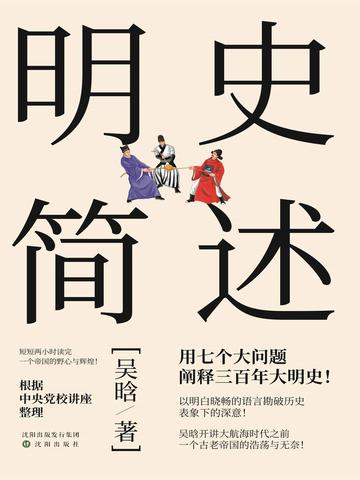


"A Brief Introduction to the History of the Ming Dynasty" is a transcript of an academic lecture given by Wu Han at the Central Advanced Party School. It briefly and systematically describes issues in the history of the Ming Dynasty such as the founding of the Ming Dynasty by Emperor Taizu of the Ming Dynasty, the move of the capital of Ming Dynasty to Beijing by Emperor Chengzu of the Ming Dynasty, the Northern Lu and the Southern Japanese, the Donglin Party Struggle, the Jurchens of Jianzhou, Zheng He's voyages to the West, and the emergence of capitalism. The author quotes a lot of historical materials, which is not easy to read. You can skip to read it.
This book provides an overview of the history of the Ming Dynasty from a professional perspective, and also discusses the reasons and limitations of the Ming Dynasty's demise. It is worth noting that the author discusses it from the perspective of historical materialism while maintaining national unity. Although this book inevitably has traces of the times, it is still a good book.
Worthy of being an expert on Ming history, this level is very good. It refreshed my understanding of the land system.
This "A Brief Introduction to the History of the Ming Dynasty" is really good! Mr. Wu Han's explanation was easy to understand and allowed me to quickly understand the basic context of Ming history in a relaxed language. He is very rigorous in identifying historical materials, and the content in this book is very valuable. And I especially like some of the historical facts in it that subvert cognition, it's very interesting! I feel that I have benefited a lot and recommend it to friends who like history!
Wu Han's level is indeed great. He looks at the ancients dialectically and attacks historical nihilism. The Huayi debate is also quite exciting.
The first half is easy to read
There is something, a good book
Beautiful, a masterpiece
Concise and to the point, highly academic
That makes sense
Good book, concise and comprehensive
Learn to accumulate knowledge
It is a relatively academic book and is highly usable if you want to have an in-depth understanding of the history of the Ming Dynasty. However, for me, who uses the fragmented time to read, it was a waste of time [face covering]
The literature is concise and smooth, objective and detailed. Nice