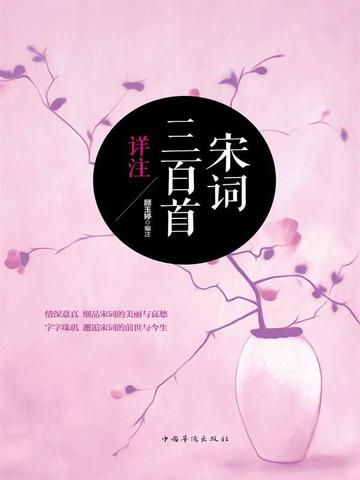
The contents of the poems include patriotic speeches, love in the boudoir, sorrows of traveling and separation, scenery of the frontier, chants of history and objects, pastoral landscapes, and folk customs. Some are exquisitely conceived, some are poetic and picturesque, some are local characteristics, or some are profound in meaning, reflecting the historical characteristics of the Song Dynasty and the artistic trajectory of the development of Song Ci. Each lyric piece has a brief introduction to the poet, notes on the lyrics, and an artistic analysis of the lyrics. Detailed interpretation, profound and simple explanations, both elegant and popular.
Reader comments
In the book, the author selects 300 representative Song poetry works and interprets and analyzes them in detail. He not only introduced the background and characteristics of these word works from the perspectives of history, culture, and society, but also deeply analyzed their expression techniques and connotations from the aspects of art, language, and artistic conception. This book is a very classic literary work. It is not only a must-read for lovers of lyrics and music, but also an important reference book to help people better understand and appreciate Chinese traditional culture.
Many famous poetic figures appeared in the Song Dynasty, and thus they also brought us many beautiful poems. However, because many contemporary people have very poor understanding of ancient Chinese, it will cause us great difficulties when reading these poems. This work is designed to appear on front-line groups such as the military. He gave detailed annotations on the profound words in it, and also directly translated these poems in vernacular. It is a work that is very suitable for contemporary young people.
Entering the Song Dynasty, the creation of poetry gradually became more and more popular, and a large number of poets with outstanding achievements were produced. Famous works emerged one after another, and various styles and schools emerged. Su Shi made drastic developments and changes in Ci and made indelible contributions. He was the first poet to comprehensively innovate Song poetry, and he was also the poet who created the most lyrical tones in the Song Dynasty. Li Qingzhao made good use of line drawing techniques in form, found his own way, and used clear language. The argument emphasizes the law of association, advocates elegance, puts forward the saying "don't be the same family" in lyrics, and opposes writing lyrics in the same way as poetry.
The beauty of ancient poetry is not only in the language!
Poetry flourished in the Song Dynasty. When reading Song poetry, one should look for both body and spirit, and body is more important than spirit. ——Kuang Zhouyi Those who achieve great things in ancient and modern times must pass through three realms. [Last night the west wind withered the green trees. Standing alone on a tall building and looking at the end of the world], this is the first realm. [The belt becomes wider and wider, but I don't regret it at all, and I feel haggard because of the loss of my clothes.] This is the second state. [The crowd searched for him thousands of times, but suddenly looked back, and there he was, in a dimly lit place]. This is the third realm. ——Wang Guowei. For young readers, cultivating artistic appreciation is an important part of comprehensively improving artistic accomplishment. When it comes to the cultivation of beauty and aesthetic sense, we need to write about it with human feelings, explore the truth to get the pearl, and we have to dive into it, contain the satirical words, contain the eloquent words, appreciate it carefully, and finally leave the raft and land on the shore.
This book contains detailed annotations of 300 Song poems and is rich in content, covering a variety of themes and styles. The writing style is easy to understand, and the analysis of the lyrics is simple and easy to understand, allowing people to better understand the artistic conception and charm of Song poetry. The characters' behaviors in the book also show the Song Dynasty literati's love and persistence in writing lyrics, allowing us to feel the cultural heritage of Song poetry. All in all, this is a good book worth reading.
Appreciate Song poetry, a cultural treasure
Not bad, let's have fun watching it
It's great, easy to understand, with translations, analysis and comments.
In the book, the author selects 300 representative Song poetry works and interprets and analyzes them in detail. He not only introduced the background and characteristics of these word works from the perspectives of history, culture, and society, but also deeply analyzed their expression techniques and connotations from the aspects of art, language, and artistic conception. This book is a very classic literary work. It is not only a must-read for lovers of lyrics and music, but also an important reference book to help people better understand and appreciate Chinese traditional culture.
Many famous poetic figures appeared in the Song Dynasty, and thus they also brought us many beautiful poems. However, because many contemporary people have very poor understanding of ancient Chinese, it will cause us great difficulties when reading these poems. This work is designed to appear on front-line groups such as the military. He gave detailed annotations on the profound words in it, and also directly translated these poems in vernacular. It is a work that is very suitable for contemporary young people.
Entering the Song Dynasty, the creation of poetry gradually became more and more popular, and a large number of poets with outstanding achievements were produced. Famous works emerged one after another, and various styles and schools emerged. Su Shi made drastic developments and changes in Ci and made indelible contributions. He was the first poet to comprehensively innovate Song poetry, and he was also the poet who created the most lyrical tones in the Song Dynasty. Li Qingzhao made good use of line drawing techniques in form, found his own way, and used clear language. The argument emphasizes the law of association, advocates elegance, puts forward the saying "don't be the same family" in lyrics, and opposes writing lyrics in the same way as poetry.
The beauty of ancient poetry is not only in the language!
Poetry flourished in the Song Dynasty. When reading Song poetry, one should look for both body and spirit, and body is more important than spirit. ——Kuang Zhouyi Those who achieve great things in ancient and modern times must pass through three realms. [Last night the west wind withered the green trees. Standing alone on a tall building and looking at the end of the world], this is the first realm. [The belt becomes wider and wider, but I don't regret it at all, and I feel haggard because of the loss of my clothes.] This is the second state. [The crowd searched for him thousands of times, but suddenly looked back, and there he was, in a dimly lit place]. This is the third realm. ——Wang Guowei. For young readers, cultivating artistic appreciation is an important part of comprehensively improving artistic accomplishment. When it comes to the cultivation of beauty and aesthetic sense, we need to write about it with human feelings, explore the truth to get the pearl, and we have to dive into it, contain the satirical words, contain the eloquent words, appreciate it carefully, and finally leave the raft and land on the shore.
This book contains detailed annotations of 300 Song poems and is rich in content, covering a variety of themes and styles. The writing style is easy to understand, and the analysis of the lyrics is simple and easy to understand, allowing people to better understand the artistic conception and charm of Song poetry. The characters' behaviors in the book also show the Song Dynasty literati's love and persistence in writing lyrics, allowing us to feel the cultural heritage of Song poetry. All in all, this is a good book worth reading.
Appreciate Song poetry, a cultural treasure
Not bad, let's have fun watching it
It's great, easy to understand, with translations, analysis and comments.