Stats
5.8Score
Synopsis
No synopsis yet.
We haven’t got an English blurb for this one. It appears once the source description has been translated.
Reader comments
In booklists 3
World Famous Books
🍅All the world famous books I can find are thrown at me, I can bear it
9.3MViews764Books3dUpdated
Are There Any... Foreign Masterpieces... Chinese Masterpieces?
2MViews783Books5dUpdated
I Am a High School Student. Online Classes Are a Bit of a Waste of My Studies. Are There Any Books with Internal Volumes? All Types of Books Are Available.
39.7kViews94Books1yUpdated
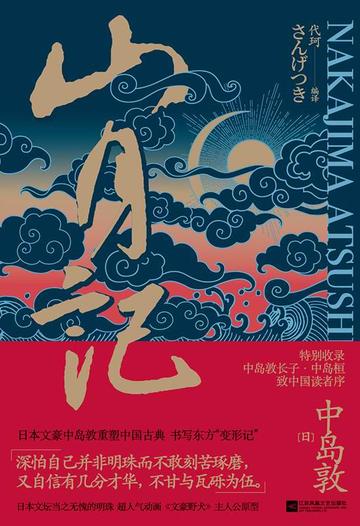
"Because I am afraid that I am not a beautiful jade, I dare not work hard to carve it, and because I partially believe that I am a beautiful jade, I cannot live with the rubble." ——"Mountain and Moon"
"Sangetsuki" Atsushi Nakajima → Recommended 1. I am deeply afraid that I am not a pearl and dare not study hard. I am also confident that I have some talent and I am unwilling to be with the rubble. As he retreats from the world day by day, his low self-esteem and cowardly self-esteem eventually become more and more arrogant in anger and shame. Everyone in the world is an animal tamer, and the beast is everyone's temperament. 2. "Being respectful and respectful can inspire courage; being broad-minded and upright can foster strength; being gentle and decisive can suppress adultery." 3. People sometimes feel that something is missing, but they don't know exactly what is missing. 4. "While there is life, there is no death. When it comes to death, I have nothing. What should I be afraid of?" 5. "The eyes can see everything, but they cannot see themselves. After all, the self cannot understand itself." "People who understand ultimate madness are happy. They save themselves by killing themselves. People who do not understand ultimate madness are unfortunate. They cannot control their own life and death, and can only slowly move toward destruction.
"A gentleman will be crowned even after death!"
After reading it, I need to read some professional reviews. This can be regarded as the first Japanese sinology work! The experience is very unique, but I don't seem to understand it.
Whether it is Li Zheng, Li Ling or Wu Jing, they all have their own life trajectories. How to learn lessons from them, how to explore the wisdom and love that are still desolately trying to bloom in the face of eventual destruction, and such beautiful things are also what we, a drop in the ocean, need to understand.
This is a book describing the deeds of famous people in ancient my country, such as Li Zheng, also known as Zixi and Zhongmin, who was a talented scholar in the literary history of the Tang Dynasty. He was a litterateur, official and essayist during the Dezong period of Tang Dynasty. Li Zheng is famous for his outstanding literary talent and elegant writing style. He was born in a cultural family with many literary talents. He was smart and studious since childhood, and was particularly interested in poetry and literature. He dabbled extensively in various literary works, admired the character and integrity of ancient literati, and was deeply influenced by ancient literature. Through his literary creation, he expressed his pursuit of beautiful things and reflection on social reality, which had a profound impact on later generations of literati. Interested readers can come and read it.
How would you rate this book? I think it talks about the state of mind of "not being willing to be an ordinary person, but eventually becoming the most ordinary person." I think almost everyone, from childhood to adolescence to middle age or even later, will look back on his or her life with a sigh, that is: I originally thought that I was unique and different, and would achieve great achievements when I grew up, but in the end, I found that I had just become an extremely ordinary person.
I still haven't read the Chinese poems yet I was shocked by the author's literary skills and imagination On the one hand, it is an unknown and comprehensive history; on the other hand, it is flesh-and-blood plots and imagination (perhaps) rather than excerpts. Great philosophy can be found in simple places, and sentences are as beautiful and precious as pearls. Using it as a textbook, Japanese students are quite happy To borrow a word, human nature Insight into human nature, feel life, and understand philosophy
There is this passage in the book: I am deeply afraid that I am not a beautiful jade, so I dare not study hard, but I half believe that I am a beautiful jade, so I do not want to be mediocre and associate with rubble. If the result of pondering is the same, then what is the point of pondering? But if you don't think about it, how do you know that the result of thinking will be the same for thousands of people? Or if a hard stone becomes a pearl and jade after being polished, and who is more precious and who is worse between a pearl, jade and a hard stone is just the standard of Luosheng people, after all, not everyone thinks that pearls and jade are more precious than hard stones. So, do you choose to ponder it or not? If we choose to think about ourselves, countless trivial matters will erode us every moment. It seems that only living this way - living hard can lead to the road to success.
The level is not high enough. I can only understand it superficially. I hope I can have a deeper understanding in the future.
Atsushi Nakajima (1909-1942), Japanese novelist. In February 1942, he published "The Story of the Mountain and the Moon" and "The Disaster of Words", which were highly praised by Japanese literary circles. In May, he published "Light, Wind, Dream", which was shortlisted for the Akutagawa Literary Prize. This book is a collection of works by Japanese writer Atsushi Nakajima, including 14 classic short stories. Atsushi Nakajima interprets classical Chinese stories with Japanese ghost stories, integrates modern ideas into ancient historical figures, and creates strange dream-like worlds. Among them, the short story "The Story of the Mountain and the Moon" is adapted from a Chinese mythical story.
It's amazing... I read the last Chinese poem in a hurry. The ones that shocked me the most were the first chapter "Shan Yue Ji" and the second chapter "The Disciple". I read both of them several times. A little bit, sad? Can you describe it like this, and a little sad... I didn't read this awesome article very clearly, maybe because I don't want to think about it in detail and I'm too tired to use my brain (!) Anyway, after reading it, that's it! Maybe I'll come back to see you in the future
Philosophical, worth reading if you are confused. Recommended by a physics teacher. I'm not that advanced yet. I hope I can see more truth in the future.
Wu Jing's Birth requires careful reading. This is a very philosophical chapter. The stories in this book are all selected from ancient Chinese books, and the content is very interesting and inspiring.
Deep, philosophical, and worth savoring, highly recommended! ! !
It feels very immersive. The author seems to be the person in the story. Their struggles are real and concrete I hope that I will have a more macro understanding and thinking about life as I continue to make progress.
The writing is smooth and natural, the plot is surprising, and it contains philosophy.