Stats
5.8Score
Synopsis
No synopsis yet.
We haven’t got an English blurb for this one. It appears once the source description has been translated.
Reader comments
In booklists 7





Study Books
Are there any books that are helpful for studying? Please recommend! ! ! ! ! !
101.4MViews648Books7dUpdated




Why Not Read Classics?
Recommend some good books that are meaningful, influential and well-written.
54.6MViews881Books14hUpdated





Worth Reading Literary Works
Keep it for the record and look at it again when you have time.
48.1MViews651Books2dUpdated



Does Tomato Have Any Philosophy Books?
I have become more interested in philosophy recently. Are there any high-quality introductory books on philosophy? : D
4MViews408Books2dUpdated





Are There Any Books That Girls Can Read That Can Improve Their Status?
2.4MViews681Books11hUpdated




Are There Any... Foreign Masterpieces... Chinese Masterpieces?
2MViews783Books5dUpdated



European Background
Looking for a bibliography on European background
1.6MViews92Books1moUpdated
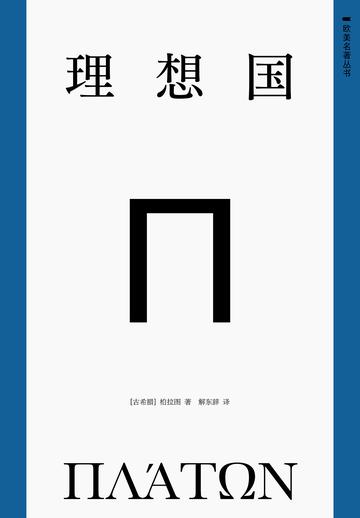
The human soul is actually just like the human eye. When the soul gazes into the region illuminated by truth and reality, the soul can know and understand as if it possessed reason. But when it turns to look at the dark area, the area where light and darkness change, because the objects become blurred, it can only have wavering opinions, and it seems like it has lost its reason. ——[Ancient Greece] Plato's "Utopia" Thank you! Socrates! Thank you, Plato, who loves the truth but not the teacher! Since the dissipation of individuals is to continue a better "self", then living or dying is not so scary. The questions that First Philosophy explores are extremely complex. Some people have debated the answer to the existence of "free will" for thousands of years. What I can't understand is why the questions raised must have an answer? Perhaps there must be an ultimate answer for you, a definite and universal answer similar to the laws of mathematics, physics and chemistry. But I think natural philosophy is an endless discipline that pursues the affirmation of affirmation and the existence of existence.
Justice means doing one's duty well. When we come into this world, everyone has their own talents and specialties. Instead of being so sophisticated, it is better to discover our talents and hobbies, find a career that matches them, make some achievements, leave a brilliance to the world, and realize the "justice" of life.
Everyone's life is a different script, some are smooth sailing, some are bumpy, and some are unremarkable, but these are not the most important. People who have a smooth life should not laugh at other people's lives that are mediocre and full of suffering. Ordinary people should not envy smooth sailing, and do not pity those who are homeless. People who are homeless should not give up on themselves because of the suffering of their fate. Only by improving their souls can they see a different scenery. Come on strangers!
After reading it, I had an urge to go back thousands of years to listen to Socrates and Plato in person, and to discuss it with them in person. I think this would be a very interesting thing [laughs]
Even today, Socrates' remarks are still very easy to understand! Their philosophical thoughts have influenced the whole world until today. It is necessary to read them. I also hope that there will be people like his friends Glaucon and Adeimantus to debate with him in real life.
Whoever cultivates his spirituality will surely succeed, and whoever seeks to harm his own spirituality will surely fail - Quran Philosophers have been discussing issues of right and wrong, good and evil, spiritual soul, subjective intuition and objective feelings cannot escape from life itself. The life and death of the subject itself are also spirit and sex, and the unified component of spirituality has become the ontology.
What we have been looking for is what we already have. We always look around and miss what we want, which is why we still have difficulty getting what we want - Plato's "Utopia"
The five-star rating is not because I think this book is perfect in my heart, but because I find it obscure and difficult to understand, but I am worried about the limitations of my own knowledge and dare not give a low score rashly. I will read it a few more times later. I am ashamed to give it five stars first and then talk about it. As a master of philosophy thousands of years ago, Socrates is a pioneer of philosophy. From the book, it can be seen that Socrates has extremely deep thinking and is truly pursuing wisdom. Perhaps it is due to the limitations of knowledge, technology, and the times, and philosophers such as Socrates also have shortcomings in understanding, but the truth they obtained is eternal and unchanging. Thinking about justice is very enlightening and worthy of our continuous thinking and exploration. Let me make a follow-up comment: I don't agree with the discussion about theology, poetry, painters, kings and city-states, etc. For the time being. Many of the argument processes are close to sophistry. Perhaps the translation is not perfect enough, which consumes my reading comprehension too much. The road is long and the road is far away, so I will search up and down.
It's quite good. It breaks the conventional cognition, such as the immortality of the soul, opinions that exist between reason and sensibility, the knowable and unknowable world, etc. These ideas are eye-opening, but they still have the limitations of this era, such as despising the lives of slaves, despising human lives for the sake of social humanity, etc. Let me talk about my personal opinion of this book. This book is too undervalued. The value of emotion to the cultivation of the soul. In the Utopia, everyone is doing their own thing. If we add that everyone is very rational, although they are just, they ignore human nature. Robots are introduced here. Assume that the robots are super robots. They will think to ensure that they pursue the truth, but they have no emotions. So what is the difference between the people in the Utopia and these super robots?
It's fine if you read it carefully at the beginning. You know why religion and music come from, but you don't understand the rest. You just have to read the article and understand some of the truths mentioned later. I simply think that the so-called justice is the satisfaction of my inner spirit, because everyone yearns for light, and doing unjust things will make their hearts dirty and their spirits difficult to be satisfied. The wealth of the spiritual world is far higher than the superficial wealth, and their thoughts are indeed advanced. Isn't the highest city-state they created just like our motherland now? I feel that many ideal societies are just like our current society, which shows that we are on the right path now, and that they are indeed intellectually advanced. However, as mentioned in the comments, their ideal city-states follow the people but lack emotion. For example, they do not very much agree with lyric poetry, and one of their All the goals are for the motherland. They believe that the pessimistic poems described in lyric poems will only make people more and more pessimistic. They do not recommend that people express their true nature, but only want the motherland to live a good life. However, they may realize that absolute democracy is not possible, but they forget that non-democracy is not good. The people are the mountains and rivers, and the mountains and rivers are the people. What we learn is the poet's feelings. We should slowly express our nature, but this must be moderate, and we should live out our own routine. This is just my personal feeling, there may be some misunderstandings, and I may have new feelings next time.
Finally, justice and injustice exist in each other. There must be punishment and reward, which way to choose, who are you and who are we? What a breakthrough it is to make the right choices and things. Maybe we will never disappear and exist forever. But your choices determine who you want to be. I think this book "Utopia" is really good. I can see the wisdom revealed by the philosophers from their dialogues, and they have said a lot. You may only get this little insight after reading it once, but it will be a new discovery and a new beginning the next time.
Although justice cannot be achieved, the desire of the heart
It is a thought-provoking book. Although some of the ideas and insights in it are no longer applicable to today, or even slightly conflicting, it is still a book worth reading.
I just can't find the words to play Socrates. In addition, the language of the characters in the book is very interesting.
Life is a process of walking out of a cave. Everyone has his own cave. When you walk out of the first cave, you may find that this is the cave of our life, but the caves of society are one inside another. We don't know where the end is. There may be no end, but there are always people pursuing it. This may be understood as the shackles of our human thoughts.
Think about it, this book is more than 2,000 years old. Even though some of the content in it is not in line with modern times, it does not affect its continuing to shine. I have benefited a lot. I have to read many parts several times before I can understand the meaning.
When blindly following disorder in a materialistic society, looking at the Utopia is of great benefit to the soul. We always follow the love and wisdom part of the soul!
This book is very wise. "Utopia" is closely related to today's society. Many thoughts and opinions really inspired me a lot. It is worth reading. When I read many opinions in the book, as Teacher Luo said, they will affect the current world and future generations. Dialogues with the sages will help me learn many principles of life.
From a modern perspective, some theories are not valid Teacher Luo once said, read it as an educational book I've benefited a lot (I guess I'll forget about it again in a few days, but it doesn't matter, I can still pick something out of my head when needed😂)
Believe that the soul is immortal and can endure any extremes of good and evil.
I didn't watch it for long. Sometimes it's quite difficult to understand, and it makes my head spin. It seems that I need to take a closer look and slowly understand it.
It's very good. I felt a little forced before watching it, but when I watched it, I found that I was quite interested in it. It wasn't very intense. I would occasionally let it flow for a while, which was good. You may not be able to understand it at one time, so read it several times. First, read through and find a point (the discussion is also composed of many small pieces), mark it (underline, bookmark), go back and read it again, so that you can understand it better. I read the first chapter, wrote it, reviewed it and reviewed it, and then I almost read it once in detail and then briefly or twice. Some of the views in it are not very good, such as Plato's contempt for women in the lines (although he also advocates equality between men and women, I think she is still biased against women), such as the criticism of hippos, and the indifference to imitation... It is best not to accept it entirely and read it objectively. The views in philosophy books are only the author's personal views. Not everyone thinks that way, but you can get your own views from his thoughts, either from approval or opposition. It makes people think, this book is still very meaningful. This book is not difficult to read (at a shallow level). There are only a few things that make people confused. Most of them are that they don't understand or understand some of them. Just read it a few times or look it up online. Some are limitations caused by conflicting opinions. For example, if you don't agree with the idea that a just person is a ruler, you also don't agree with the process by which he proves this idea. You don't understand how to deduce it. In this case, it's best to just bring it into your mind. If you can't substitute it, forget it, and you won't lose anything. The second half of Volume 4 and the line metaphor in Chapter 6 feel very good. Xuandu I also forgot that living in "Utopia" seems to be a very painful thing. I understood that correctly.
Just a personal opinion, Selasimak's view may be on the side that believes that the existence of justice is subjective, which is obviously contrary to what we know. But breaking away from our education and speaking from their environment and background, perhaps we can understand the source of Selasimak's ideas. In other words, when we consider his views, we should agree with meaning determinism. Looking back at Socrates' debate, he was a clear debater who could quickly catch the loopholes in other people's arguments. Other than that, it is difficult for me to comment.
I am willing to spend my whole life searching for my soul!
It is said that in order to understand the content and core ideas of a work, you must understand its author's life and his ideas. Similarly, if you want to comment on "The Republic", you have to look at the problem from Plato's era, rather than commenting on its quality from today's perspective.
People must understand their own limitations.
Reading "The Republic" gives you the feeling of being able to directly talk to philosophers, and its discussion of human nature is very insightful.
I'm afraid this is absolute rationality, right?
If justice is the right of the strong, then if the strong bullies another strong person [the strong person treats the strong person who bullies him as a weak person], then does he still represent justice? Justice is good to friends and evil to enemies. So if a former friend becomes an enemy, should we respond with a good or evil attitude?
Philosophy, my enlightenment