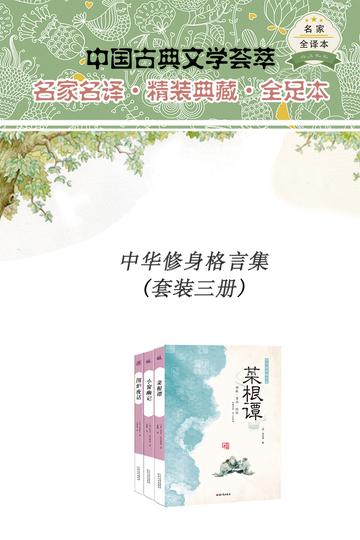
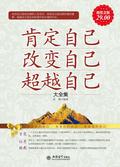
"Collection of Chinese Self-cultivation Aphorisms" includes three books: "Cai Gen Tan", "Little Window Quiet Notes" and "Night Talk Around the Fireplace", which incisively explains the contents of self-cultivation, reading and determination, living in poverty and living happily, helping the world and helping others, running the family and educating children, being loyal, filial and righteous, and serving as an official and governing, etc., Covering all aspects of life. The diction is beautiful, the dialogues are neat, thought-provoking, and it contains profound philosophy. This book is an excellent piece of advice.
Reader comments
"Collection of Chinese Self-cultivation Maxims" is a set of three volumes, which mainly collects classic aphorisms, famous aphorisms, etc. In traditional Chinese culture. Most of these maxims use concise and incisive language to explain life, society, history and other aspects, aiming to inspire readers to think and guide them to establish correct values and codes of conduct. The book revolves around moral concepts such as "benevolence", "integrity", "diligence" and "humility", and focuses on personal growth and progress, including self-awareness, learning and growth, and adversity training.
"Those who abide by morality will be lonely for a while; those who rely on power will be desolate forever." The words quoted at the beginning of this book point out a scholar's pursuit of self-cultivation, that is, not to be burdened by material fame and fortune, but rather to choose a simple and pure life that is loyal to the inner moral laws. Throughout the book, these self-cultivation aphorisms taken from three famous works such as "Cai Gen Tan" follow the same main line, that is, the shaping of human spirit by Confucian ethics, emphasizing maintaining noble sentiments in terms of mind, spirit, life and life attitude, actively participating in the world, and courageously taking on responsibilities.
This is a collection of aphorisms that covers a wealth of Chinese cultural wisdom and moral principles. It brings together the wise words of many ancient literati, philosophers, and thinkers, including classic maxims on self-cultivation, dealing with people, and practicing morality. Each volume covers different topics and content so that readers can better understand and apply the wisdom contained therein. These self-cultivations can be often used to learn and serve as reference and guidance for people to cultivate their moral character, shape their character, and cultivate their moral concepts.
As the ancients said, people without faith cannot stand in the world. If a person does not have any motto or belief in his heart to encourage and support him, it is probably easy to give up and become distracted, which will lead to accomplishing nothing in the end. So how can we get our own life motto? Learning the mottos of famous people and learning their attitude towards life is a very good way. Let us pick up this book together and experience the methods of self-cultivation practiced by famous people in history.
If you still appreciate or even admire the few words left by foreign poets and novelists in their works, you still have not seen the excellence of our Chinese civilization, whether it is a night talk around the stove or a vegetable story; the aphorisms in it can be said to be more all-encompassing, and not only that , which contains all aspects of life such as reading, self-cultivation, wealth, and governance, etc., Are worthy of our study and practice. Cai Gen's proverb says that God does not prohibit people from being rich and noble, but prohibits people from being leisurely. People are not leisurely. If they can be content with the situation, do not think about the future, and do not chase the past, why not have leisure?
Good, high-end and classy, low-key luxury and connotation.
"Collection of Chinese Self-cultivation Maxims" is a set of three volumes, which mainly collects classic aphorisms, famous aphorisms, etc. In traditional Chinese culture. Most of these maxims use concise and incisive language to explain life, society, history and other aspects, aiming to inspire readers to think and guide them to establish correct values and codes of conduct. The book revolves around moral concepts such as "benevolence", "integrity", "diligence" and "humility", and focuses on personal growth and progress, including self-awareness, learning and growth, and adversity training.
"Those who abide by morality will be lonely for a while; those who rely on power will be desolate forever." The words quoted at the beginning of this book point out a scholar's pursuit of self-cultivation, that is, not to be burdened by material fame and fortune, but rather to choose a simple and pure life that is loyal to the inner moral laws. Throughout the book, these self-cultivation aphorisms taken from three famous works such as "Cai Gen Tan" follow the same main line, that is, the shaping of human spirit by Confucian ethics, emphasizing maintaining noble sentiments in terms of mind, spirit, life and life attitude, actively participating in the world, and courageously taking on responsibilities.
This is a collection of aphorisms that covers a wealth of Chinese cultural wisdom and moral principles. It brings together the wise words of many ancient literati, philosophers, and thinkers, including classic maxims on self-cultivation, dealing with people, and practicing morality. Each volume covers different topics and content so that readers can better understand and apply the wisdom contained therein. These self-cultivations can be often used to learn and serve as reference and guidance for people to cultivate their moral character, shape their character, and cultivate their moral concepts.
As the ancients said, people without faith cannot stand in the world. If a person does not have any motto or belief in his heart to encourage and support him, it is probably easy to give up and become distracted, which will lead to accomplishing nothing in the end. So how can we get our own life motto? Learning the mottos of famous people and learning their attitude towards life is a very good way. Let us pick up this book together and experience the methods of self-cultivation practiced by famous people in history.
If you still appreciate or even admire the few words left by foreign poets and novelists in their works, you still have not seen the excellence of our Chinese civilization, whether it is a night talk around the stove or a vegetable story; the aphorisms in it can be said to be more all-encompassing, and not only that , which contains all aspects of life such as reading, self-cultivation, wealth, and governance, etc., Are worthy of our study and practice. Cai Gen's proverb says that God does not prohibit people from being rich and noble, but prohibits people from being leisurely. People are not leisurely. If they can be content with the situation, do not think about the future, and do not chase the past, why not have leisure?
Good, high-end and classy, low-key luxury and connotation.
Should be vigorously promoted