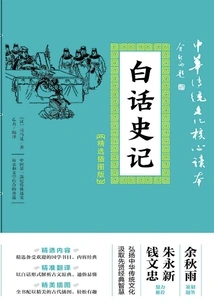
Vernacular Historical Records
by (han) Sima Qian Compiled By Yili
About This Novel
Sima Qian was a great historian and writer during the Western Han Dynasty in my country. His "Historical Records" is a great historical work and a great literary work. "Historical Records" is my country's first biographical general history. It records the political, economic, cultural and other aspects of the situation for about three thousand years starting from the legendary Yellow Emperor and ending with Emperor Wu of the Han Dynasty, as well as the deeds of emperors, generals, scholars, knights and other figures. The whole book is divided into twelve chronicles, ten tables, eight books, thirty aristocratic families and seventy biographies, with a total of 130 chapters and more than 520,000 words. It was praised by Mr. Lu Xun as "the swan song of historians and the unrhymed Li Sao". "Historical Records" has high literary and ideological value. To this day, people are still studying it, studying it, learning from it, and constantly drawing nutrients from it. This book selects 38 works from the "Historical Records" such as "The Chronicles of the Five Emperors", "The Chronicles of Xiang Yu", "The Family of Dukes of Lu and Zhou", "The Family of Xiao Xiangguo", "Biographies of Boyi" and "Biographies of Huo Shi", translated into vernacular, with vivid words and touching stories.
Official Sources
What Readers Think
Rating
Community(0)
Official(7)Scraped 1mo ago
vernacular of historical records
Highly recommended, much better than the original version
Vernacular writing is very good
Were ancient people so weak in their will to survive? They wanted to commit suicide at every turn🤗and committed suicide at every turn. . .
I think Ji Chang in the book is a true gentleman, but King You of Zhou was very confused. In order to make Bao Si smile, he sacrificed the entire Zhou Dynasty. The foundation that our ancestors had worked so hard to create was ruined.
This book mainly talks about historical records and other aspects translated in vernacular. It seems to be less troublesome and easy to understand, making it easier for children who have not studied ancient Chinese to understand history.
This book is the first general history of the Ji Dynasty in the history of our country. The author Sima Qian was roughly the same as Liu Che, Emperor Wu of the Han Dynasty. Therefore, the historical records record the historical facts from the Yellow Emperor to the Taichu period of Emperor Wu of the Han Dynasty.
very good
Difficult words are marked with pinyin
It is best to read it in conjunction with the original text. There are many places in the original text that can only be understood but cannot be explained. If it is translated into vernacular, no matter how it is translated, it will always make little sense.
Rating
Community(0)
Official(7)Scraped 1mo ago
vernacular of historical records
Highly recommended, much better than the original version
Vernacular writing is very good
Were ancient people so weak in their will to survive? They wanted to commit suicide at every turn🤗and committed suicide at every turn. . .
I think Ji Chang in the book is a true gentleman, but King You of Zhou was very confused. In order to make Bao Si smile, he sacrificed the entire Zhou Dynasty. The foundation that our ancestors had worked so hard to create was ruined.
This book mainly talks about historical records and other aspects translated in vernacular. It seems to be less troublesome and easy to understand, making it easier for children who have not studied ancient Chinese to understand history.
This book is the first general history of the Ji Dynasty in the history of our country. The author Sima Qian was roughly the same as Liu Che, Emperor Wu of the Han Dynasty. Therefore, the historical records record the historical facts from the Yellow Emperor to the Taichu period of Emperor Wu of the Han Dynasty.
very good
Difficult words are marked with pinyin
It is best to read it in conjunction with the original text. There are many places in the original text that can only be understood but cannot be explained. If it is translated into vernacular, no matter how it is translated, it will always make little sense.