I Am the Master of My Spring and Autumn Period, King Wen Gong of Jin Dynasty
by Begonia Qilu
About This Novel
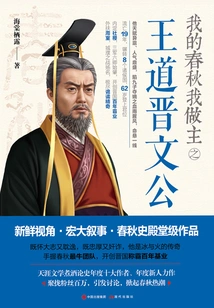
The "My Spring and Autumn Period, I Make the Decision" series uses a new perspective to panoramically show the turmoil of the feudal kingdoms competing for hegemony in the "Spring and Autumn Era". In 770 BC, the Zhou royal family moved eastward to Luoyi to continue to enjoy the country, which was known as the Eastern Zhou Dynasty in history. After the first monarch of the Eastern Zhou Dynasty, King Zhou Ping, there were a total of twenty-five kings. They were destroyed by Qin in 256 BC, which lasted 515 years. In the first half of the Eastern Zhou Dynasty, vassal states competed for hegemony, which is known as the "Spring and Autumn Period" in history. Most of China's laws, regulations, and cultural customs originated from the "Spring and Autumn Period", and many of the political conquests and legendary allusions widely used in later generations also originated from this period. For more than two hundred years, the countries of Lu, Qi, Song, Jin, Chu, Zheng, Cao, Chen, Wei, Yan, Qin, Cai, Wu, Yue, etc. Entangled, collided, contained, and formed alliances with each other, and together they created an era that was bloody, turbulent, and full of the vitality of Chinese culture. Based on historical materials, the author takes the feudal princes' struggle for hegemony as the main line, with the "Five Hegemons" as the center, and uses popular and friendly words and rich writing styles to examine, narrate and evaluate the geographical pattern, cultural landscape and political evolution of the "Spring and Autumn Period" from multiple angles. This book is the second part of "The Royal Way of Jin Wen Gong". It mainly describes the process of Chong'er, a down-and-out young master of the Jin Kingdom who was born with different traits, and how he finally became the hegemon of the generation after facing "dangers and hardships". Chong'er was forced to go into exile due to the Liji Rebellion. He traveled thousands of miles and experienced ups and downs several times. Finally, he gained the benefits of being thrifty and courteous, and took over the Jin Kingdom with the strong support of Duke Mu of Qin. Duke Wen of Jin appointed good ministers such as Hu Yan, Xian Zhen, Zhao Shui, and Jia Tuo internally. He ignored the resentment and only listened to the virtuous. He created three armies and six ministers, showing his royal demeanor; In 632 BC, Duke Wen of Jin defeated the Chu army in Chengpu, magnificently performing the king's way of "retreating to three quarters". In the winter of the same year, he convened the Qin, Lu, Qi and other nine nationalities to form an alliance in Wendi, creating a century-old hegemony for the Jin state. Later, his son Jin Xianggong and the famous prime minister Zhao Dun came to power one after another, and Jin's hegemony continued.
Official Sources
What Readers Think
Rating
Community(0)
Rating
Community(0)