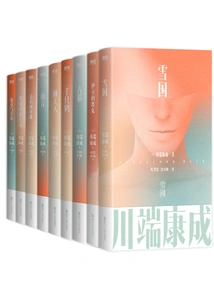
Translation Series of Kawabata Yasunari's Famous Works (set of 9 Volumes in Total)
by H
About This Novel
This set is a set of works by Nobel Prize winner Kawabata Yasunari. It includes 9 masterpieces of Kawabata Yasunari's creative career: "Snow Country", "Dancing Girl of Izu", "Ancient Capital", "Thousand Cranes", "Sleeping Beauty", "Sound of the Mountain", "Waltz of Flowers", "Station in the Shower", and "Wisteria and Strawberry". This set uses classic translations by well-known translators Ye Weiqu and Tang Yuemei, and adds Ye Weiqu's in-depth interpretation of the corresponding works, as well as a chronology of Kawabata Yasunari's life to help readers better understand Kawabata Yasunari and his creations. It can not only meet readers' daily reading needs, but also has collection value. The beauty of the East is all in Kawabata Yasunari's words; the essence of Kawabata Yasunari's literature is all in these 9 novels. "Snow Country": a textbook of Japanese aesthetics, understanding the beauty of mourning; "The Dancing Girl of Izu": a famous work by a master, taking you back to the beauty of life; "Ancient Capital": using a novel to define this thousand-year-old ancient capital; "Thousand Cranes": a stunning work of Japanese aesthetic literature; "Sleeping Beauty": a true love story The helplessness of death and the remembrance of youth; "Mountain Sound": understand the loneliness and death in Kawabata's works; "Waltz of Flowers": a collection of Kawabata Yasunari's classic short stories; "The Station in the Shower": a collection of Kawabata Yasunari's classic short stories; "Fujihana and Strawberry": a collection of Kawabata Yasunari's classic short stories.
Official Sources
What Readers Think
Rating
Community(0)
Official(2)Scraped 1mo ago
Such a good book
Highly recommend, this style suits me very well.
I've read them all, but I really didn't understand some of the smaller novels at the end. The main works have been read before. I had only understood "The Dancing Girl of Izu" before, and I also understood it when I was rereading it in the past few years. Once I understood it, I felt that it was among the world's masterpieces. And "Snow Country" and "Thousand Paper Cranes" were not understood at all a few years ago. But this time I felt a huge tremor after reading it. "Ancient Capital" and "Celebrity" are also good, but my personal psychological feelings are not as deep as the previous ones. I haven't finished reading "Sleeping Beauty" yet. Reading literary works requires appreciation ability (the word appreciation is a bit frivolous), and it also requires the reader's life experience. Especially in articles like Kawabata's, if the whole world in the heart or in the reader's heart does not contain these things, then even if you read the entire article, you will not be able to understand what the author is saying. "Snow Country" should be simpler, so-called sad and beautiful; "Thousand Paper Cranes" is more complicated, and I even feel a little nauseated during or after reading it, even when I look back at it now (several months have passed). However, it contains a lot of things that can be discussed. There may be no right and wrong in this world. The article leaves a huge space and a huge world for readers to discuss and try to interpret.
Rating
Community(0)
Official(2)Scraped 1mo ago
Such a good book
Highly recommend, this style suits me very well.
I've read them all, but I really didn't understand some of the smaller novels at the end. The main works have been read before. I had only understood "The Dancing Girl of Izu" before, and I also understood it when I was rereading it in the past few years. Once I understood it, I felt that it was among the world's masterpieces. And "Snow Country" and "Thousand Paper Cranes" were not understood at all a few years ago. But this time I felt a huge tremor after reading it. "Ancient Capital" and "Celebrity" are also good, but my personal psychological feelings are not as deep as the previous ones. I haven't finished reading "Sleeping Beauty" yet. Reading literary works requires appreciation ability (the word appreciation is a bit frivolous), and it also requires the reader's life experience. Especially in articles like Kawabata's, if the whole world in the heart or in the reader's heart does not contain these things, then even if you read the entire article, you will not be able to understand what the author is saying. "Snow Country" should be simpler, so-called sad and beautiful; "Thousand Paper Cranes" is more complicated, and I even feel a little nauseated during or after reading it, even when I look back at it now (several months have passed). However, it contains a lot of things that can be discussed. There may be no right and wrong in this world. The article leaves a huge space and a huge world for readers to discuss and try to interpret.