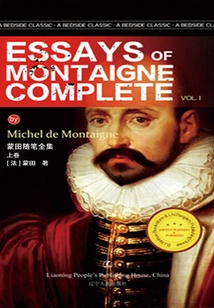
The Complete Essays of Montaigne·volume 1
by H
About This Novel
"The Complete Essays of Montaigne" has a total of 107 chapters and more than 1 million words. It was published in three volumes in France from 1580 to 1588. Since then, the book has never been out of print. "The Complete Essays of Montaigne" is a voluminous volume with extensive quotations, brilliant literary talent and moving eloquence. Together with Bacon's "On Life" and Pascal's "Thoughts" (already included in the "Most Classic English Library"), it is known as the three classics of modern European philosophical prose. Since then, the essay has been established as a literary style. The background of the creation of "The Complete Essays of Montaigne" was during the French Civil War. The cruelty of the religious war deeply hurt Montaigne's heart. The sorrow and pain of the chaos of his family and country ran through the process of writing the essays. However, as a thinker, he tried to maintain a sense of rationality and depth in his creations. He turned his anger into fresh and exciting words. By talking about himself, humanity, and the world, he guided people to understand the true meaning of life contained in the words. The content of Montaigne's essays is complex and roughly focused on three aspects. The first is the author's self-writing and expression. Montaigne advocated pursuing a life of self, and his essays recorded his simple and natural lifestyle, his true appearance, and his personality. In the "Preface", Montaigne made it clear: "Reader, this is a sincere book... I wrote this book purely for my family and myself." "I would rather appear in front of readers in a simple, natural and ordinary manner without making any artificial efforts, because what I depict is myself." Famous "Love Life" is his reflection on the value and meaning of life: "Our life is gifted by nature, and it is extremely superior"; "Seeing that my time in life is limited, the more I want to increase the weight of life." Secondly, the essay records the author's experience and thinking of reading ancient sages, and then questioning human nature. In "On Hermitage", Montaigne explores the true purpose and correct way of hermit life by introducing the poems of Horace, Virgil and others. As a humanist, he emphasizes putting people first and believes that people are the most beautiful existence in the world. He highly admired the wisdom of Socrates and agreed that human wisdom should not be used to destroy oneself. Self-righteousness is the greatest weakness of human beings.
Official Sources
What Readers Think
Rating
Community(0)
Rating
Community(0)