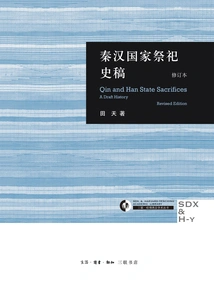
Draft History of State Sacrifice in Qin and Han Dynasties (revised Edition)
by Tian Tian
About This Novel
"The major affairs of the country lie in sacrifice and military affairs." Sacrifice was an important political system and cultural form of the ancients. National sacrifice is not only an important perspective for understanding ancient Chinese history and religious traditions, but is also closely related to the changes in political power and ideological and cultural changes. This book conducts a comprehensive study of state sacrifices during the Qin and Han dynasties, and outlines the evolution of the "formative period" of the unified dynasty's national sacrifice paradigm. In the early Qin Dynasty, the first emperor of the Qin Dynasty integrated the traditions of the Warring States Period and created a unified dynasty and national sacrificial framework. The Han Dynasty inherited the Qin system, and was reformed and restructured many times by Emperor Wen, Emperor Wu, and Emperor Xuan. The Western Han Dynasty established the "Han system" through sacrifices. Wang Mang created the "Yuan Shi Yi", which changed the scattered and widespread form of the original national sacrificial temples and emphasized the unique sacredness of the southern suburbs, thereby unifying the country's administrative center and sacrificial center, thus starting the "southern suburb sacrificial era" in China for more than two thousand years. The author provides detailed evidence and research on the specific systems of state sacrifices in each stage of the Qin and Han Dynasties, such as the location of temples, objects of sacrifice, and methods of sacrifice. His research focuses on the geographical characteristics of sacrificial activities and interprets the spatial meaning of national sacrificial rituals. At the same time, it combines factors such as central and local power relations, political geography, and the development of Confucian thought to present the inextricable connections between the transformation of national sacrificial rituals and the historical process of China's "Great Unification."
Official Sources
What Readers Think
Rating
Community(0)
Rating
Community(0)