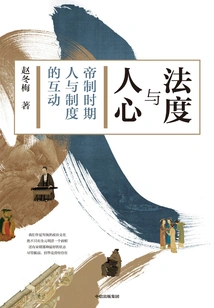
Laws and Human Hearts: the Interaction between People and Institutions in the Imperial Era
by Zhao Dongmei
About This Novel
"Laws and Human Hearts - The Interaction between People and Systems in the Imperial Period" is a popular book for ordinary readers that comprehensively explains the entanglements between people and systems in the imperial period, based on 30 years of historical research by teacher Zhao Dongmei, an expert on Song history from Peking University. This book consists of three parts: institutional history, cultural history, and intensive reading of historical works. The author changes the serious stereotype of institutional narratives, and uses a relaxed and lively way to think about institutional changes, understand the gains and losses of previous institutions, and tell the relationship between the system and people at different levels from national stories, group stories, and individual stories. This book uses an open historical topic and a discussion method full of problem awareness to conduct an in-depth discussion of the historical elements that truly shaped traditional China and influence it to this day, and answers the hidden logic that "history does not always move forward" - in terms of understanding the nature of the imperial court and the relationship between monarchs and ministers, the Yuan Dynasty experienced two major setbacks: From the perspective of the nature of the imperial court, the Chinese tradition will The world is called Jiangshan Sheji, which advocates "one person to rule the world, and not one person to serve the world." However, in the Yuan Dynasty, the world went into the royal private purse - Jiangshan Sheji became the private property of the royal family. From the perspective of the relationship between monarch and ministers, Chinese tradition advocates that "the king envoys his ministers with courtesy, and the ministers serve the king with loyalty." However, in the Yuan Dynasty, ministers were reduced to taking pride in calling themselves slaves - the relationship between monarch and ministers was reduced to a master-slave relationship. From then on, the intensification of tyranny and suspicion continued unabated until modern times. The author can not only put forward new insights from existing historical perspectives, but also draw new historical perspectives from well-known historical materials; his problem-conscious narrative style is full of possibilities for discussion and the extensibility of topics.
Official Sources
What Readers Think
Rating
Community(0)
Official(3)Scraped 1mo ago
In fact, the reform of the system must be based on the situation at that time, but people in the past did not think so. They carried out the reform based on the Western Zhou system.
Different times have different systems. From the Western Zhou Dynasty, the feudal system was implemented. Until Qin Shihuang unified the six countries, the imperial system was implemented.
It seems that no matter what time or situation, one should not take action lightly. Song Taizu was so angry that he smashed two front teeth of an official and wanted to record this incident.
Rating
Community(0)
Official(3)Scraped 1mo ago
In fact, the reform of the system must be based on the situation at that time, but people in the past did not think so. They carried out the reform based on the Western Zhou system.
Different times have different systems. From the Western Zhou Dynasty, the feudal system was implemented. Until Qin Shihuang unified the six countries, the imperial system was implemented.
It seems that no matter what time or situation, one should not take action lightly. Song Taizu was so angry that he smashed two front teeth of an official and wanted to record this incident.