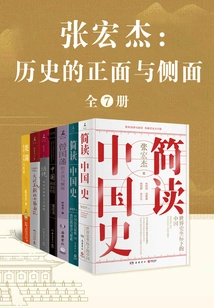
Zhang Hongjie: the Front and Side of History (7 Volumes in Total)
About This Novel
This set is a series of brief readings of Chinese history by the well-known historian Zhang Hongjie. "A Brief Reading of Chinese History: China in the Coordination of World History": This book puts Chinese history into the context of world history, clarifies the development of Chinese history, and hopes that readers can establish an overall concept of Chinese history in a short time. At the same time, it uses a "long-term, long-distance, wide-view" interpretation method to comprehensively present the internal logic and rules of the game behind the cycle of chaos in Chinese history. "A Brief Reading of Chinese History: Power and Finance Behind the Corruption in Chinese History": Power games and financial rules, systems and checks and balances, top-level designs and the naked humanity behind bad rules are real and cruel. The root cause of corruption in China's past dynasties is absolute power control. It is impossible to solve the corruption problem without solving the foundation of the power structure. The history of imperial rule and the history of official corruption have always been inseparable. The author focuses on the Han, Tang, Song, Yuan, Ming and Qing dynasties, makes horizontal and vertical comparisons, explores the imperial rule and official ecology of ancient Chinese society, and clearly presents a multi-angle context of Chinese history to readers. "Qianlong: Politics, Love and Character": A politician, a scholar, a poet, a traveler, a hunter, the politics, harem and life of the most complicated emperor in Chinese history. "Bad Rules: Corruption and Anti-Corruption in the Ming and Qing Dynasties": This book focuses on the Ming and Qing Dynasties, and uses clear logic and vivid details to completely tell the beginning and end of the anti-corruption efforts of Zhu Yuanzhang, Hongli and others. Taking "bad regulations", a phenomenon of corruption that ran through the Ming and Qing dynasties, as an entry point, it reproduces the imperial institutional structure and officialdom ecology at that time, deeply explores the root causes of the decline of the Ming and Qing dynasties, and puts forward reflections that transcend the times. "The Evolution of Chinese National Character": A general history of China from a new perspective, exploring the past and future of the national character, and fundamentally understanding and changing the thoughts and behaviors of the Chinese people! "The Front and Side of Zeng Guofan": From an angry youth to a successful official, how he "reborn" after experiencing five humiliations. Zeng Guofan, who was completely different around the age of 30, showed the majority of young people how a young man moves from ideal to reality, which is of great practical significance. "Seven Faces of the Ming Dynasty": an emperor: Zhu Yuanzhang; a usurper: Zhu Di; an upright official: Hai Rui; an eunuch: Wei Zhongxian; a rebel: Zhang Xianzhong; a traitor: Wu Sangui; and a loyal minister: Zheng Chenggong. Seven people and seven profiles form a complete picture of the autocratic centralization system of the Ming Dynasty and the spiritual enslavement of the Chinese people.
Official Sources
What Readers Think
Rating
Community(0)
Rating
Community(0)