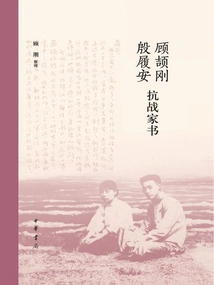
Gu Jiegang's Family Letters from Yin Lu'an During the Anti-japanese War
About This Novel
"Gu Jiegang and Yin Lu'an's Family Letters of the Anti-Japanese War" contains letters from Gu Jiegang and Yin Lu'an during the Songhu Anti-Japanese War in 1932 and the all-out Anti-Japanese War from 1937 to 1943. On January 23, 1932, Gu Jiegang left Peking to visit his father in Hangzhou. After the "January 28th Incident", he stayed in Hangzhou for several months. After the "July 7th Incident" in 1937, Gu Jiegang was hunted by the Japanese for promoting anti-Japanese aggression. He traveled to Suiyuan, Suzhou, Gansu, Qinghai, Yunnan, Sichuan, Chongqing and other places. During the turbulent years, Gu Jiegang and his family spent less and less time together, and his wife Yin Lu'an worked hard to support the family. Mountains and rivers are ruined, wives and children are separated, family and country are righteous, and children are tender. There is a past behind every letter from home. There is a pair of eyes at the end of every postal route. The feelings are vividly and fully reflected in the letters exchanged, which are story-telling, readable, and life-like. "Gu Yin's Family Letters" is not only a true testimony of how the Gu family, their relatives, friends, and academic colleagues supported the army in the war of resistance during the national crisis, and how they were displaced and struggled to make a living during the war; it is also a true reflection of the life encounters, family changes, and psychological feelings of individuals in the tragic war years; and under the background of a grand historical narrative, it provides vivid details and rich materials to fill the wide historical gaps. It is also an extremely precious archival historical material. At the end of the book are attached letters between Gu Jiegang's eldest daughter, second daughter and their parents, which can be read in conjunction with Gu Yin's family letters, making some of the affairs between the couple coherent and complete, with multi-dimensional perspectives and a unique sense of situation. The organizer has made concise annotations on the characters involved in the letters, their font sizes, aliases, nicknames, backgrounds at the time, relationships between the characters, etc., To make it easier to understand.
Official Sources
What Readers Think
Rating
Community(0)
Rating
Community(0)