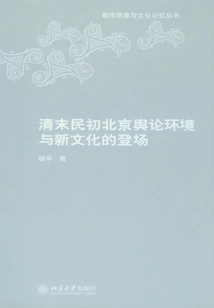
The Public Opinion Environment in Beijing and the Emergence of New Culture in the Late Qing Dynasty and the Early Republic of China
by Yang Zao
About This Novel
The main content of "Public Opinion Environment in Beijing and the Emergence of New Culture in Late Qing Dynasty and Early Republic of China": Talking about "urban imagination and cultural memory" must take into account architecture, history, world affairs, scenery, writers, works, etc., And discuss it from the multiple perspectives of political history, cultural history and literary history. Chang'an in the Han and Tang Dynasties, Luoyang in the Han and Wei dynasties, Jinling in the Six Dynasties, Kaifeng in the Northern Song Dynasty, Lin'an in the Southern Song Dynasty, Suzhou and Yangzhou in the Ming and Qing Dynasties, Guangzhou and Shanghai in the late Qing Dynasty, Tianjin, Hong Kong and Taipei in modern times, as well as Beijing, the 800-year-old capital, and Chongqing and Kunming during the Anti-Japanese War, etc., All deserve the careful attention of researchers. Such "attention" will naturally not be limited to the traditional "recording of scenery" and "the study of anecdotes." The grasp of urban form, history, and spirit requires an interdisciplinary vision and solid academic training. Therefore, I hope to combine the rigor of scholars, the warmth of literary scholars, and the curious eyes of travelers to pay attention to, considerate, describe, and discover "this" city that interests me. Discussions about cities can and must have multiple angles and methods. Like all memories, they are always incomplete and may be infinitely close to the goal. It may also drift away - it is in this huge tension between forgetting (misunderstanding) and memory (recreation) that the human spirit can continue to extend forward. There are always things that cannot be forgotten, and there are always things that cannot be remembered. "The memory of forgetting" makes us keep talking about this city and this history. In this sense, memory is not just a tool or a process, it can also become a stage in itself, and even constitute a force that creates history.
Official Sources
What Readers Think
Rating
Community(0)
Rating
Community(0)