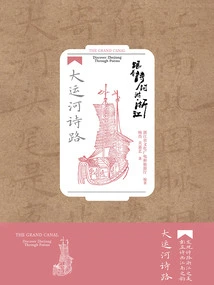
Traveling in Zhejiang with Poetry: Grand Canal Poetry Road
About This Novel
Emperor Yang of the Sui Dynasty opened the Grand Canal, which paved the way for the southward movement of the Chinese cultural center in later generations. Today, the east and west banks of the Grand Canal are deposited with poetry, buried with poets, continuing the poetic scenery, and exuding poetic sentiment. The main line of the Grand Canal Poetry Road runs along the Jiangnan Canal and the East Zhejiang Canal, with the World Cultural Heritage Protection Area as its core. It is an important cultural waterway for poets of all ages to explore the south of the Yangtze River. This book takes poetry as the starting point, relies on the road, and uses scenes, stories and scenery as the narrative carrier to record the humanistic charm of Zhejiang contained in the natural scenery, traditional villages, historical relics, intangible cultural heritage and modern living space. In this way, it conveys the quietest scenery and the silent civilization contained in the poetic road of Zhejiang, as well as the unique and distinctive oriental life aesthetics behind them. As the "Grand Canal Poetry Road" volume of the "Traveling with Poems in Zhejiang" book series, the author follows the poems and retravels the Grand Canal Road from north to south, recording the historical texts and cultural customs of Gongshu, Linping, Deqing, Nanxun, Tongxiang, Xiuzhou, Binjiang, Yuecheng and Yinzhou. He also conducts on-site inspections of many large and small restaurants, scenic B&Bs, New and old scenic spots, research bases, and carefully matched real-life shooting illustrations make the Grand Canal Poetry Road in the "Four Poetry Roads" cultural belt concrete, real-life, and perceptible, integrating into a canal tour guide that is both interesting, informative, and practical, providing a valuable reference guide for researchers and leisure travelers.
What Readers Think
Rating
Community(0)
Rating
Community(0)