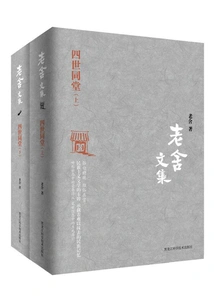
Collected Works of Lao She: Four Generations under One Roof
by Lao She
About This Novel
"Four Generations Under One Roof" is divided into three parts: "Confusion", "Stealing Life", and "Famine", with nearly one million words. It is the longest work among Lao She's works, and it is also the work that took the longest time to write, took a lot of energy, and was the most difficult to complete. The work is set in the occupied area of Peiping during the Anti-Japanese War, with the life of the four generations of the Qi family living under one roof as the main line. It vividly and vividly depicts the humiliating torture and suffering of people from all walks of life, represented by the residents of Xiaoyangquan Hutong, and the process of their gradual awakening and struggle to resist. It praises their valuable national integrity as well as the Chinese nation's unyielding will to fight and determination to resist the war. "Four Generations Under One Roof" is a "history of pain" and "history of anger" written with the blood of the nation and the writer. It truly shows the disasters suffered by the people of Peking and their precious national integrity under the iron heel of the Japanese invaders.
Official Sources
What Readers Think
Rating
Community(0)
Official(3)Scraped 2mo ago
To treasure
Good looking Using the form of short stories to discover problems and try your best to solve them may not be the best way, but it may be more appropriate under the circumstances. Living in a peaceful era, we should cherish the present👩👍
There is no need to say much about Mr. Lao She's works. After all, his name is there and it is his masterpiece. There is no need for me, a mediocre person, to dwell on it. But halfway through the book, something stuck in my throat, and I couldn't help but express my opinions. I wrote this review after reading around chapter 13. In these short chapters, various characters appeared: old Beijing, new intellectuals, selfish mediocrities, vicious Japanese soldiers, and indifferent foreign priests. They each have their own lives, and they were originally a group sharing weal and woe in the same city of Beijing. When Japanese artillery fire broke the tranquility, various reactions occurred like chemical reactions. The teacher captured the reflections of each type of people here, and related the reflections to the person's age, personality, occupation, and experience. In other words, there are no "one-size-fits-all" characters in this book, and every character is not absolutely black and white (except for the Japanese soldiers): the simple-minded coachman who has not been soaked in knowledge also has simple patriotic feelings; Dequan, who is strong-willed and wants to escape from Beijing, also has two weaknesses: relatives and lovers, and he also had some ideological struggles before escaping from Beijing; people have a bad impression of the concubine, but who wouldn't pity a person buried in a traitor family? Everything is life and destiny. Yes, in Mr. Wang's writings, everyone is moving towards their final destination, the result of accepting the baptism of the Anti-Japanese War. I didn't want to write this at first, but when I saw Mrs. Qi taking to the street, I was struck by it. When I saw him, I suddenly remembered Wang Lifa's line "Why don't you let me live" in "Teahouse", and tears fell down all of a sudden. Who knows, maybe this is the charm of literary works? A corner of history was suddenly pulled apart and placed in front of the readers.
Great, I finally found the whole chapter.
Rating
Community(0)
Official(3)Scraped 2mo ago
To treasure
Good looking Using the form of short stories to discover problems and try your best to solve them may not be the best way, but it may be more appropriate under the circumstances. Living in a peaceful era, we should cherish the present👩👍
There is no need to say much about Mr. Lao She's works. After all, his name is there and it is his masterpiece. There is no need for me, a mediocre person, to dwell on it. But halfway through the book, something stuck in my throat, and I couldn't help but express my opinions. I wrote this review after reading around chapter 13. In these short chapters, various characters appeared: old Beijing, new intellectuals, selfish mediocrities, vicious Japanese soldiers, and indifferent foreign priests. They each have their own lives, and they were originally a group sharing weal and woe in the same city of Beijing. When Japanese artillery fire broke the tranquility, various reactions occurred like chemical reactions. The teacher captured the reflections of each type of people here, and related the reflections to the person's age, personality, occupation, and experience. In other words, there are no "one-size-fits-all" characters in this book, and every character is not absolutely black and white (except for the Japanese soldiers): the simple-minded coachman who has not been soaked in knowledge also has simple patriotic feelings; Dequan, who is strong-willed and wants to escape from Beijing, also has two weaknesses: relatives and lovers, and he also had some ideological struggles before escaping from Beijing; people have a bad impression of the concubine, but who wouldn't pity a person buried in a traitor family? Everything is life and destiny. Yes, in Mr. Wang's writings, everyone is moving towards their final destination, the result of accepting the baptism of the Anti-Japanese War. I didn't want to write this at first, but when I saw Mrs. Qi taking to the street, I was struck by it. When I saw him, I suddenly remembered Wang Lifa's line "Why don't you let me live" in "Teahouse", and tears fell down all of a sudden. Who knows, maybe this is the charm of literary works? A corner of history was suddenly pulled apart and placed in front of the readers.
Great, I finally found the whole chapter.
