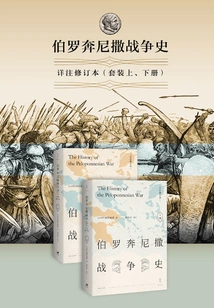
History of the Peloponnesian War
by (ancient Greece) Thucydides, Translated And Annotated By Xu Songyan
About This Novel
From 431 BC to 404 BC, hundreds of city-states were involved in the unprecedented "Greek World War", which spread to almost the entire Mediterranean civilized world at that time. The two major military groups, the Peloponnesian League and the Athenian Empire, headed by Sparta, one dominated the land and the other dominated the sea. Both sides used their tactics to launch a long-term tug-of-war. Just when both sides were losing money and running out of money and troops, the covetous Persians took the opportunity to intervene, and finally helped the Spartans defeat the Athenians and destroy the then-prosperous Athenian maritime empire. This war had a huge impact and shock on the politics of the Greek states. It was tantamount to a catastrophe for the social economy. It had a major and far-reaching impact on the subsequent ideological culture of the Greeks and the international situation in the Mediterranean world. The historian Thucydides, who personally experienced this war, with his objective and calm attitude, vivid and bold historical writing, and concise and smooth writing, not only comprehensively recorded the main historical facts of the war (up to 411 years ago), showed the magnificent scenes of land and sea battles, the cruelty and brutality of partisan struggles, and also appropriately described the subtle changes in people's psychological mentality during the period. This work is a cultural masterpiece from the heyday of Greek classical civilization. For thousands of years, it has attracted countless readers to appreciate, ponder, and think...
Official Sources
What Readers Think
Rating
Community(0)
Official(1)Scraped 2mo ago
Western history is a more complex historical field.
The following are the main thoughts: 1. No matter how realistic the translation is, it is only second-hand information. If you want to truly understand the history of a foreign country, you still need to learn a foreign language and read first-hand information. For general history buffs, reading the translation is enough, but for professional researchers, it is far from enough. 2. Judging from the layout of this book, it is a fact that Western historical documents are not as systematic, coherent and logical as Chinese history books. However, the authenticity is still there and cannot be denied. Therefore, I personally do not agree with the so-called Western pseudo-history theory, which is also a kind of historical nihilism. 3. The advantage of this book is that the author has realized that economic problems are the fundamental reason for the outbreak of the war. It is worthy of recognition to use disputes over economic interests to explore the causes of the Greek Civil War. Moreover, the author has humanistic ideas and knows how to use human causes to explain various phenomena in the war, rather than believing that there is some divine power. The shortcoming is that the author's values are too biased in favor of Athens. In fact, neither Athens nor Sparta is justice. Moreover, the sources of various speeches cited in this book should be based on evidence, but it is unknown how much of it is the original text and how much is the author's personal addition.
Rating
Community(0)
Official(1)Scraped 2mo ago
Western history is a more complex historical field.
The following are the main thoughts: 1. No matter how realistic the translation is, it is only second-hand information. If you want to truly understand the history of a foreign country, you still need to learn a foreign language and read first-hand information. For general history buffs, reading the translation is enough, but for professional researchers, it is far from enough. 2. Judging from the layout of this book, it is a fact that Western historical documents are not as systematic, coherent and logical as Chinese history books. However, the authenticity is still there and cannot be denied. Therefore, I personally do not agree with the so-called Western pseudo-history theory, which is also a kind of historical nihilism. 3. The advantage of this book is that the author has realized that economic problems are the fundamental reason for the outbreak of the war. It is worthy of recognition to use disputes over economic interests to explore the causes of the Greek Civil War. Moreover, the author has humanistic ideas and knows how to use human causes to explain various phenomena in the war, rather than believing that there is some divine power. The shortcoming is that the author's values are too biased in favor of Athens. In fact, neither Athens nor Sparta is justice. Moreover, the sources of various speeches cited in this book should be based on evidence, but it is unknown how much of it is the original text and how much is the author's personal addition.