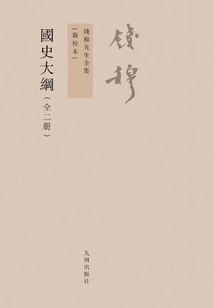
Outline of National History (2 Volumes in Total)
by Qian Mu
About This Novel
"Outline of National History" is a general history of China. It strives to be concise, giving its outline and omitting trivial details. In less than 1,000 pages, the details of the characters and the preparation of the career also show the author's great power to control the complicated history. The whole book outline is clear and simple, and the complexity is appropriate. "National History Outline" discusses the evolution and development of traditional Chinese academic thoughts, political systems, and social trends, as well as domestic and foreign situations, in order to integrate the history of our country, clarify the reasons for the rise and fall of its governance, elucidate its system of continuous succession, and indicate the source of the life and spirit of our nation. Mr. Qian Mu wrote this book during the Anti-Japanese War. When the country was in peril, scholars used their pen as an army. With "the country with the most complete history" as the deep foundation of the writing, it was written in nearly 800,000 words, which is soul-stirring. It aims to inspire the national spirit of the people, respond to the reality, and serve as a mirror for the founding of the country during the Anti-Japanese War.
Official Sources
What Readers Think
Rating
Community(0)
Official(6)Scraped 2mo ago
Chinese, you have to be confident.
The title is what I personally think is the spiritual core of this book. This book can be regarded as a superior work in the general history of China. Specifically, the main strengths of this book are: 1. This book breaks through the traditional biographical and chronological framework of Chinese history, and compiles Chinese history for the first time with the purpose of exploring historical laws. For example, the origin of Chinese history starts from the Stone Age, which is obviously different from tradition. 2. This book is full of golden sentences and novel and pertinent views. For example, it is found that Chinese mythology has a more humanistic flavor than the West. 3. Personally, I think the most important value of this book is that in the low traditional cultural atmosphere at that time, it shouted out the idea that Chinese people should be confident. This book also has flaws, mainly including: 1. The author still has the contempt or even contempt of the feudal literati for the people. For example, instead of calling the Taiping Heavenly Kingdom the Hongyang Rebellion, the problem can be seen with just one messy word. In addition, it is a bit taken for granted that the Sui and Tang dynasty brews had the spirit of producing goods for the people. 2. The narrative of this book is inevitably a bit anticlimactic. Before the Song Dynasty, it was a classic with constant high-level arguments. However, the Yuan, Ming and Qing dynasties seemed to have been written in a hurry. Especially the Qing Dynasty hardly talked about progress and development. It only focused on shortcomings and mostly contained nationalistic narratives, which was inevitably distorted. It also did not talk enough about the modern invasion of foreign powers. 3. Although the author has a true view of the historical laws behind historical phenomena, most of the time he can only attribute the reasons to social consciousness, and cannot further realize the economic problems behind them, that is, the principle that the economic base determines the superstructure. All in all, this book is still an excellent work on the general history of China and is worth reading.
I saw the comment section and laughed. The book written by Mr. Qian Mu, you said it was written by Mr. Qian Xuesen😑
Study hard and work hard every day!
Uh-huh, uh-huh, uh-huh, uh-huh, uh-huh.
I didn't have high hopes at first, thinking that the old scholars of the past must be very pedantic. After reading it, I realized that the master is the master.
Qian Mu, courtesy name Binsi, is the author of this book and a historian.
The National History Outline does not involve primitive society. The Outline of National History is Qian Mu's lecture notes on ancient Chinese history. Qian Mu and Qian Xuesen have no relationship except that they both have the same surname.
Rating
Community(0)
Official(6)Scraped 2mo ago
Chinese, you have to be confident.
The title is what I personally think is the spiritual core of this book. This book can be regarded as a superior work in the general history of China. Specifically, the main strengths of this book are: 1. This book breaks through the traditional biographical and chronological framework of Chinese history, and compiles Chinese history for the first time with the purpose of exploring historical laws. For example, the origin of Chinese history starts from the Stone Age, which is obviously different from tradition. 2. This book is full of golden sentences and novel and pertinent views. For example, it is found that Chinese mythology has a more humanistic flavor than the West. 3. Personally, I think the most important value of this book is that in the low traditional cultural atmosphere at that time, it shouted out the idea that Chinese people should be confident. This book also has flaws, mainly including: 1. The author still has the contempt or even contempt of the feudal literati for the people. For example, instead of calling the Taiping Heavenly Kingdom the Hongyang Rebellion, the problem can be seen with just one messy word. In addition, it is a bit taken for granted that the Sui and Tang dynasty brews had the spirit of producing goods for the people. 2. The narrative of this book is inevitably a bit anticlimactic. Before the Song Dynasty, it was a classic with constant high-level arguments. However, the Yuan, Ming and Qing dynasties seemed to have been written in a hurry. Especially the Qing Dynasty hardly talked about progress and development. It only focused on shortcomings and mostly contained nationalistic narratives, which was inevitably distorted. It also did not talk enough about the modern invasion of foreign powers. 3. Although the author has a true view of the historical laws behind historical phenomena, most of the time he can only attribute the reasons to social consciousness, and cannot further realize the economic problems behind them, that is, the principle that the economic base determines the superstructure. All in all, this book is still an excellent work on the general history of China and is worth reading.
I saw the comment section and laughed. The book written by Mr. Qian Mu, you said it was written by Mr. Qian Xuesen😑
Study hard and work hard every day!
Uh-huh, uh-huh, uh-huh, uh-huh, uh-huh.
I didn't have high hopes at first, thinking that the old scholars of the past must be very pedantic. After reading it, I realized that the master is the master.
Qian Mu, courtesy name Binsi, is the author of this book and a historian.
The National History Outline does not involve primitive society. The Outline of National History is Qian Mu's lecture notes on ancient Chinese history. Qian Mu and Qian Xuesen have no relationship except that they both have the same surname.