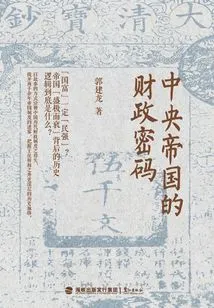
The Financial Code of the Central Empire
by Guo Jianlong
About This Novel
The author of this book takes Chinese dynasties as the basis and modern economic theory as the latitude, from the Qin and Han Dynasties to the late Qing Dynasty, to comb in detail the changes in the financial system of the central empire that lasted for more than two thousand years, to analyze the gains and losses of the financial systems of past dynasties, and to try to explain from the land tax system, the currency system, and the official economy that the rise and fall of traditional Chinese politics is closely related to the financial status of the empire. This book is divided into three parts, using the three social and financial reconstructions in Chinese history as the criteria for dividing stages. The first part focuses on the period from the Qin and Han Dynasties to the Southern Dynasties, using the state-owned system established by Emperor Wu of the Han Dynasty, the financial monopoly of Emperor Wu of the Han Dynasty and Wang Mang, and the land and household registration system in the Wei, Jin, Southern and Northern Dynasties as clues to interpret the financial phenomena during this period; the second part uses the land state-owned reform in the Northern Wei Dynasty It begins with the great chaos caused by the state ownership of land in the Tang Dynasty and ended with the great collapse caused by the financial reform in the Song Dynasty. The third part starts with the experimental fiscal policy of the Yuan Dynasty government, then discusses the conservative finance in the Ming and Qing Dynasties, and ends with the efforts and inertia of fiscal modernization in the late Qing Dynasty.
Official Sources
What Readers Think
Rating
Community(0)
Official(26)Scraped 2mo ago
At all times and in all countries, for a centralized government, there are only two things it cares about most: first, how to establish a complex bureaucratic system to control society; second, how to extract sufficient fiscal revenue from the private economy to support this bureaucratic system. Whether it is state-owned enterprises, public land systems, or monopoly currency issuance, they are all a means for the government to raise finances. When formal taxes are not enough to feed a large bureaucracy, governments look for new ways to generate revenue. Therefore, the so-called three foundations are actually three means of making money.
A very vivid interpretation of the economic context of China's past dynasties
The economies of past dynasties, based on the small-scale peasant economy, originally lacked a lot of room for fiddling. The rulers of the past dynasties could only fiddle with a few limited projects such as land, capitation, and salt industry. After a centralized system operated for a period of time, unavoidable redundancy would inevitably occur, and the collapse of the building was inevitable. History is always surprisingly similar and also surprisingly inevitable The modern social and economic structure has undergone major changes. The secondary and tertiary industries and the financial industry have added great space and flexibility to society. Coupled with the development of high-tech informatization, a new historical map has been opened.
Chapter 6 jumped
Why did Chapter 6 suddenly skip the Sui and Tang Dynasties and go directly to the late Tang Dynasty? Is it because of the arrangement or not written at all? It seems very abrupt, but there should be an excess, or an analysis of the reasons for the early prosperity, and an explanation of the advantages of the system.
A good book, with a broad vertical and horizontal perspective, and easy to understand.
Reading literature can cultivate sentiments and nourish feelings; reading history can learn about the past and the present, understand gains and losses, and understand the rise and fall; reading philosophy can grasp laws and increase knowledge.
A different story
The author takes a different approach and uses unique insights to analyze and explain that today's socialist China's fiscal system can actually find its origins in ancient times, including state monopoly, land nationalization and currency monopoly. The prosperity and changes in the past dynasties were all caused by problems in the country's financial system and the inability to make ends meet. For example, the Jiedushi system of the Tang Dynasty was a secondary strategy devised when the country was unable to bear the huge local financial expenditures. The central government did not have enough tax revenue, so it had to delegate local military and financial powers to local envoys to solve the financial crisis. This objectively strengthened local power and led to the Anshi Rebellion. The Tang Dynasty gradually declined from then on. It really proves the saying - the economic base determines the superstructure.
Financial history study check-in
Teacher recommended reading books Compared with financial history textbooks, the descriptions are more vivid and interesting. The operation of finance is the core of the operation of a national institution. We should learn from history and forge ahead.
Very good professional angle. Worth considering again and again
A refreshing angle
Growing up, the history books I read were nothing more than princes, generals, ministers and generals. In addition to the political system, it talks about historical events. No one has ever analyzed history from an economic perspective and interpreted the reasons for the rise and fall of dynasties. This book really gives people a completely different feeling. Highly recommended!
The author of this book has a unique view on historical events, but some of it is too colloquial. It is a good historical work!
Rating
Community(0)
Official(26)Scraped 2mo ago
At all times and in all countries, for a centralized government, there are only two things it cares about most: first, how to establish a complex bureaucratic system to control society; second, how to extract sufficient fiscal revenue from the private economy to support this bureaucratic system. Whether it is state-owned enterprises, public land systems, or monopoly currency issuance, they are all a means for the government to raise finances. When formal taxes are not enough to feed a large bureaucracy, governments look for new ways to generate revenue. Therefore, the so-called three foundations are actually three means of making money.
A very vivid interpretation of the economic context of China's past dynasties
The economies of past dynasties, based on the small-scale peasant economy, originally lacked a lot of room for fiddling. The rulers of the past dynasties could only fiddle with a few limited projects such as land, capitation, and salt industry. After a centralized system operated for a period of time, unavoidable redundancy would inevitably occur, and the collapse of the building was inevitable. History is always surprisingly similar and also surprisingly inevitable The modern social and economic structure has undergone major changes. The secondary and tertiary industries and the financial industry have added great space and flexibility to society. Coupled with the development of high-tech informatization, a new historical map has been opened.
Chapter 6 jumped
Why did Chapter 6 suddenly skip the Sui and Tang Dynasties and go directly to the late Tang Dynasty? Is it because of the arrangement or not written at all? It seems very abrupt, but there should be an excess, or an analysis of the reasons for the early prosperity, and an explanation of the advantages of the system.
A good book, with a broad vertical and horizontal perspective, and easy to understand.
Reading literature can cultivate sentiments and nourish feelings; reading history can learn about the past and the present, understand gains and losses, and understand the rise and fall; reading philosophy can grasp laws and increase knowledge.
A different story
The author takes a different approach and uses unique insights to analyze and explain that today's socialist China's fiscal system can actually find its origins in ancient times, including state monopoly, land nationalization and currency monopoly. The prosperity and changes in the past dynasties were all caused by problems in the country's financial system and the inability to make ends meet. For example, the Jiedushi system of the Tang Dynasty was a secondary strategy devised when the country was unable to bear the huge local financial expenditures. The central government did not have enough tax revenue, so it had to delegate local military and financial powers to local envoys to solve the financial crisis. This objectively strengthened local power and led to the Anshi Rebellion. The Tang Dynasty gradually declined from then on. It really proves the saying - the economic base determines the superstructure.
Financial history study check-in
Teacher recommended reading books Compared with financial history textbooks, the descriptions are more vivid and interesting. The operation of finance is the core of the operation of a national institution. We should learn from history and forge ahead.
Very good professional angle. Worth considering again and again
A refreshing angle
Growing up, the history books I read were nothing more than princes, generals, ministers and generals. In addition to the political system, it talks about historical events. No one has ever analyzed history from an economic perspective and interpreted the reasons for the rise and fall of dynasties. This book really gives people a completely different feeling. Highly recommended!
The author of this book has a unique view on historical events, but some of it is too colloquial. It is a good historical work!