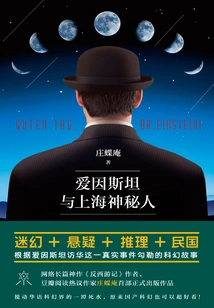
Einstein and the Mysterious Man in Shanghai
About This Novel
At the end of 1922, on the eve of the famous scientist Einstein's visit to Shanghai, China, newspaper reporter Lin Ziwen found Huo Xiaoqing, a famous Shanghai mystery novelist and translator, and said that the fictional legendary detective Cheng Sang in the novel had actually become a real person in reality and was assisting the police in investigating special mysterious cases in the Shanghai Concession. Huo Xiaoqing didn't believe it at first, but after meeting the real "Cheng Sang" by chance, he knew better than anyone else that his fictional character had actually become a living person. After being frightened, Huo Xiaoqing began to cooperate with reporter Lin Ziwen, trying to find out the truth behind it.
Official Sources
What Readers Think
Rating
Community(0)
Official(1)Scraped 2mo ago
First of all, this is a pretty crappy novel. As for the reasons: 1. I don't like the story style of PHS Traveling in the Future, which makes this novel feel like it is written for elementary and junior high school students. 2. The lame imitation of the popular style of the Republic of China in the article is really weird, especially when it is applied to future people and Germans. 3. The dialogue style may be very Republican, but it is very un-Chinese. 4. The author's description of the future human society is a bit really ridiculous. As a contemporary science fiction novel, this is a fantasy that completely ignores any social psychology, personal psychology and fundamentals of human nature. 5. It is always assumed that people in the past are wiser than people in the future. This is actually the product of liberal arts and religious perceptual thinking. How could such a recognition be possible in the future rational society described by the author? If this kind of understanding is common in future society, then the future you create cannot exist. This is a paradox of human nature. 6. The female characters in it are just vases, and they are superfluous to the content of the entire book. In the latter part, the author forcibly arranges a love story for the male reporter, which is particularly abrupt and blunt, and also particularly Western. The only science fiction perspective in the book that is logically self-consistent is that in the future, the boundaries between humans and intelligent machines will become increasingly blurred. Anyway, I regret buying this book.
Rating
Community(0)
Official(1)Scraped 2mo ago
First of all, this is a pretty crappy novel. As for the reasons: 1. I don't like the story style of PHS Traveling in the Future, which makes this novel feel like it is written for elementary and junior high school students. 2. The lame imitation of the popular style of the Republic of China in the article is really weird, especially when it is applied to future people and Germans. 3. The dialogue style may be very Republican, but it is very un-Chinese. 4. The author's description of the future human society is a bit really ridiculous. As a contemporary science fiction novel, this is a fantasy that completely ignores any social psychology, personal psychology and fundamentals of human nature. 5. It is always assumed that people in the past are wiser than people in the future. This is actually the product of liberal arts and religious perceptual thinking. How could such a recognition be possible in the future rational society described by the author? If this kind of understanding is common in future society, then the future you create cannot exist. This is a paradox of human nature. 6. The female characters in it are just vases, and they are superfluous to the content of the entire book. In the latter part, the author forcibly arranges a love story for the male reporter, which is particularly abrupt and blunt, and also particularly Western. The only science fiction perspective in the book that is logically self-consistent is that in the future, the boundaries between humans and intelligent machines will become increasingly blurred. Anyway, I regret buying this book.
