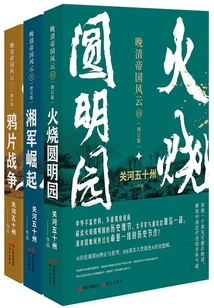
The Storm of the Empire in the Late Qing Dynasty Series (updated Edition)
About This Novel
The Empire of the Late Qing Dynasty series is a blockbuster work of modern historical writing in the fifty states of Guanhe. This series refers to rich historical materials at home and abroad, using multiple observation perspectives to deeply understand the positions of all parties at the historical scene at that time, as well as their true human background and cognitive logic. It attempts to reorganize the development of modern history, reproduce a real and perceptible past, and interpret the diverse possibilities of history. It is divided into three parts: "The Opium War", "The Rise of the Hunan Army" and "The Burning of the Old Summer Palace". "The Opium War" begins with the accession of Emperor Daoguang to the throne. Through the interpretation of the many shortcomings of the Qing Empire in decline, as well as the multi-faceted display of the personality clashes and conflicts of various characters, "The Opium War" reveals the secrets behind the historical curtain of the Opium War. It interprets the reasons for the outbreak of the Opium War and China's failure from many aspects, as well as many historical details of the collision, trial, conflict and game with the British Empire. "History has made the Hunan Army, and the Hunan Army has changed history." Based on rich historical materials, "The Rise of the Hunan Army" tells the history of the rise of the Hunan Army from a new perspective, and its combat style of "increasing courage with every setback, and fighting after repeated defeats." It also vividly evaluates the unique organizational structure of the Hunan Army Group, the army's brave fighting style, unique training methods, recruitment system, as well as the personal character, talents and relationships of the leaders of the Hunan Army. "The Burning of the Old Summer Palace" takes the incident of the Burning of the Old Summer Palace as the starting point, and slowly unfolds the turbulent historical scene of the late Qing Empire, and introduces many historical figures such as Emperor Xianfeng, Zeng Guofan, Hu Linyi, Li Hongzhang, Hong Xiuquan, Li Xiucheng, Park Li, Wall... The characters are portrayed and described in depth with the background of human nature; here are the growth and defeat of influential figures, the treacherous waves of court politics, the blood on the battlefield, the dilemma of the Qing government in the external game, and the flash, cowardice and complexity of human nature.
Official Sources
What Readers Think
Rating
Community(0)
Rating
Community(0)