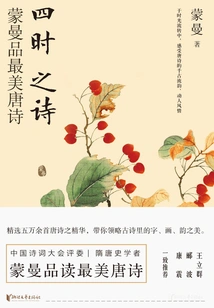
Poems of the Four Seasons: Meng Manpin's Most Beautiful Tang Poems
by Monman
About This Novel
This book is the first work explaining Tang poetry by Mr. Meng Man, a famous scholar of Sui and Tang history and a judge of the Chinese Poetry Conference. Teacher Mengman takes you back to the Tang Dynasty to read the most beautiful Tang poetry. This book takes the classical 24 solar terms and modern festivals as the starting point, leading readers to read selected Tang poetry works in the four seasons, appreciate the linguistic and literary beauty of Tang poetry, tell cultural allusions, and enter the poet's state of mind. Based on this theme, 32 poems and essays were carefully compiled and revised. These poems revolve around the four seasons and festivals. In fact, they revolve around the cycle of time in the Tang Dynasty and the cycle of life of the Tang people. I hope to see them in this reincarnation - Li Bai, Du Fu, Wang Wei, and even more hope to see us - you, me and him (her) in this reincarnation. We and them, ancient times and today, tradition and future, meet in this wonderful poem of the four seasons. Let us, together with Teacher Mengman, appreciate in detail the wind, flowers, snow and moon that have traveled through thousands of years, and the immortal embroidered brocade heart that has lasted for thousands of years.
Official Sources
What Readers Think
Rating
Community(0)
Official(39)Scraped 2mo ago
A great book worth reading! ! !
The literati's pen and ink are full of wit and humor, and Mr. Mengman's eloquent stories also make readers feel the same way. They may be in the early spring in the south of the Yangtze River, or in the desert beyond the Great Wall, or feel the poet's sorrow, or share the comfort with him. Thank you sincere Mengman, and thank you, China, for your good poetry!
four distinct seasons
The four seasons are distinct, and the ancients had a strong sense of ritual! That's why we have different feelings about the four seasons today.
In poetry, you can feel the changes of the four seasons, and the emotions of the Chinese people are in them!
Can't think of a title
I like Teacher Mengman's books very much and will read more in the future.
The scenery you are used to seeing is not scenery. People are often more likely to find beauty in the contrast between the unfamiliar and the familiar.
I like Teacher Mengman's explanation.
Chinese literature is indeed broad and profound.
Good books are worth savoring.
The peaches are blooming in spring, the lotuses are light in summer, the chrysanthemums are faint in autumn, and the plum blossoms are proud of the snow in winter. Therefore, there is a snow-appreciating hall for reading in winter and spring, and a pavilion for listening to the rain while drinking tea in summer and autumn. The beauty of the four seasons is over!
Rating
Community(0)
Official(39)Scraped 2mo ago
A great book worth reading! ! !
The literati's pen and ink are full of wit and humor, and Mr. Mengman's eloquent stories also make readers feel the same way. They may be in the early spring in the south of the Yangtze River, or in the desert beyond the Great Wall, or feel the poet's sorrow, or share the comfort with him. Thank you sincere Mengman, and thank you, China, for your good poetry!
four distinct seasons
The four seasons are distinct, and the ancients had a strong sense of ritual! That's why we have different feelings about the four seasons today.
In poetry, you can feel the changes of the four seasons, and the emotions of the Chinese people are in them!
Can't think of a title
I like Teacher Mengman's books very much and will read more in the future.
The scenery you are used to seeing is not scenery. People are often more likely to find beauty in the contrast between the unfamiliar and the familiar.
I like Teacher Mengman's explanation.
Chinese literature is indeed broad and profound.
Good books are worth savoring.
The peaches are blooming in spring, the lotuses are light in summer, the chrysanthemums are faint in autumn, and the plum blossoms are proud of the snow in winter. Therefore, there is a snow-appreciating hall for reading in winter and spring, and a pavilion for listening to the rain while drinking tea in summer and autumn. The beauty of the four seasons is over!