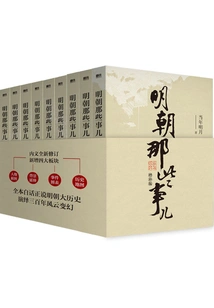
Those Things in the Ming Dynasty·complete Works (2021 Supplementary Edition)
About This Novel
This book mainly talks about the history of the Ming Dynasty in the three hundred years from 1344 to 1644. It refers to more than twenty kinds of historical materials and notes of the Ming Dynasty, such as "Records of the Ming Dynasty", "Tongjian of the Ming Dynasty", "History of the Ming Dynasty", "Chronicles of the Ming Dynasty", etc. It is reviewed and recommended by Mao Peiqi, an expert on the history of the Ming Dynasty. Looking at the history of the Ming Dynasty over the past three hundred years, you can see a different Ming Dynasty. Dynasty: In the 276th year of the Ming Dynasty, there have been 16 emperors, and no emperor has a similar routine; follow Zhu Yuanzhang to learn entrepreneurship, the failure of Emperor Jianwen, the power manipulation of Emperor Jiajing, the literary and artistic young Ming Wuzong, the Ming Xiaozong who insisted on monogamy, and the carpenter emperor Ming Xizong; there are so many loyal and righteous people that it is sad to see. Looking coldly at the enemy and shedding tears is a hero. Xu Da, Chang Yuchun, Lan Yu, how to arrange the founding war gods, scholar Yu Qian won the battle to defend Beijing, why Wang Yangming was worshiped by the Japanese, formation madmen Qi Jiguang, Yuan Chonghuan, are they heroes or sinners; interpretation of officialdom politics and imperial power. Regardless of the country, power, world, and people's hearts, the man behind Zhu Di, Yao Guangxiao, \u002FThe multi-faceted life of a generation of upright official Hai Rui\u002FXu Jie, the number one politician in the Ming Dynasty\u002FWho was touched by Zhang Juzheng's reforms. What kind of organization is the Donglin Party? Spring and Autumn Period, poetry and painting, novels and legends, a dynasty with prosperous culture, economy and art, how "Yongle Dadian" was compiled, the prodigal talent Tang Bohu, the emergence of the four great wonders of the Ming Dynasty ("Romance of the Three Kingdoms", "Water Margin", "Journey to the West" and "Jin Ping Mei"), the madman Li Zhi. The Ming Dynasty was a bloody dynasty, a grotesque dynasty, a strong and tender dynasty, a dynasty that had experienced disasters and was magnificent. The Ming Dynasty is like the folds of Chinese history. Every time you open a chapter, there are wonderful stories that contain the cultural codes, political logic, and human experience of the Chinese people.
Official Sources
What Readers Think
Rating
Community(0)
Official(3)Scraped 1mo ago
The rise and fall of dynasties is not a matter of one family or one surname.
Personal feelings: 1. Judging from this book, the demise of the Ming Dynasty best reflects the view that the demise of a dynasty depends on comprehensive social factors. When the internal problems of a dynasty accumulate to a certain extent but cannot be effectively corrected, it is dangerous. From this point of view, this book is quite consistent with historical materialism. 2. This book has a somewhat pity attitude towards the demise of the Ming Dynasty. In fact, the demise of the Ming Dynasty is not a pity at all, and it is not a sign of exhaustion. It did not reform when it was time to reform, and allowed more and more problems to become bigger and bigger, which eventually led to the destruction of the country and the family. This was a common problem in all dynasties, and it was entirely a human matter. 3. This book contains some opinions, such as: "The government of Wanli is basically anarchic. From this point of view, he should be an anarchist. It is really not easy for his thinking to be so advanced. Generally speaking, when historical materials write this paragraph, they always write vigorously and denounce Wanli as mediocre and corrupt, the government is ineffective, and the people live in dire straits. In my opinion, those who hold this view are either being hypocritical or ignorant. The Wanli period was precisely the period when the economy of the Ming Dynasty was most developed, and the so-called germination of capitalism flourished here. The life of ordinary people is really nourishing, and they can do whatever they want. In the early Ming Dynasty, if you went out to the village and asked for a letter of introduction, wandering around without permission, you would be sent to the army if caught. During the Wanli period, let alone a letter of introduction, you don't even need a household registration (yellow register). If you have the ability, no one will care about you when you go to the United States. " Finally came to the conclusion: The truth during the Wanli period was probably this: a world of political chaos, economic prosperity, splendid culture, and vitality. However, this world was eventually destroyed. In fact, what I saw was that the eunuchs under Emperor Wanli were either here to collect taxes today or there to mine tomorrow, oppressing the people everywhere. The Wanli era can be said to be an era of many civil unrest. How can the people not be said to be living in dire straits? The Chinese government is supposed to govern the country well. Suddenly there are so many staff shortages and it has become anarchy. Is it normal? How can people's lives be called moist? The only people who can benefit are the landlords and industrial and commercial people. In addition, what is the difference between the so-called splendid culture and the transsexual and gay sex in Western countries today? Apart from the fact that people may move more freely, what's so good about this era? Overall, this book is a good book on the history of the Ming Dynasty. It is suitable for leisure reading for history lovers. However, its views must be analyzed reasonably and cannot be generalized.
History is just history, seeing yourself in others. After everything happened, it was like nothing happened.
Coca Cola la la la ababa
Rating
Community(0)
Official(3)Scraped 1mo ago
The rise and fall of dynasties is not a matter of one family or one surname.
Personal feelings: 1. Judging from this book, the demise of the Ming Dynasty best reflects the view that the demise of a dynasty depends on comprehensive social factors. When the internal problems of a dynasty accumulate to a certain extent but cannot be effectively corrected, it is dangerous. From this point of view, this book is quite consistent with historical materialism. 2. This book has a somewhat pity attitude towards the demise of the Ming Dynasty. In fact, the demise of the Ming Dynasty is not a pity at all, and it is not a sign of exhaustion. It did not reform when it was time to reform, and allowed more and more problems to become bigger and bigger, which eventually led to the destruction of the country and the family. This was a common problem in all dynasties, and it was entirely a human matter. 3. This book contains some opinions, such as: "The government of Wanli is basically anarchic. From this point of view, he should be an anarchist. It is really not easy for his thinking to be so advanced. Generally speaking, when historical materials write this paragraph, they always write vigorously and denounce Wanli as mediocre and corrupt, the government is ineffective, and the people live in dire straits. In my opinion, those who hold this view are either being hypocritical or ignorant. The Wanli period was precisely the period when the economy of the Ming Dynasty was most developed, and the so-called germination of capitalism flourished here. The life of ordinary people is really nourishing, and they can do whatever they want. In the early Ming Dynasty, if you went out to the village and asked for a letter of introduction, wandering around without permission, you would be sent to the army if caught. During the Wanli period, let alone a letter of introduction, you don't even need a household registration (yellow register). If you have the ability, no one will care about you when you go to the United States. " Finally came to the conclusion: The truth during the Wanli period was probably this: a world of political chaos, economic prosperity, splendid culture, and vitality. However, this world was eventually destroyed. In fact, what I saw was that the eunuchs under Emperor Wanli were either here to collect taxes today or there to mine tomorrow, oppressing the people everywhere. The Wanli era can be said to be an era of many civil unrest. How can the people not be said to be living in dire straits? The Chinese government is supposed to govern the country well. Suddenly there are so many staff shortages and it has become anarchy. Is it normal? How can people's lives be called moist? The only people who can benefit are the landlords and industrial and commercial people. In addition, what is the difference between the so-called splendid culture and the transsexual and gay sex in Western countries today? Apart from the fact that people may move more freely, what's so good about this era? Overall, this book is a good book on the history of the Ming Dynasty. It is suitable for leisure reading for history lovers. However, its views must be analyzed reasonably and cannot be generalized.
History is just history, seeing yourself in others. After everything happened, it was like nothing happened.
Coca Cola la la la ababa