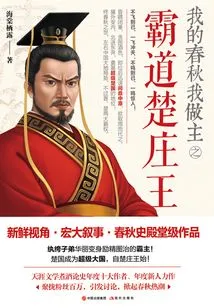
I Am the Master of My Spring and Autumn, the Overbearing King Chuzhuang
by Begonia Qilu
About This Novel
The "My Spring and Autumn Period, I Make the Decision" series presents a panoramic view of the feudal kingdoms competing for hegemony in the "Spring and Autumn Era" from a brand-new perspective. In 770 BC, the Zhou royal family moved eastward to Luoyi to continue to enjoy the country, which was known as the Eastern Zhou Dynasty in history. After the first monarch of the Eastern Zhou Dynasty, King Zhou Ping, there were a total of twenty-five kings. They were destroyed by Qin in 256 BC, which lasted 515 years. In the first half of the Eastern Zhou Dynasty, vassal states competed for hegemony, which is known as the "Spring and Autumn Period" in history. Most of China's laws, regulations, and cultural customs originated from the "Spring and Autumn Period", and many of the political conquests and legendary allusions widely used in later generations also originated from this period. For more than two hundred years, the countries of Lu, Qi, Song, Jin, Chu, Zheng, Cao, Chen, Wei, Yan, Qin, Cai, Wu, Yue, etc. Entangled, collided, contained, and formed alliances with each other, and together they created an era that was bloody, turbulent, and full of the vitality of Chinese culture. Based on historical materials, the author takes the feudal princes' struggle for hegemony as the main line, with the "Five Hegemons" as the center, and uses popular and friendly words and rich writing styles to examine, narrate and evaluate the geographical pattern, cultural landscape and political evolution of the "Spring and Autumn Period" from multiple angles. This book is the third volume, "The Overbearing King of Chuzhuang", which mainly describes the process by which King Chuzhuang, his son King Chugong, and his grandson King Chukang achieved the great success of Chu Kingdom. Faced with internal and external troubles, the King of Chuzhuang, who had been dormant for a time, cheered up, defeated Ruo Ao, and marched northward to aspire to the Zhou Dynasty. The battle in Bi and the Jin army swept across the Jin army, which historically broke the Jin's hegemonic monopoly; Shangqiu besieged the city and forced the Song to surrender, which essentially laid the foundation for Chu's hegemony. King Zhuang of Chu "merged twenty-six countries and opened up three thousand miles of land" in his life. He showed his domineering power and pushed the Chu country to the top. The two guardian kings, King Gong of Chu and King Kang of Chu, inherited the legacy of King Zhuang of Chu and dealt with Jin without falling behind. At the Xiangxu Extermination Meeting, Jin and Chu equally divided the Central Plains hegemony, paving the way for China to usher in a more chaotic Warring States era.
Official Sources
What Readers Think
Rating
Community(0)
Rating
Community(0)