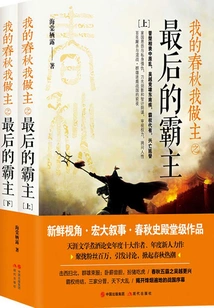
My Spring and Autumn I Call the Master: the Last Overlord (collection)
by Begonia Qilu
About This Novel
The "My Spring and Autumn Period, I Make the Decision" series presents a panoramic view of the feudal kingdoms competing for hegemony in the "Spring and Autumn Era" from a brand-new perspective. In the first half of the Eastern Zhou Dynasty, the vassal states competed for hegemony. The states of Lu, Qi, Song, Jin, Chu, Zheng, Cao, Chen, Wei, Yan, Qin, Cai, Wu, Yue, etc. Entangled, collided, contained, and formed alliances with each other, jointly interpreting an era that was bloody and turbulent, but also full of the vitality of Chinese culture. Based on historical materials, the author takes the feudal princes' struggle for hegemony as the main line, with the "Five Hegemons" as the center, and uses popular and friendly words and rich writing styles to examine, narrate and evaluate the geographical pattern, cultural landscape and political evolution of the "Spring and Autumn Period" from multiple angles. This book is the fourth volume, "The Last Overlord", which mainly describes the process of Wu and Yue's struggle for hegemony against the background of the decline of the old hegemony of Jin and Chu. As the traditional ethics further collapsed, the dictatorship of the great officials seized power, and civil strife broke out among the princes of the Central Plains. The hegemony gradually disappeared, and the Wu and Yue countries in the southeast rose one after another. King Helu of Wu reused Sun Wu and his military officials to rectify the military and political affairs, build waterways to boost the military, and the country's strength advanced rapidly. In the Battle of Baiju, the Wu army directly attacked the capital of Ying, and its soldiers dug up graves and whipped corpses. In the Battle of Xiali, Helu fell into the hands of the Yue army because he underestimated the enemy. His son, King Fucha of Wu, was determined to take revenge. After defeating the Vietnamese army in the Battle of Fujiao, Helu counterattacked Kuaiji. He could have killed the Yue King Gou Jian, but instead allowed the tiger to cause trouble. After Gou Jian was lucky enough to escape, he worked hard on the firewood and relied heavily on Fan Li and Wenzhong. After ten years of gathering together and ten years of lessons, the Yue Kingdom became prosperous. Fu Chai was so pleased with his achievements that he went to Xian and Ren. After attacking Chu and invading Vietnam, he continued to repair rivers and canals. He sent his troops north, surrendered to Lu and attacked Qi. He competed with Huangchi of Jin for hegemony. While spreading the country's prestige to the four realms, it also caused serious internal diseases that were difficult to resolve. Gou Jian took advantage of the situation and took advantage of the opportunity of Fucha Kong's expedition to stay in Huangchi to raid the capital of Wu. In one fell swoop, he reversed Wu's weakening situation and finally put Wu to death through constant attacks. Taking advantage of the power of Wu, Gou Jian took control of Jiangdong, and found his own way to give full play to Yue's advantage in controlling the sea. He took advantage of the convenient coastal areas and abandoned the inland areas of Jianghuai. He used kindness and power to win the final honor of overlord in the Spring and Autumn Period. However, the Qing clan of Jin State was in power and attacked and killed each other. After the three clans of Zhao, Wei and Han were wiped out, their intentions were still unfinished. Eventually, the three clans were divided into Jin and the world was in disorder. Chinese history entered the Warring States Period.
Official Sources
What Readers Think
Rating
Community(0)
Rating
Community(0)