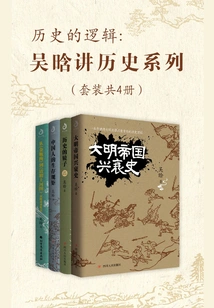
The Logic of History: Wu Han's History Series (set of 4 Volumes in Total)
by Wu Han
About This Novel
The History of the Rise and Fall of the Ming Empire tells the story of the relationship between the rise and fall of the Ming Dynasty and the rise and fall of its bureaucracy and army. In the history of the Ming Dynasty, Zhu Yuanzhang, a rogue and bandit, established the dynasty with a strong army and was recorded in history books as Emperor Taizu Gao. However, the failed Li Zicheng became a thief, thief, bandit, and bandit. Although he was also an emperor, old historians were snobbish. However, force can be used to seize political power, but it cannot be used to govern a country. To govern a country, you must establish a bureaucracy that is easy to use and can be used by the emperor, and bureaucracy must use literati. The interests of the scholar-bureaucrats were consistent with the imperial power. They served the imperial power and helped the emperor govern the country. Once this institution was completely corrupted, the empire would inevitably fall. The famous historian Wu Han uses a fair and rigorous attitude, real and interesting historical materials, and reveals the historical logic behind the rise and fall of the Ming Empire from the two main perspectives of bureaucracy and the army. The mirror of history In ancient times, students studied hard for ten years, but after getting the diploma, they married a concubine for themselves; officials said they were honest and honest, but privately they spent wantonly and indulged in prostitution; famous Confucian scholars claimed to be indifferent to fame and fortune, but in reality After entering an official position, you will be greeted by both sides, worshiping the superior and suppressing the inferior... History is a mirror. It can not only reflect the rise and fall of dynasties and the change of dynasties, but also reflect the thoughts of people at that time, social customs, and the complex human nature hidden under the bright appearance. "Mirror of History" tells us in detail the causes, manifestations, effects of corruption and thoughts on anti-corruption in history from the perspectives of traditional Chinese ethics and social atmosphere. The Chinese people's rules of survival If a person wants to survive in society, he must abide by the society's rules of survival. In the past dynasties of China, the emperor had his own rules for living, officials had their own rules for officials, and the common people had their own rules for living. Everyone struggled and lived within the rules of the game set by the society at that time. In the feudal society, the emperor came from all over the world and was worshiped by thousands of people. In order to maintain the ancestral foundation, he also had to compete with everyone; the officials were superior to others and had infinite glory in appearance, but they also accompanied the emperor like a tiger and were on tenterhooks all day long; the people always thought that it was good to be ordinary and stick to their duties, but they did not want to be exploited at all levels. The famous historian Wu Han interprets the survival rules of ancient Chinese people from a historical perspective, summarizes their survival wisdom and experiences and lessons, and uses history to draw lessons from the present. From "Jin Ping Mei" to "Along the River During the Qingming Festival": Wu Han's Notes on Reading History The famous historian Wu Han unearthed long-standing historical stories from a series of rare classics and documents. Here, we can see people's misunderstanding and misinterpretation of "The Plum in the Golden Lotus", the historical connection between "Along the River During the Qingming Festival" and "The Plum in the Golden Lotus", the evolution of the story of Queen Mother of the West, the ancient stories and their systems in "The Classic of Mountains and Seas", and the truth about Hu Weiyong's party case in the Ming Dynasty. Prime Minister, Wang Maoyin's currency reform in the Xianfeng era, and Li Manzhu who was tampered with, forged and distorted in the history of the founding of the state... Wu Han relayed these vivid historical stories to the public through accurate interpretation and rigorous reasoning, allowing us to enjoy the fun of reasoning in history!
Official Sources
What Readers Think
Rating
Community(0)
Rating
Community(0)