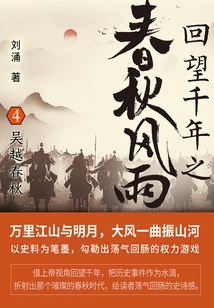
Looking Back at the Thousand Years of Spring and Autumn Storm 4: Wu Yue Spring and Autumn Period
by Liu Yong
About This Novel
This book is the first work in the series of looking back at the millennium. This work sorts out a clear main line of the Spring and Autumn Period from the complex historical materials, which can help readers grasp the historical process of the Spring and Autumn Period from a macro perspective. The main line of Spring and Autumn is mainly divided into four stages. The early Spring and Autumn Period - after King Ping moved eastward, the Three Little Overlords of the Spring and Autumn Period headed by Zheng Zhuanggong supported the main line of the Early Spring and Autumn Period. The work revolves around the perspectives of Zheng, Qi and Chu, telling the historical events of the Early Spring and Autumn Period; the middle stage of the Spring and Autumn Period - after the rise of Duke Huan of Qi, the main line of the Early Spring and Autumn Period is continued, and the work revolves around The struggle for hegemony between Qi and Chu unfolds, telling the historical events from Duke Huan's first hegemony of the Central Plains to the battle between Qi and Chu over the Yangtze River and Huaihe River; the late Spring and Autumn Period - introduces the background of Qu Wo Dai Yi and the rise of the Jin State, taking Jin Wengong Chong'er's exile in various countries as the main line, and restoring the beginning and end of the Battle of Chengpu from multiple perspectives such as politics, military, and geography. From the Battle of Chengpu in 632 BC to the second annihilation of the military alliance in 546 BC, in nearly a hundred years, the struggle between Jin and Chu for hegemony became the main theme of the era. At the end of the Spring and Autumn Period - after the second war and alliance, the countries of the Spring and Autumn Period had a truce for forty years. While the external conflicts of each country were alleviated, the Jin, Chu, and Qi countries all experienced internal worries to varying degrees. The scholar-bureaucrat class rose up and gradually emptied the power of the princes and kings. This phenomenon had a profound impact on later generations, such as the division of the three families into Jin and the succession of the Tian family to Qi. During the same period, Wu and Yue in the southeast region rose one after another, pushing Wu and Yue's struggle for hegemony to its climax. In the end, King Gou Jian of Yue succeeded in his revenge. This established the pattern of the four great powers of Jin, Chu, Qi and Yue in the early Warring States Period.
Official Sources
What Readers Think
Rating
Community(0)
Rating
Community(0)