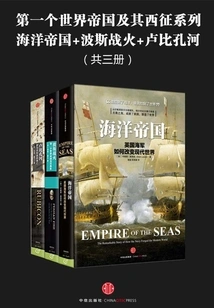
The First World Empire and Its Western Expeditions Series: Ocean Empire + Battle of Sri Lanka + Polubicon River (three Volumes in Total)
by (uk) Brian Lively Tom Holland
About This Novel
In 49 BC, Caesar led the Gallic legions across the Rubicon River and returned to Rome, pushing the 460-year-old Roman Republic into the abyss of civil war. The Rubicon is a dividing river. According to the laws of the Roman Republic, any general was not allowed to lead his army across the Rubicon, otherwise he would be considered a treason. In the 1st century BC, it was in front of this small river that Caesar made the decision to rebel. Why did Caesar, who was at the top of power, do this? What made him determined to leave the glory of the Republic behind when he hesitated on the banks of the Rubicon? Where will Rome go under Caesar? How will the world outside Rome change? "Rubicon" tells us the decline of the Roman Republic through the incident of Caesar crossing the Rubicon. Since the establishment of the Republic in 509 BC, Rome has expanded rapidly after several conquests. By the 1st century BC, it had transformed from a small city-state into a world empire. The republic was unsustainable, and Rome would usher in a drastic social change. The book focuses on describing the social conditions of class antagonism and contradictions in the Republic before the advent of change. The dazzling stars in Roman history also appeared one after another during this period. The three Roman giants who competed for dictatorial privileges, Cicero and Cato who adhered to the concept of the Republic, and Spartacus who launched a slave uprising... Together they performed the bloody process of the decline of the Roman Republic, and sketched a portrait of the late Republic full of sacrifice, betrayal, disaster, intrigue and unlimited ambition. In the 5th century BC, Persia was determined to conquer Greece westward, and the eastern and western worlds fell into war. Persia was an unprecedentedly powerful super empire in the world at that time, with a mighty iron cavalry and the ability to destroy countless enemies. Starting from Cyrus, the "King of the Universe", in just one generation, Persia swept across the entire Middle East and established a huge country extending from India to Egypt. Greece is located on the Aegean coast. It is barren and weak, with many city-states, and its territory is not as large as a small province in Persia. In the eyes of the Persians, Greece is a group of rogue countries, and Persia should bring them truth and order; in the eyes of the Greeks, Persia is an unreasonable barbarian, and the Greeks have the blood of "cannot be enslaved" flowing in their bones. There are insurmountable differences between the two civilizations. Differences create doubts, and doubts lead to war. "Persian War: The First World Empire and its Western Expedition" tells the story of the causes and consequences of the Persian War and the entire process, from the Persian emperor who was proficient in power and the Greek city-states who were keen on infighting, to the Spartan warriors with militarized and perverted management, and the Athenian politicians who flaunted good government, writing a majestic epic full of wildness. The highlight of the book is the restoration of the thrilling and fierce battle scenes between the two sides. Whether it is the encounter between the two sides on the Plains of Marathon in 490 BC; or the bloody battle between 300 Spartan warriors against Xerxes, the "King of Kings" at the Thermopylae; or the naval battle of Salamis, in which 1,200 Persian warships were completely defeated by 300 Athenian warships... Every scene is depicted as vividly as if the reader was on an ancient battlefield and saw it with his own eyes through armor. As the first international contest across Europe and Asia in the classical world, the Persian War marked the beginning of thousands of years of conflict between Eastern and Western civilizations. "Persian War: The First World Empire and its Western Expedition" reproduces this civilizational struggle in the classical world from a new perspective. For readers who want to understand this period of history, this book is a highly anticipated introductory book. 1. From the 400-year struggle of the British Navy, tell the rise of the British Empire and how it changed the modern world. A primer on the rise and fall of sea power and civilization. The first part, "Heart of Oak", tells the story of the development of the Royal Navy from the 16th to the 18th century. The wealth, power and honor of the empire will be born in the ocean; the second part, "The Golden Sea", tells the rise of the British Empire from the 18th to the 19th century. During this period, Britain proved that "whoever controls the ocean controls the world"; the third part, "The Rising Wind", tells the story of maritime trade and maritime hegemony in the 19th century. Britain holds two tridents, creating the imperial legend of the 19th century; The fourth chapter, "Great Changes in the Sea," tells the story of the decline of the British Empire's maritime hegemony from the 20th century to World War I, and the crisis of global civilization it triggered. 2. Take history as a mirror and reflect on how marine civilization changed the modern world order. Britain is one of the representative countries of maritime civilization. The rise of the British Empire and the formation of the modern world have been deeply marked by maritime civilization. Traditional China has always adhered to a closed agricultural civilization, and has long been isolated and lagging behind the modern world dominated by maritime civilization. How to bridge the gap between agricultural civilization and marine civilization? Is it to reconstruct modern society in the way of marine civilization? Or seek the unity of agricultural civilization and marine civilization? In today's society, each of us should reflect on these issues. 3. The Sunday Times bestseller and the BBC hit documentary of the same name. "Empire of the Sea" was listed as a bestseller in the "Sunday Times". When the documentary of the same name was broadcast in the UK, the response from everyone from the Prime Minister to the public was extremely enthusiastic. The documentary is hosted by Dan Snow, the famous host of the BBC history column. Together with the book, it presents a 400-year history of the rise and fall of the empire full of heroic ambitions, and impassionedly reproduces the unparalleled glory that the British Empire once created. In 1588, the British Royal Navy defeated the Spanish Armada. This victory created a legend. In the next few hundred years, the wealth, power and glory of the empire would be born in the ocean. The Royal Navy would push Britain from the edge of Europe to the center of the modern world. "Empire of the Sea" takes the 400-year development history of the British Navy as the main line and tells the story of the rise of the British Empire and how it affected the rise and fall of modern civilization. The book is divided into four chapters, "Heart of Oak", "Golden Ocean", "Wind and Surge", and "Great Changes in the Ocean", one by one showing Britain's journey from controlling the lifeline of maritime traffic to establishing a global maritime empire, which ultimately led to a crisis in global civilization. Readers can explore the following history from the book: How did the Royal Navy develop from a ragtag group engaged in maritime plunder to a world policeman maintaining "peace under the British Empire"? From the 16th to the 18th century, how did Britain defeat almost all maritime powers in Europe and create a maritime legend of dominating the world? The pirate Drake, Prime Minister William Pitt Jr., Lord Admiralty Fisher and Churchill... What impact did the naval reforms they carried out have on the British political, economic and cultural systems? Britain became the birthplace of the Industrial Revolution and shaped modern capitalist civilization. What are the intrinsic connections between these and the Royal Navy? Why did Britain and Germany engage in a naval arms race, and how did British maritime hegemony go from its peak to its decline?
Official Sources
What Readers Think
Rating
Community(0)
Rating
Community(0)
