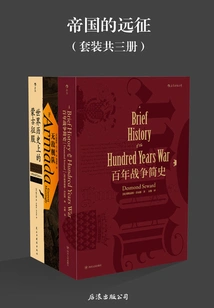
Imperial Crusade (set of Three Volumes)
by (uk) Desmond Seward (us) Garrett Mattingly Mei Tianmu
About This Novel
"A Brief History of the Hundred Years' War" For more than 100 years, Britain invaded French territory many times on the pretext that its king had the right to inherit the French throne. France at this time was a large but uncontrollable kingdom, and England was small and poor. Yet for much of the war, the British dominated the course of the war, seizing cities and winning numerous battles - including the great victories at Crécy, Poitiers and Agincourt. However, the balance of the war quickly tilted towards France in just over 20 years after the emergence of Joan of Arc, and eventually ended with France taking back all continental territories except Calais. The author uses concise and concise language to sort out the complex and wide-ranging historical events of the Hundred Years' War between England and France. He traces the changes that ultimately led to France's victory during the war, and vividly reproduces the intrigue and interest in medieval European epics, painting a fascinating picture of medieval war for readers. "Armada" is a wonderful description of the famous naval battle between Britain and Spain in 1588 against the background of the fierce struggle between Catholic and Protestant forces throughout Europe in the 16th century. The author perfectly integrated rich knowledge, superb writing and exquisite layout, making this book still a classic work on this subject. The author combines a wealth of first-hand historical materials and a large number of second-hand works, and skillfully uses them without leaving any trace, so that historical details, academic achievements and the main narrative line are closely integrated. "The Mongol Conquest in World History" is a new heavyweight work in the field of research on the history of the Mongolian Empire in recent years. From the perspective of world history and global history, the author focuses on describing the Eurasian cultural exchanges promoted by Genghis Khan and the emergence of a new Eurasian world after the successive collapse of the Mongol khanates. Under the forcible promotion of the Mongol rulers, the East and the West began a process of mutual exchange, and a new Eurasian culture was born under the "Mongol rule." This, to a certain extent, corrected the image of Mongolia as a barbarian who destroyed the civilized world.
Official Sources
What Readers Think
Rating
Community(0)
Rating
Community(0)