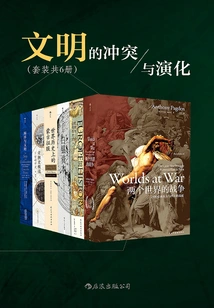
The Clash and Evolution of Civilizations (set of 6 Volumes in Total)
by (u. S.) Anthony Pagodon Eric R. Wolfe, Etc.
About This Novel
"The War of Two Worlds" Since the "9·11" incident, Western countries have published a large number of works that analyze the root causes of terrorism from the perspectives of history, politics, religion, culture, etc. This book synthesizes all these perspectives and puts forward its own point of view, believing that all this must start from the separation of reality and thought between the West and the East 2,500 years ago. "Europe and the People Without History" selects 1400 AD as a historical reference point to explain in detail the appearance of Europe and the world outside Europe during that period; combined with rich historical materials, it conducts in-depth analysis and demonstration of the era of colonial empires before the emergence of the Industrial Revolution from the 15th to the second half of the 18th century, and the development of the global expansion and dominance of the capitalist era from the second half of the 18th century to the present. It also narrates the different changes experienced by different groups of people in the world when encountering this series of great changes. "Silver Capital" is a challenging and important work that provides a magnificent account of the economic connections between various parts of the world since 1500. The author Andre Gond Frank places China at the center of Asia and Asia at the center of the global economy. He believed that the combination of China's demand for silver and Europe's demand for Chinese goods led to the expansion of commerce around the world. "Ocean and Civilization" retells the history of the world from the perspective of the ocean, shows the connection between the rise and fall of civilization and the ocean, narrates the development of human navigation in a fascinating way, and composes an epic about the voyagers. "An Overview of Asian History" On the vast Asian continent, the Chinese civilization of East Asia, the civilization of West Asia, the Sanskrit civilization of India, and the Japanese civilization are distributed. Various heterogeneous civilizations are connected through transportation links, compete with each other, and compensate for each other, thus unfolding a grand picture of the development and evolution of Asian history. From this, we can further understand the true history of all mankind. "The Mongol Conquest in World History" is a new heavyweight work in the field of research on the history of the Mongolian Empire in recent years. From the perspective of world history and global history, the author focuses on describing the Eurasian cultural exchanges promoted by Genghis Khan and the emergence of a new Eurasian world after the successive collapse of the Mongol khanates.
Official Sources
What Readers Think
Rating
Community(0)
Official(1)Scraped 2mo ago
Okay, I believe you.
Rating
Community(0)
Official(1)Scraped 2mo ago
Okay, I believe you.