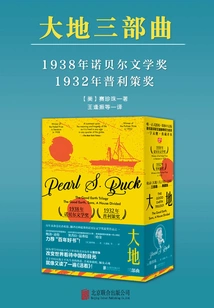
The Earth (trilogy)
by J
About This Novel
Wang Long, a poor farmer born in Anhui, married Alan, a maid from the Huang family, the landlord of the village. Although Alan is not beautiful and has a dull personality, he is hardworking and has given birth to two sons. The husband and wife worked together and had a good harvest. The good harvests in successive years even allowed Wang Long to save up and buy the fertile land of the Huang family, whose family business was declining. But just before wealth came, a natural disaster struck, and Wang Long had to flee to Nancheng with his family, begging and pulling carts, and eking out a living beside the city wall. Just when life was in quagmire, war broke out. Wang Lung unexpectedly robbed a wealthy family of silver from a house that had been robbed by thieves, and set out to return home. He used the unexpected wealth to buy cattle, seeds, and plowing equipment to revive his home. With good harvests every year, Wang Lung continued to buy more land and gradually became the richest man in the village. Wang Lung, who had become prosperous, began to go to restaurants and spend a lot of money. He also married a wine girl named He Hua as his concubine under Alan's eyes. Until natural disaster strikes again...
Official Sources
What Readers Think
Rating
Community(0)
Official(5)Scraped 2mo ago
I came here after watching the movie. It's a great book.
Yuan gets her love, what a beautiful love
The real modern history of China
It truly records the rise and fall of three generations of a family from the Qing Dynasty to the Republic of China.
I didn't finish reading all of it. I gave up after reading part of the third part. Because of this book, I specifically wanted to learn about Pearl Buck, but I only saw a little about her relationship with Lin Yutang. So I read Lin's "Smoke in Beijing" and a book on Lin's research. I have never given four stars or one star to a book I have read. I really don't agree with this book. Pearl Buck has lived in China for thirty years, which is a long time, but how much can she know about Chinese farmers? I felt a great sense of alienation in the book, and I couldn't put my pen down. I think that Sai has no actual background as a farmer, nor does she have much experience in getting along with farmers, so her article is probably based on imagination. We can only first have a concept, a big idea and a big understanding, and then tell the story. I'm just telling a story, I don't have the ability to describe the process. Because there is no experience, no experience. Reading "Beijing" is obviously much better than this book, but "Beijing" is not very realistic or close, because Lin Yutang is a blend of Chinese and Western cultures. Both of them introduced China to the world, but Lin was born in China anyway and had a good foundation in Chinese culture. Although compared with Lu Xun, Mao Dun, Yu Dafu and others, the traditional feeling will be weaker. There is no need to be superstitious about the so-called Nobel Prize in Literature. How can he compare with Lu Xun, Mao Dun, Zhao Shuli, and Wang Zengqi? Lin's "Beijing" was nominated for the Nobel Prize for Literature, wasn't it also because of its great influence in the American market? How can Nobel Prize winners in literature compare with literary masters, literary giants, and great writers?
The first part was very successful, and I think the first part of The Great Land did not deliberately promote certain ideas or values, but instead portrayed the characters as faithfully as possible, which is very rare. The second part was okay, the third one was a bit forced, but overall the first part was really good.
Rating
Community(0)
Official(5)Scraped 2mo ago
I came here after watching the movie. It's a great book.
Yuan gets her love, what a beautiful love
The real modern history of China
It truly records the rise and fall of three generations of a family from the Qing Dynasty to the Republic of China.
I didn't finish reading all of it. I gave up after reading part of the third part. Because of this book, I specifically wanted to learn about Pearl Buck, but I only saw a little about her relationship with Lin Yutang. So I read Lin's "Smoke in Beijing" and a book on Lin's research. I have never given four stars or one star to a book I have read. I really don't agree with this book. Pearl Buck has lived in China for thirty years, which is a long time, but how much can she know about Chinese farmers? I felt a great sense of alienation in the book, and I couldn't put my pen down. I think that Sai has no actual background as a farmer, nor does she have much experience in getting along with farmers, so her article is probably based on imagination. We can only first have a concept, a big idea and a big understanding, and then tell the story. I'm just telling a story, I don't have the ability to describe the process. Because there is no experience, no experience. Reading "Beijing" is obviously much better than this book, but "Beijing" is not very realistic or close, because Lin Yutang is a blend of Chinese and Western cultures. Both of them introduced China to the world, but Lin was born in China anyway and had a good foundation in Chinese culture. Although compared with Lu Xun, Mao Dun, Yu Dafu and others, the traditional feeling will be weaker. There is no need to be superstitious about the so-called Nobel Prize in Literature. How can he compare with Lu Xun, Mao Dun, Zhao Shuli, and Wang Zengqi? Lin's "Beijing" was nominated for the Nobel Prize for Literature, wasn't it also because of its great influence in the American market? How can Nobel Prize winners in literature compare with literary masters, literary giants, and great writers?
The first part was very successful, and I think the first part of The Great Land did not deliberately promote certain ideas or values, but instead portrayed the characters as faithfully as possible, which is very rare. The second part was okay, the third one was a bit forced, but overall the first part was really good.