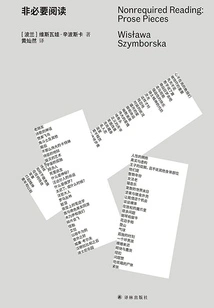
Non-essential Reading
by (poland) Wislawa Szymborska
About This Novel
Polish poet Szymborska is known for her profound insights into human nature. She is also a wise and profound essayist, a humorous critic, and a friendly and gentle reading mentor. She has been a columnist for decades, reviewing a variety of books under the modest title "Non-Essential Reading," compiled into this honest reading diary. The prose collected here is anything but ordinary and on par with her best poetry. In ninety-six short articles, Szymborska talks about fashion, cooking, home furnishing, opera, literature, history, music, etc., Which are full of interest in life and insights. It teaches us how to love life, how to treat reading well, and how to closely connect reading with life.
Official Sources
What Readers Think
Rating
Community(0)
Official(1)Scraped 1mo ago
10.5 I read physical books in the library and had a few leftovers. I found them here and started writing something. My family's words. The author is a gentle poet, and it is rare to see her using a subjective view of a certain prose. It feels like she is a person who loves fairy tales, she loves miracles, and she loves fantasy. She doesn't think reality is necessarily good. She likes reading, dabbling in various types of books, and liking the miracles created by ordinary people. This is my first experience with a book review - in the author's words, it's like a sketch. At first, I didn't feel that this book was a commentary by the author, but rather it felt like a part of a book had been cut out, or it was an independent essay. After reading it, I realized something was wrong, so I went back to read the preface, only to realize how careless I was. It covers many fields. As a bibliography of reviews, there are several articles that greatly aroused my interest. The author's words are like prose and fall into my heart. They are short, concise, implicit and meaningful. Although the prose itself is not seen, the vivid words are vividly seen on the page. Even if it is read as an independent book, it is not a bad idea. I have excerpted many words and left them with their eloquence in the future. It's worth reading, especially for people like me who no longer read books and have suddenly become dyslexic.
Rating
Community(0)
Official(1)Scraped 1mo ago
10.5 I read physical books in the library and had a few leftovers. I found them here and started writing something. My family's words. The author is a gentle poet, and it is rare to see her using a subjective view of a certain prose. It feels like she is a person who loves fairy tales, she loves miracles, and she loves fantasy. She doesn't think reality is necessarily good. She likes reading, dabbling in various types of books, and liking the miracles created by ordinary people. This is my first experience with a book review - in the author's words, it's like a sketch. At first, I didn't feel that this book was a commentary by the author, but rather it felt like a part of a book had been cut out, or it was an independent essay. After reading it, I realized something was wrong, so I went back to read the preface, only to realize how careless I was. It covers many fields. As a bibliography of reviews, there are several articles that greatly aroused my interest. The author's words are like prose and fall into my heart. They are short, concise, implicit and meaningful. Although the prose itself is not seen, the vivid words are vividly seen on the page. Even if it is read as an independent book, it is not a bad idea. I have excerpted many words and left them with their eloquence in the future. It's worth reading, especially for people like me who no longer read books and have suddenly become dyslexic.