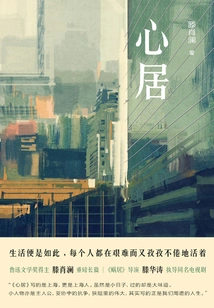
Heart of the Heart (original Work of the Tv Series of the Same Name Starring Hai Qing, Tong Yao and Zhang Songwen)
by Teng Xiaolan
About This Novel
"Heart Residence" - a novel by New Shanghai School writer Teng Xiaolan. Diving deeply into life, writing about the struggles in the complicated daily life. This is Shanghai at the moment, with city residents who were born and raised here, old Shanghainese who have spent half their lives just to return to their roots, and new Shanghainese who don't want to be transparent and work hard to make progress. In the ever-changing metropolitan era, the people of Shanghai, represented by the three brothers and sisters of the Gu family, have experienced various joys and sorrows around their houses. After experiencing ups and downs in life, they long for a more abundant material life, and they also spare no effort to find a safe place for their souls to live. The author's unhurried, delicate and soft writing style is the most authentic footnote of the "flavor of Shanghai" - the city and its people retain their warm shrewdness, harmless ambition, and the appropriateness to blend into the fireworks of the world.
Official Sources
What Readers Think
Rating
Community(0)
Official(16)Scraped 1mo ago
Heart--Comments on "Heart Dwelling"
"Heart Residence" writes about "Shanghai at the moment". New and old Shanghainese have derived various joyful life experiences around the house. Among them are ordinary people's unremitting longing for "small lives" and the hard work of daily life. People who have experienced tribulations in life long for a more abundant material life, and they also spare no effort to find a safe place for their souls to live. Teng Xiaolan's writing is extremely "literary". The textual family space she constructs with language is obviously more realistic and complex than the urban life picture created by the current cultural context. If the housing issue has become a real situation that all residents living in Shanghai have to face for decades, then at first glance, literature, or literary and artistic works, does not seem to be too deeply involved in this issue. "Heart Home" does not deal with too many material issues. Although the sale of houses is closely related to money exchanges, the spatial connotation of the "house" itself and the resulting cultural orientation are what the author Teng Xiaolan is really concerned about. Although the "gap" in the text is "home", the core is "heart". If we understand "home" as a "material space", then "heart" points to an "ethical space" and "cultural space", which is first expressed in the form of discourse. The novel begins with a family gathering in the Gu family, from the living room of Gu Shihong's family, to Gu Qingyu's living room, to Shi Yuan's small residence, and then to the houses of Gu Shilian and Gu Shihai. The novel focuses on the creation of "family enclosed spaces" and the unfolding and collision of various discourses in this space. In "Heart Residence", it seems that there will never be a lack of dialogue, and the most exciting thing is the dialogue. Those language fragments mixed with authentic Shanghainese vocabulary unfold slowly like a picture scroll, calmly and unhurriedly. Language is not just language, but also a kind of "expression", which is a combination of expression of opinions and narration of events. In "Heart Residence", this function is demonstrated through the subtle irony revealed in each character's dialogue. As a representative of an ordinary Shanghai family, the Gu family's tacit understanding is based on the constant flow, expansion, transcendence, resistance, contraction, reversal, and even timely silence during the dialogue process. They constitute the mutual testing and recognition, appreciation and refutation, admiration and resentment, comfort and hurt between the two parties in the discourse. The "Heart Residence" did not choose to reveal it in a tense way, but this does not mean that the "Heart Residence" is a barren and monotonous internal space. She shows the order of internal ethics through the construction of discourse and the soft heart of the characters. This is not to avoid the so-called "big historical context", but to cleverly check and balance its invincibility with the particularity of the "family space". Through "Heart Dwelling", Teng Xiaolan attempts to find a special way of expression and a representative style for ordinary people's living conditions in his recognition and reflection of the city and the present.
Can such a work be remade into a TV series?
Is this the level of a Shanghai writer? Shanghai's cultural heritage is written like this? Don't you write about the alley? Shanghai people are smart and have a sense of superiority. After reading most of the text, what kind of writing skills do you have? It was Wang Anyi who described the taste of Shanghai, the dormitory windows, and the Shanghai characteristics in the alleys.
The trivial and ordinary things in life condense into the human world - Pingxinju
Fireworks life, the heart has a place to live This sentence is the most concise summary of this article. Is life difficult? There is no doubt that some people lose themselves in life, but some people still live tirelessly. Why? If the heart of hope has a place, it will not waver, it will be firm enough and have a sense of belonging. The fireworks in the world are ethereal, and you feel that reality is cruel. But when your heart has a place to live, you will resist hardship and work hard to live. The protagonist of this novel is not a big shot, nor a hero, nor does he have any great specialties. Like most people, he is an ordinary person. What is the hardest thing about being an ordinary person? It is compromising to life again and again, but there is nothing that can be done. Sad but helpless. But should we really compromise? This novel tells me that it is not. The struggle in compromise symbolizes that ordinary people still have their own greatness in their hearts. This novel has profound meaning, and you will be deeply touched after reading it. The writing is delicate. Relatively close to reality. Is a good book.
he
7 7415
The trivial and ordinary things in life condense into the human world - Pingxinju
Fireworks life, the heart has a place to live This sentence is the most concise summary of this article. Is life difficult? There is no doubt that some people lose themselves in life, but some people still live tirelessly. Why? If the heart of hope has a place, it will not waver, it will be firm enough and have a sense of belonging. The fireworks in the world are ethereal, and you feel that reality is cruel. But when your heart has a place to live, you will resist hardship and work hard to live. The protagonist of this novel is not a big shot, nor a hero, nor does he have any great specialties. Like most people, he is an ordinary person. What is the hardest thing about being an ordinary person? It is compromising to life again and again, but there is nothing that can be done. Sad but helpless. But should we really compromise? This novel tells me that it is not. The struggle in compromise symbolizes that ordinary people still have their own greatness in their hearts. It is these trivial and ordinary things that condense into the human world.
Running around in material life is what everyone is doing in reality, and everyone's approach and views are different, so the characters created by the author are very distinct.
It's very nice, the content inside is very detailed.
Old Shanghainese have a sad attitude towards Shanghai, a prosperous city. This is contrary to the thoughts of people who have just entered Shanghai. After all, they have different ideas.
The characters have distinct personalities and detailed descriptions, which are worth reading.
The three Gu brothers and sisters are typical representatives of old Shanghainese. The characteristics they exude are the characters the author wants to create, making them more relevant to daily life.
Rating
Community(0)
Official(16)Scraped 1mo ago
Heart--Comments on "Heart Dwelling"
"Heart Residence" writes about "Shanghai at the moment". New and old Shanghainese have derived various joyful life experiences around the house. Among them are ordinary people's unremitting longing for "small lives" and the hard work of daily life. People who have experienced tribulations in life long for a more abundant material life, and they also spare no effort to find a safe place for their souls to live. Teng Xiaolan's writing is extremely "literary". The textual family space she constructs with language is obviously more realistic and complex than the urban life picture created by the current cultural context. If the housing issue has become a real situation that all residents living in Shanghai have to face for decades, then at first glance, literature, or literary and artistic works, does not seem to be too deeply involved in this issue. "Heart Home" does not deal with too many material issues. Although the sale of houses is closely related to money exchanges, the spatial connotation of the "house" itself and the resulting cultural orientation are what the author Teng Xiaolan is really concerned about. Although the "gap" in the text is "home", the core is "heart". If we understand "home" as a "material space", then "heart" points to an "ethical space" and "cultural space", which is first expressed in the form of discourse. The novel begins with a family gathering in the Gu family, from the living room of Gu Shihong's family, to Gu Qingyu's living room, to Shi Yuan's small residence, and then to the houses of Gu Shilian and Gu Shihai. The novel focuses on the creation of "family enclosed spaces" and the unfolding and collision of various discourses in this space. In "Heart Residence", it seems that there will never be a lack of dialogue, and the most exciting thing is the dialogue. Those language fragments mixed with authentic Shanghainese vocabulary unfold slowly like a picture scroll, calmly and unhurriedly. Language is not just language, but also a kind of "expression", which is a combination of expression of opinions and narration of events. In "Heart Residence", this function is demonstrated through the subtle irony revealed in each character's dialogue. As a representative of an ordinary Shanghai family, the Gu family's tacit understanding is based on the constant flow, expansion, transcendence, resistance, contraction, reversal, and even timely silence during the dialogue process. They constitute the mutual testing and recognition, appreciation and refutation, admiration and resentment, comfort and hurt between the two parties in the discourse. The "Heart Residence" did not choose to reveal it in a tense way, but this does not mean that the "Heart Residence" is a barren and monotonous internal space. She shows the order of internal ethics through the construction of discourse and the soft heart of the characters. This is not to avoid the so-called "big historical context", but to cleverly check and balance its invincibility with the particularity of the "family space". Through "Heart Dwelling", Teng Xiaolan attempts to find a special way of expression and a representative style for ordinary people's living conditions in his recognition and reflection of the city and the present.
Can such a work be remade into a TV series?
Is this the level of a Shanghai writer? Shanghai's cultural heritage is written like this? Don't you write about the alley? Shanghai people are smart and have a sense of superiority. After reading most of the text, what kind of writing skills do you have? It was Wang Anyi who described the taste of Shanghai, the dormitory windows, and the Shanghai characteristics in the alleys.
The trivial and ordinary things in life condense into the human world - Pingxinju
Fireworks life, the heart has a place to live This sentence is the most concise summary of this article. Is life difficult? There is no doubt that some people lose themselves in life, but some people still live tirelessly. Why? If the heart of hope has a place, it will not waver, it will be firm enough and have a sense of belonging. The fireworks in the world are ethereal, and you feel that reality is cruel. But when your heart has a place to live, you will resist hardship and work hard to live. The protagonist of this novel is not a big shot, nor a hero, nor does he have any great specialties. Like most people, he is an ordinary person. What is the hardest thing about being an ordinary person? It is compromising to life again and again, but there is nothing that can be done. Sad but helpless. But should we really compromise? This novel tells me that it is not. The struggle in compromise symbolizes that ordinary people still have their own greatness in their hearts. This novel has profound meaning, and you will be deeply touched after reading it. The writing is delicate. Relatively close to reality. Is a good book.
he
7 7415
The trivial and ordinary things in life condense into the human world - Pingxinju
Fireworks life, the heart has a place to live This sentence is the most concise summary of this article. Is life difficult? There is no doubt that some people lose themselves in life, but some people still live tirelessly. Why? If the heart of hope has a place, it will not waver, it will be firm enough and have a sense of belonging. The fireworks in the world are ethereal, and you feel that reality is cruel. But when your heart has a place to live, you will resist hardship and work hard to live. The protagonist of this novel is not a big shot, nor a hero, nor does he have any great specialties. Like most people, he is an ordinary person. What is the hardest thing about being an ordinary person? It is compromising to life again and again, but there is nothing that can be done. Sad but helpless. But should we really compromise? This novel tells me that it is not. The struggle in compromise symbolizes that ordinary people still have their own greatness in their hearts. It is these trivial and ordinary things that condense into the human world.
Running around in material life is what everyone is doing in reality, and everyone's approach and views are different, so the characters created by the author are very distinct.
It's very nice, the content inside is very detailed.
Old Shanghainese have a sad attitude towards Shanghai, a prosperous city. This is contrary to the thoughts of people who have just entered Shanghai. After all, they have different ideas.
The characters have distinct personalities and detailed descriptions, which are worth reading.
The three Gu brothers and sisters are typical representatives of old Shanghainese. The characteristics they exude are the characters the author wants to create, making them more relevant to daily life.