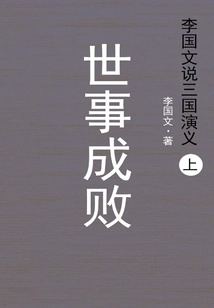
Li Guowen Talks About the Romance of the Three Kingdoms (part 1): Success or Failure in World Affairs
by Li Guowen
About This Novel
"Li Guo Wen Shuo Three Kingdoms" is based on the original length of Li Guo's literary review "The Romance of the Three Kingdoms", reducing redundancy and adding new ones, and expanded it into 240 exquisite articles. The visualization insights are published in the most complete form for the first time. "The Romance of the Three Kingdoms" is the quintessence of Chinese culture, the most influential and widely circulated historical novel, and can be called a strange book in Chinese history. The famous contemporary literary writer Li Guowen, as a literary man, uses literature to reflect history, uses characters to radiate the times, and uses the past to reflect the present. He reviews books without being limited to books, and talks about history without being limited to history. He has insights and insights into the contemporary literary world, society, and nation, which shows the integrity and social responsibility of intellectuals. The upper part, "Success and Failure in World Affairs", focuses on the content of the first 40 chapters of "The Romance of the Three Kingdoms", with two comments per chapter. It is informative and has novel insights. It cites "Three Kingdoms", "Book of the Later Han Dynasty", "Historical Records", "Zi Zhi Tong Jian" and other historical documents. It is based on historical facts and expresses unique opinions based on the opinions of various scholars. It has high reference and guiding value for readers to understand the real history. While the writing is concise and elegant, it also takes into account the use of spoken language and slang. In a relaxed and interesting reading atmosphere, it infiltrates historical literature and spreads Chinese culture. The illustrations are interspersed with selected works from "The Chronicles of the Three Kingdoms" (Huang's edition in the late Ming Dynasty) and "The Romance of the Three Kingdoms with the Embroidered Portraits of the First Talent" (early Qing Dynasty). The illustrations of the classic embroidered portrait versions allow readers to gain a rich aesthetic experience.
Official Sources
What Readers Think
Rating
Community(0)
Rating
Community(0)