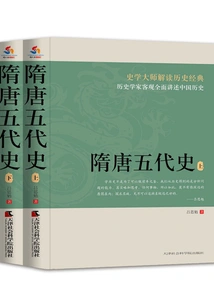
History of Sui, Tang and Five Dynasties (part 1 and 2)
by Lu Simian
About This Novel
This book fully embodies Lu Simian's historical research methods. From beginning to end, it is full of various methods of reading history and historical viewpoints. It is full of hidden hooks, vertical and horizontal openings and closings, and has sufficient historical materials. Each section is enough to complete a major paper. During the Republic of China, it was included in the monograph collection of the Chinese Academy of Qilu University, and later became a history textbook in colleges and universities across the country.
Official Sources
What Readers Think
Rating
Community(0)
Official(4)Scraped 2mo ago
📜In the turmoil of Sui, Tang and Five Dynasties, understand the "metabolism" of Chinese history
Mr. Lu Simian's "History of the Sui, Tang and Five Dynasties" is not a simple "chronological account of dynasties", but uses a historian's pen to cut through the historical texture - from "how the Guanlong Group held up the prosperity of the Sui and Tang Dynasties" to "why the Five Dynasties and Ten Kingdoms became a 'puzzle of troubled times'". He used a "reversal perspective" to break stereotypes and make the rise and fall of dynasties thousands of years ago a "mirror of history" that shines upon today. ✨Three "historical insights" that subvert cognition, it is amazing to read 1. The backside of the "Reign of Zhenguan": The prosperous age is not "pie in the sky" The teacher did not deny the great talent of Tang Taizong, but he also pointed out that the foundation of the "Zhenguan Rule" was the special environment of "vast land, sparsely populated areas, and no danger of annexation" after the war in the late Sui Dynasty. - The "remnants of the land equalization system" left behind by the exhaustion of Sui Yang's imperial power allowed the people of the early Tang Dynasty to "have farmland to farm"; - The "external vacuum" caused by the Turkic civil strife and the split of Goguryeo gave the Tang Dynasty a window period to recuperate. He wrote: "The success of the prosperous age is not the work of one person, but the result of the times and manpower." (Breaking the one-dimensional narrative of "sage kings create history" can be called the enlightenment of historical perspective!) 2. The Anshi Rebellion: Not only a "beautiful woman brings disaster", but also an inevitable consequence of the system's corruption Many people in the world criticize Concubine Yang for harming the country, but Mr. Yang goes straight to the core: - The collapse of the government's military system resulted in the central government having no troops to adjust, and the Jiedushi "holding powerful troops but the emperor has no authority"; - After the disintegration of the land equalization system, the number of refugees increased sharply. An Lushan's "Mixed Army of Hu and Han" was essentially a "troubled-time armed force" that absorbed a large number of unemployed vagrants. The sentence "The roots of rebellion were buried under the prosperity of the Kaiyuan Dynasty" expresses the historical law of "prosperity and decline" - it turns out that the real historical lesson is never to "prevent a certain person", but "to guard against the long-lasting disadvantages of the system." 3. Five Dynasties and Ten Kingdoms: The code of the "Tang and Song Dynasty changes" was hidden in troubled times During this period that was considered "chaos," Mr. Wang saw progress: - The noble gentry was completely wiped out (Zhu Wen killed all the "Baimayi Qingliu"), and the imperial examination system truly became the "passage to the rise of poor families"; - Commercial towns emerged, "Jiaozi" sprouted in Shu, and citizen culture began to emerge (half a century earlier than the Song Dynasty). He said: "The Five Generations Change was a 'painful transition' from aristocratic politics to civilian politics - when the old order collapsed, the seeds of a new civilization had already broken ground in the ruins." 🌟Why is it said that this is the "ceiling for entry-level history reading"? Three "hard core" reasons] - "Overturning the verdict" is not arbitrary and relies entirely on historical data: Every time he raises a point of view, he must quote original historical materials such as "Old Tang Book" and "Zi Zhi Tong Jian" for comparison - for example, to examine the "Xuanwu Gate Change", he not only lists the "Justice Narrative" in "Tang Book", but also extracts the "Li Yuan Faction Records" from "Datang Entrepreneurship and Living Notes", allowing readers to see for themselves the "game of positions in historical writing." - "Small incision" meets "big context", reject fragmentation: It seems to be talking about the "Party Struggle between Niu and Li", but in fact it connects the "confrontation between the imperial examination system and the remnants of the clan"; when writing about "Huang Chao Uprising", it digs into the "problems of heavy taxes and refugees since the middle Tang Dynasty" - every historical event is the result of the interweaving of "economy, system and human nature", and reading it is like solving a complex historical equation. - The language is as sharp as a knife, but it hides realistic concerns: He wrote "The Sui Dynasty was overthrown by eagerness for quick success (the Grand Canal and the conquest of Goguryeo)", and he changed his writing style: "Governing a country is like controlling a flood. Rapid dredging will lead to collapse, slow steering will lead to peace." It seems to be talking about the past, but in fact he is talking about the "rhythm of development"; he wrote "Five generations of military generals caused chaos in government", and lamented: "If there is no check and balance on power, even an ordinary man can become a tiger." Between the lines, there is a soberness of "viewing the present through history". 📝One sentence summary: Reading Lu Simian is to "remove makeup" from history Different from the "story-based packaging" of popular history, this book shows you the "plain face" of history - there are shadows in prosperous times, new opportunities hide in troubled times, the current situation is behind the heroes, and there are accumulated disadvantages at the feet of the ignorant king. After reading and closing the volume, I suddenly understood what my husband said: "Learning history is not to remember years and events, but to learn to 'see clearly how something became what it is today.'" From the "Three Provinces and Six Ministries" of the Sui and Tang Dynasties to the "Primary Privy Council" of the Five Dynasties, from the equalization of land to the rent-and-yong adjustment method, the "historical logic" hidden in institutional changes still affects the way we understand the world.
I have never eaten pork, but I can watch the pigs running.
Zhong Ling had been drunk for more than ten springs and saw Yunying's upper body again. I haven't become famous yet, but I haven't married yet, so I may be inferior to others.
The theory comes from history, the historical materials are rich, and the historical commentary is questionable.
The above is my three-point summary of the characteristics of this book. First of all, this book is based on history. It can be said that no matter whether the point of view is doubtful, there is no point of view that is not derived from historical materials, which reflects the author's more rigorous view of historical research. Therefore, the historical materials cited in this book are also very rich. Unfortunately, it is possible that due to layout problems, historical materials and historical reviews are mixed together and it is difficult to distinguish, which affects the reading experience. Finally, let me talk about my feelings about the author's historical review. The author's evaluation of the Sui and Tang emperors is too low. Personally, I think this may be because the author has been in the Republic of China for a long time. The Republic of China was the low point of the development of Chinese culture. People have a skeptical or even derogatory attitude towards Chinese history. This is a limitation of the author's era, and it seems that there is no need to criticize him harshly. Nowadays, people are in a prosperous age and should respect Chinese history.
Rating
Community(0)
Official(4)Scraped 2mo ago
📜In the turmoil of Sui, Tang and Five Dynasties, understand the "metabolism" of Chinese history
Mr. Lu Simian's "History of the Sui, Tang and Five Dynasties" is not a simple "chronological account of dynasties", but uses a historian's pen to cut through the historical texture - from "how the Guanlong Group held up the prosperity of the Sui and Tang Dynasties" to "why the Five Dynasties and Ten Kingdoms became a 'puzzle of troubled times'". He used a "reversal perspective" to break stereotypes and make the rise and fall of dynasties thousands of years ago a "mirror of history" that shines upon today. ✨Three "historical insights" that subvert cognition, it is amazing to read 1. The backside of the "Reign of Zhenguan": The prosperous age is not "pie in the sky" The teacher did not deny the great talent of Tang Taizong, but he also pointed out that the foundation of the "Zhenguan Rule" was the special environment of "vast land, sparsely populated areas, and no danger of annexation" after the war in the late Sui Dynasty. - The "remnants of the land equalization system" left behind by the exhaustion of Sui Yang's imperial power allowed the people of the early Tang Dynasty to "have farmland to farm"; - The "external vacuum" caused by the Turkic civil strife and the split of Goguryeo gave the Tang Dynasty a window period to recuperate. He wrote: "The success of the prosperous age is not the work of one person, but the result of the times and manpower." (Breaking the one-dimensional narrative of "sage kings create history" can be called the enlightenment of historical perspective!) 2. The Anshi Rebellion: Not only a "beautiful woman brings disaster", but also an inevitable consequence of the system's corruption Many people in the world criticize Concubine Yang for harming the country, but Mr. Yang goes straight to the core: - The collapse of the government's military system resulted in the central government having no troops to adjust, and the Jiedushi "holding powerful troops but the emperor has no authority"; - After the disintegration of the land equalization system, the number of refugees increased sharply. An Lushan's "Mixed Army of Hu and Han" was essentially a "troubled-time armed force" that absorbed a large number of unemployed vagrants. The sentence "The roots of rebellion were buried under the prosperity of the Kaiyuan Dynasty" expresses the historical law of "prosperity and decline" - it turns out that the real historical lesson is never to "prevent a certain person", but "to guard against the long-lasting disadvantages of the system." 3. Five Dynasties and Ten Kingdoms: The code of the "Tang and Song Dynasty changes" was hidden in troubled times During this period that was considered "chaos," Mr. Wang saw progress: - The noble gentry was completely wiped out (Zhu Wen killed all the "Baimayi Qingliu"), and the imperial examination system truly became the "passage to the rise of poor families"; - Commercial towns emerged, "Jiaozi" sprouted in Shu, and citizen culture began to emerge (half a century earlier than the Song Dynasty). He said: "The Five Generations Change was a 'painful transition' from aristocratic politics to civilian politics - when the old order collapsed, the seeds of a new civilization had already broken ground in the ruins." 🌟Why is it said that this is the "ceiling for entry-level history reading"? Three "hard core" reasons] - "Overturning the verdict" is not arbitrary and relies entirely on historical data: Every time he raises a point of view, he must quote original historical materials such as "Old Tang Book" and "Zi Zhi Tong Jian" for comparison - for example, to examine the "Xuanwu Gate Change", he not only lists the "Justice Narrative" in "Tang Book", but also extracts the "Li Yuan Faction Records" from "Datang Entrepreneurship and Living Notes", allowing readers to see for themselves the "game of positions in historical writing." - "Small incision" meets "big context", reject fragmentation: It seems to be talking about the "Party Struggle between Niu and Li", but in fact it connects the "confrontation between the imperial examination system and the remnants of the clan"; when writing about "Huang Chao Uprising", it digs into the "problems of heavy taxes and refugees since the middle Tang Dynasty" - every historical event is the result of the interweaving of "economy, system and human nature", and reading it is like solving a complex historical equation. - The language is as sharp as a knife, but it hides realistic concerns: He wrote "The Sui Dynasty was overthrown by eagerness for quick success (the Grand Canal and the conquest of Goguryeo)", and he changed his writing style: "Governing a country is like controlling a flood. Rapid dredging will lead to collapse, slow steering will lead to peace." It seems to be talking about the past, but in fact he is talking about the "rhythm of development"; he wrote "Five generations of military generals caused chaos in government", and lamented: "If there is no check and balance on power, even an ordinary man can become a tiger." Between the lines, there is a soberness of "viewing the present through history". 📝One sentence summary: Reading Lu Simian is to "remove makeup" from history Different from the "story-based packaging" of popular history, this book shows you the "plain face" of history - there are shadows in prosperous times, new opportunities hide in troubled times, the current situation is behind the heroes, and there are accumulated disadvantages at the feet of the ignorant king. After reading and closing the volume, I suddenly understood what my husband said: "Learning history is not to remember years and events, but to learn to 'see clearly how something became what it is today.'" From the "Three Provinces and Six Ministries" of the Sui and Tang Dynasties to the "Primary Privy Council" of the Five Dynasties, from the equalization of land to the rent-and-yong adjustment method, the "historical logic" hidden in institutional changes still affects the way we understand the world.
I have never eaten pork, but I can watch the pigs running.
Zhong Ling had been drunk for more than ten springs and saw Yunying's upper body again. I haven't become famous yet, but I haven't married yet, so I may be inferior to others.
The theory comes from history, the historical materials are rich, and the historical commentary is questionable.
The above is my three-point summary of the characteristics of this book. First of all, this book is based on history. It can be said that no matter whether the point of view is doubtful, there is no point of view that is not derived from historical materials, which reflects the author's more rigorous view of historical research. Therefore, the historical materials cited in this book are also very rich. Unfortunately, it is possible that due to layout problems, historical materials and historical reviews are mixed together and it is difficult to distinguish, which affects the reading experience. Finally, let me talk about my feelings about the author's historical review. The author's evaluation of the Sui and Tang emperors is too low. Personally, I think this may be because the author has been in the Republic of China for a long time. The Republic of China was the low point of the development of Chinese culture. People have a skeptical or even derogatory attitude towards Chinese history. This is a limitation of the author's era, and it seems that there is no need to criticize him harshly. Nowadays, people are in a prosperous age and should respect Chinese history.