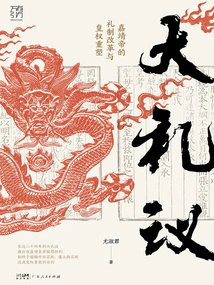
Great Etiquette Discussion: Emperor Jiajing's Etiquette Reform and Reshaping of Imperial Power
by You Shujun
About This Novel
After the death of Emperor Zhengde, he had no children. Zhu Houcong, the crown prince of Xingfan, succeeded him as Emperor Jiajing. All civil and military officials asked him to succeed him. As his heir, he recognized his cousin Emperor Hongzhi as his father and called his biological father uncle. This triggered a "Great Ceremony" that shocked the court for twenty-four years. In order to honor his biological parents, Emperor Jiajing did not hesitate to use force to suppress the group of officials who protested in Fuque, leading to the Zuoshunmen massacre; he compiled the "Minglun Dadian" to construct a theoretical text on the legitimacy of imperial power; he fabricated charges to block the way of speech and stifled the policy of "serving the king as a teacher" among scholars. The ideal of governance; the constant changes in national etiquette and laws, called "restoring the ancestral system", actually improved the political status of the biological father and consolidated his own imperial power; he also controlled the ministers, expanded the power of the cabinet, changed chief ministers several times, and the political atmosphere of the court declined, creating conditions for intensified party struggles. This book studies the changes in the political culture of the Jiajing Dynasty in the Ming Dynasty through the "Great Ceremony" incident, especially the issue surrounding the entry of Emperor Jiajing's biological father, God Zhu Youqi, into the Nephew Ancestral Temple. Jiajing monarchs and ministers argued with each other for many years. In the end, Emperor Jiajing got his wish and named his biological father the ancestral temple, which also achieved the purpose of reshaping imperial power and transforming a small sect into a large ancestral temple. However, Emperor Jiajing shook up the political and cultural system based on "rituals", privatized imperial power, and confused the status and etiquette, which led to political turmoil, conflicts between emperors and ministers, and social disorder crises in the middle Ming Dynasty, and even the gradual collapse and disintegration of the political order in the late Ming Dynasty.
Official Sources
What Readers Think
Rating
Community(0)
Rating
Community(0)