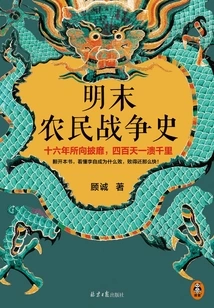
History of Peasants' War in the Late Ming Dynasty
by Gu Cheng
About This Novel
He was invincible for sixteen years, and fell thousands of miles away in four hundred days. Open this book and understand why Li Zicheng failed, and he failed so quickly! In March 1644, Li Zicheng invaded Beijing and the Ming Dynasty fell. He had been fighting for sixteen years. In April of the same year, Li Zicheng was defeated at Shanhaiguan and the Qing army entered the pass. In May of the following year, Li Zicheng sacrificed his life in Jiugong Mountain in Huguang, only 400 days before the fall of the Ming Dynasty. Public opinion lost ground: Dashun's army intensified torture and torture during the pursuit of stolen goods, and the Jin gentry was disgraced. In order to gain a foothold in Han territory, the Qing army aggressively sought to win over Han officials, gentry and landlords. These people had been attacked by the peasant army and all welcomed the Qing army. Strategic mistake: In Dashun's mind, the Ming and Qing wars were a matter of the previous dynasty. They did not have any enemies with the Qing Dynasty, so they could live in peace. They thought that after Wu Sangui surrendered, the Northeast issue would be solved, and the Qing army would be ignored. Misplacement of personnel: Dashun Army lacks a group of strategic talents who can look at the world and coordinate the overall situation. However, the Qing court recruited a group of "guides" such as Fan Wencheng and Hong Chengchou before entering the customs.
Official Sources
What Readers Think
Rating
Community(0)
Official(5)Scraped 1mo ago
Study hard and work hard every day!
This book is an academic masterpiece that explores the history of peasant wars in the late Ming Dynasty.
This book is written in chronological order and has smooth logic. It not only completely presents the entire process of the peasant uprising from the Wanli period to the early Qing Dynasty, but also provides a relatively objective verification of the necessary historical events and characters. Although it cannot be said to be a final conclusion, it also clarifies many important issues, such as the gains and losses of the Dashun regime. It cites abundant historical materials, making the argument based on history and well-founded. In short, it is an excellent academic masterpiece with important academic value. A possible problem with this book is that its historical perspective is slightly outdated. Since this book was written in the 1980s, its historical perspective is still the revolutionary class historical perspective that was prevalent from the 1950s to the 1970s. This book frequently refers to the peasant war in the late Ming Dynasty as revolution. Words such as revolution and consciousness abound when analyzing the problem. However, I personally believe that there is no analogy between the peasant wars in the late Ming Dynasty (actually throughout Chinese history) and modern revolutions. Peasants are not representatives of advanced productive forces and cannot propose a political program that transcends feudal society. Therefore, the result is either failure or rapid transformation into the landlord class. Therefore, even if Li Zicheng and Zhang Xianzhong succeed, it is just a change of feudal dynasty and cannot be compared with modern revolutions in which the class that has mastered advanced productive forces replaces the backward class. When we look at the peasant wars in ancient China today, we should affirm that the people have the right to resist. That is, in the face of tyranny, the people have the right to resist through violent means, overthrow it and restore order. That is, it is not guilty to resist but justified.
After reading this book, I realized that all the people need is a piece of land to fill their stomachs and survive. But always can't get it. Especially at the end of the dynasty, natural disasters, officers, bandits and soldiers are shocking.
The peasant war in the late Ming Dynasty was a resistance against the reactionary class. Although it was difficult to escape the comfort of the times and classes, it still showed considerable progress and advancedness, as well as resoluteness in the face of class struggle.
From the beginning of the Ming Dynasty, the overall structure, especially finance, was inherently deficient. After the middle of the Ming Dynasty, it has become difficult to recover, and class conflicts have reached an unprecedented level.
Rating
Community(0)
Official(5)Scraped 1mo ago
Study hard and work hard every day!
This book is an academic masterpiece that explores the history of peasant wars in the late Ming Dynasty.
This book is written in chronological order and has smooth logic. It not only completely presents the entire process of the peasant uprising from the Wanli period to the early Qing Dynasty, but also provides a relatively objective verification of the necessary historical events and characters. Although it cannot be said to be a final conclusion, it also clarifies many important issues, such as the gains and losses of the Dashun regime. It cites abundant historical materials, making the argument based on history and well-founded. In short, it is an excellent academic masterpiece with important academic value. A possible problem with this book is that its historical perspective is slightly outdated. Since this book was written in the 1980s, its historical perspective is still the revolutionary class historical perspective that was prevalent from the 1950s to the 1970s. This book frequently refers to the peasant war in the late Ming Dynasty as revolution. Words such as revolution and consciousness abound when analyzing the problem. However, I personally believe that there is no analogy between the peasant wars in the late Ming Dynasty (actually throughout Chinese history) and modern revolutions. Peasants are not representatives of advanced productive forces and cannot propose a political program that transcends feudal society. Therefore, the result is either failure or rapid transformation into the landlord class. Therefore, even if Li Zicheng and Zhang Xianzhong succeed, it is just a change of feudal dynasty and cannot be compared with modern revolutions in which the class that has mastered advanced productive forces replaces the backward class. When we look at the peasant wars in ancient China today, we should affirm that the people have the right to resist. That is, in the face of tyranny, the people have the right to resist through violent means, overthrow it and restore order. That is, it is not guilty to resist but justified.
After reading this book, I realized that all the people need is a piece of land to fill their stomachs and survive. But always can't get it. Especially at the end of the dynasty, natural disasters, officers, bandits and soldiers are shocking.
The peasant war in the late Ming Dynasty was a resistance against the reactionary class. Although it was difficult to escape the comfort of the times and classes, it still showed considerable progress and advancedness, as well as resoluteness in the face of class struggle.
From the beginning of the Ming Dynasty, the overall structure, especially finance, was inherently deficient. After the middle of the Ming Dynasty, it has become difficult to recover, and class conflicts have reached an unprecedented level.