Japanese History·1600-2000: from the Tokugawa Shogunate to the Heisei Era
About This Novel
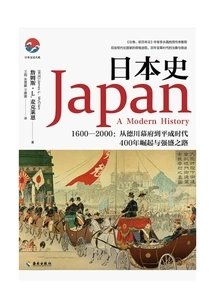
The content of this book spans four hundred years of history from the time when the Tokugawa shogunate was entrusted by the emperor to rule at Fushimi Castle to the Japanese New Year celebrations in 2000. It is divided into five parts: "Japan in the Traditional Era", "Japan in the Revolutionary Era", "Japan in the New Century", "Japan in the War" and "Contemporary Japan". From changes in the political situation to the rise of the business class, from the proletarian workers' movement to changes in gender concepts and family marriage customs, from colonization and war to occupation and democratization... The whole book uses a narrative that combines "big events" and "small stories" to provide an informative and informative Based on historical materials, data and charts, using an objective and neutral attitude towards history, and a panoramic line drawing writing technique, it depicts a multi-dimensional, group-portrait historical narrative for us, showing the setbacks and endeavors, failures and rises of Japanese society in the modernization transformation period.
Official Sources
What Readers Think
Rating
Community(0)
Official(1)Scraped 2mo ago
The overall flow is smooth but the perspective is a bit shallow
The military leader who unified the entire territory (or almost unified) for the first time in Japanese history was Oda Nobunaga. After the Honnoji Incident, Oda Nobunaga's retainer Toyotomi Hideyoshi inherited his mantle and became the new general. Before his death, Toyotomi Hideyoshi entrusted five ministers, one of whom was the Tokugawa family. Kang, but the latter obviously had greater ambitions, overthrew the Toyotomi family and became the new shogun - these things happened around 1600. At this time, during the Wanli period of the Ming Dynasty in China, Europe entered the Baroque period from the Renaissance, and the British established the East India Company. From Oda Nobunaga to Toyotomi Hideyoshi to Tokugawa Ieyasu, three generations of shoguns relied on force to unify or almost unify the entire territory. They realized the advancement of power and finance, but did not pursue becoming the masters of the country. This is very different from ancient Chinese history. Ancient Chinese military generals, whether they were born into noble families or were reckless, once they succeeded, they would have the will to rule the world. But none of the three generations of shoguns did this. Although they de facto ignored the imperial family, they still respected the imperial family in name. On the other hand, what I find quite interesting is that the shogun's rule at this stage is actually relatively loose or takes relatively few political/economic/cultural initiatives. After the shogun's campaign, he assigned the domain to various military families, that is, the "daimyos". There was not much unified policy that was strongly implemented from top to bottom, whether it was economic or administrative. The entire shogunate period in Japan, from today's perspective, looks like a loose underworld organization, with one boss leading a bunch of gangs, fighting mostly and little governance. And the scale of the fight was also very interesting. Tokugawa Ieyasu didn't even regain Ryukyu, but recognized the autonomy of the Ryukyu Kingdom. As a result, one of his subordinate daimyo led a 1,500-strong samurai group and attacked Ryukyu - isn't this the equivalent of a gang fight between two gangsters? [Yun Bei] In comparison, China had a very strict and rigorous feudal political system 1,000 years ago, and the British established the East India Company - which makes the shogunate era even more... Peculiar.
Rating
Community(0)
Official(1)Scraped 2mo ago
The overall flow is smooth but the perspective is a bit shallow
The military leader who unified the entire territory (or almost unified) for the first time in Japanese history was Oda Nobunaga. After the Honnoji Incident, Oda Nobunaga's retainer Toyotomi Hideyoshi inherited his mantle and became the new general. Before his death, Toyotomi Hideyoshi entrusted five ministers, one of whom was the Tokugawa family. Kang, but the latter obviously had greater ambitions, overthrew the Toyotomi family and became the new shogun - these things happened around 1600. At this time, during the Wanli period of the Ming Dynasty in China, Europe entered the Baroque period from the Renaissance, and the British established the East India Company. From Oda Nobunaga to Toyotomi Hideyoshi to Tokugawa Ieyasu, three generations of shoguns relied on force to unify or almost unify the entire territory. They realized the advancement of power and finance, but did not pursue becoming the masters of the country. This is very different from ancient Chinese history. Ancient Chinese military generals, whether they were born into noble families or were reckless, once they succeeded, they would have the will to rule the world. But none of the three generations of shoguns did this. Although they de facto ignored the imperial family, they still respected the imperial family in name. On the other hand, what I find quite interesting is that the shogun's rule at this stage is actually relatively loose or takes relatively few political/economic/cultural initiatives. After the shogun's campaign, he assigned the domain to various military families, that is, the "daimyos". There was not much unified policy that was strongly implemented from top to bottom, whether it was economic or administrative. The entire shogunate period in Japan, from today's perspective, looks like a loose underworld organization, with one boss leading a bunch of gangs, fighting mostly and little governance. And the scale of the fight was also very interesting. Tokugawa Ieyasu didn't even regain Ryukyu, but recognized the autonomy of the Ryukyu Kingdom. As a result, one of his subordinate daimyo led a 1,500-strong samurai group and attacked Ryukyu - isn't this the equivalent of a gang fight between two gangsters? [Yun Bei] In comparison, China had a very strict and rigorous feudal political system 1,000 years ago, and the British established the East India Company - which makes the shogunate era even more... Peculiar.