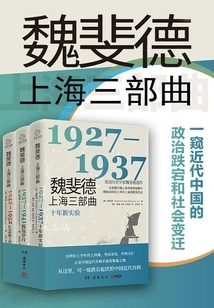
Wakefield's Shanghai Trilogy (complete Collection)
by I
About This Novel
This book systematically describes the process by which the Kuomintang government relied on police force to achieve initial rule over Shanghai from 1927 to 1937, and clarifies many historical issues during this decade: such as the relationship between the central system and local forces; the role of secret organizations and criminal groups in corroding party and government agencies; The evolution of Shanghai's political organization under the pressure of invasion and occupation, etc... "Wilfield's Shanghai Trilogy: 1937-1941": This book vividly reproduces the political and social situation of Shanghai as an "isolated island" from the 1937 Songhu Battle to the outbreak of the "Pearl Harbor Incident" at the end of 1941. It involves the anti-Japanese activities of the Kuomintang's "Blue Clothes Society" in Shanghai, the assassinations of pro-Japanese elements by the "military reunification", the bloody revenge of the Japanese puppets, the reign of terror of the Wang puppet regime, the ugly social phenomena in the "bad soil" area in western Shanghai, etc... With a unique perspective and informative materials, the book reproduces the entangled struggles and bloody storms of various forces in Shanghai's "isolated island" period. "Wilfield's Shanghai Trilogy: 1942-1952": This book tells the story of the establishment of secret party branches and other underground activities carried out by the Chinese Communist Party in Shanghai from the Japanese occupation of the Shanghai Concession in 1942 until the entire War of Liberation. As well as a series of transformation campaigns carried out by the people's power on Shanghai's municipal administration, police system and the entire society in the early days of Shanghai's liberation - such as closing the underground black market and cracking down on the opium trade; suppressing counterrevolutionaries, deporting refugees, reforming prostitutes, dancers and drug addicts, etc.
Official Sources
What Readers Think
Rating
Community(0)
Official(1)Scraped 1mo ago
It was precisely the contradictions of these police officers that aroused Wei Feide's serious curiosity when the information was released abroad. Started rigorous research
Rating
Community(0)
Official(1)Scraped 1mo ago
It was precisely the contradictions of these police officers that aroused Wei Feide's serious curiosity when the information was released abroad. Started rigorous research