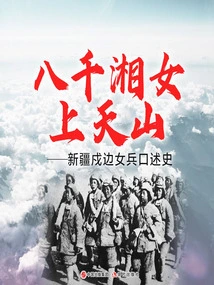
Eight Thousand Hunan Girls Went to Tianshan
by Lu Yiping
About This Novel
At the end of 1949, after the peaceful liberation of Xinjiang, the policymakers of the Republic ordered the 200,000 officers and soldiers stationed in Xinjiang to forge swords into plowshares, reclaim wasteland and farmland, and take root in Xinjiang, so as to change the situation in which the cultivation of land has been limited to one generation since the Han Dynasty. To achieve the strategic goal of long-term peace and stability. But "you can't settle down without a wife, and you can't put down roots without children." If the marriage problems of officers and soldiers are not resolved, it will affect the smooth realization of this strategic goal. Therefore, policymakers decided to recruit female soldiers to solve this problem. They first recruited 8,000 Hunan women. Most of these female soldiers are educated young people, including top university students, daughters of Kuomintang generals, and daughters of wealthy businessmen. With youthful dreams in mind, everyone marched for several months to reach the distant frontier. From then on, they began to interpret stories of joys and sorrows one after another in this vast Gobi desert, as well as their ideals and pursuits, glory and dreams. They gave birth to future generations and also gave birth to the spirit of love, tolerance, righteousness and perseverance. They are known as the "first generation mothers in the wasteland of Xinjiang". This reportage is written in the form of "oral narrative". The fate of the Hunan women reported in it is actually the epitome of the fate of eight thousand Hunan women. It is a collective memoir of the female soldiers who entered Xinjiang, a document narrated by them, and a historical testimony. It is the first comprehensive revelation of historical facts that have been dusted away, and an effort to restore the obliterated public memory. To write this book, the author spent five years, revised the manuscript three times, and visited hundreds of Hunan women in Hunan, Beijing, Sichuan and the Xinjiang Production and Construction Corps. After some chapters were published and serialized in newspapers and periodicals, they received a strong response and won the China Reportage Award and the Kunlun Literary Award.
Official Sources
What Readers Think
Rating
Community(0)
Rating
Community(0)