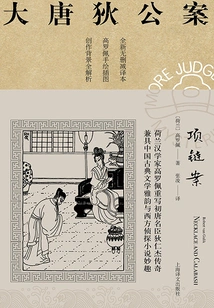
The Necklace Case (the Case of Di Gong in the Tang Dynasty)
About This Novel
The Dutch sinologist Roberto Gorope rewrites the legend of Di Renjie, a famous official in the early Tang Dynasty, combining the elegance of Chinese classical literature with the fun of Western detective novels. It is a brand new unabridged translation with a full analysis of the creative background. The translator has studied Gao Luopei for many years and is responsible for the translation alone to ensure a unified writing style. "The Case of Di Gong of the Tang Dynasty" successfully created "China's Sherlock Holmes" and was translated into and published in many foreign languages, leaving a significant mark in the history of cultural exchanges between China and the world. Fifteen versions of the translated version of "The Case of Di Gong of the Tang Dynasty" are planned to be published. Zhang Ling, who has studied Gao Luopei for many years, is responsible for the translation and writes annotations and postscripts that are both academic and readable. It is currently the only version on the market that has been independently translated by one person. The third volume of "The Case of Di Gong in the Tang Dynasty" includes "Purple Cloud Temple", "Liu Garden Picture", "Guangzhou Case", "Necklace Case" and "Mid-Autumn Festival Case". "The Necklace Case" tells the story of Judge Dee who passed by Hechuan Town when he was the magistrate of Puyang County and solved the murder case of the accountant, the necklace theft case and the disappearance of the woman alone.
Official Sources
What Readers Think
Rating
Community(0)
Official(2)Scraped 21d ago
Very beautiful, well written
Everything is empty
Mr. Calabash compares himself to a bronze mirror, which reminds people of the Buddhist "mirror metaphor". All dharmas arise due to causes and conditions, are constantly changing, and are constantly arising and dying, just like the illusion in a mirror, all appearances are empty. Only by transcending all tangible mirror images can we find the mirror itself that generates all mirror images.
Rating
Community(0)
Official(2)Scraped 21d ago
Very beautiful, well written
Everything is empty
Mr. Calabash compares himself to a bronze mirror, which reminds people of the Buddhist "mirror metaphor". All dharmas arise due to causes and conditions, are constantly changing, and are constantly arising and dying, just like the illusion in a mirror, all appearances are empty. Only by transcending all tangible mirror images can we find the mirror itself that generates all mirror images.