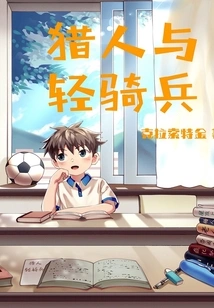
Hunters and Hussars
by Krasotkin
About This Novel
"Why are we, the spirits of all things, not as good as a small tree?" Write a campus story about children's growth and think about life and death from a child's perspective. Ke Peiwei, a first-year student in Jiangyuan No. 1 Middle School, is a slow and withdrawn child. Under the influence of his younger brother Ke Peixian, who loves football, he becomes a good goalkeeper. However, his younger brother has passed away long ago, and his elder brother has never been able to get out of the haze of the past. Nothing seems to attract his interest in life, and he is even more afraid of contact with people. Mi Le, who lived in the same dormitory, unexpectedly entered his life, and the two became best friends. Kopeway gradually wanted to "find the lost time" and find out the real cause of his brother's death, but he was still confused and refused to take action. Without the upside-down golden hook of "Captain", in an ordinary and helpless story, would Sisyphus, who was burdened with a curse and pushed the boulder forever, be happy? "Hold the spring of life in my hands, I just feel it is fresh." In addition to the unbearable lightness and weight of life, literature may once again arouse love.
Official Sources
What Readers Think
Rating
Community(0)
Official(75)Scraped 1mo ago
Intertextuality and tribute, dialogue with literary classics
"The text of any work is composed like a mosaic of many texts, and any text is the absorption and transformation of other texts." - Julia Kristeva Although it is not possible to know the major that the author studied, judging from the content of the novel, he must have participated in the school literary club and had a certain understanding of literature. The best examples are classic texts that appear profusely in novels. The poems of Mu Dan (including such a character in the novel) and Georges Perec appear in the first chapter, and Proust appears in the second chapter. Later, Wen Tianxiang, Cao Yu, Zhang Ailing, Su Shi, Lu Xun, Cervantes, Stendhal, Balzac, and Plato are mentioned. The list of banned books in the second half is more interesting. Most of the contents of the works are indeed as Miller said, involving the issue of suicide (but from Keke's self-report, I don't think he is a suicidal child), as well as a lot of family discord and childhood trauma. There is no doubt that the sister created this book list to protect her younger brother (as a person who loves literature very much, she is banning books. This is also a bit ironic and playful. The world of daily life and the world of literature are different after all), even though this method may not be appropriate. Ke Ke's biggest dilemma is the death of his younger brother, or the responsibility he should bear in this devastating event. It's not clear what the responsibility is, and even if it were, it would be difficult to bear because the brother is gone forever. Therefore, he lives in a hazy and muddle-headed way, and as he grows older, he becomes less and less willing to interact with others. Getting along with Mi Le was just as he thought during the midterm exam. He was pushed to this position and happened to bump into Mi Le who was in need of comfort. In fact, this kind of problem is exactly related to the blood of others, and it is an existential problem. Ke Ke is not a very active person. The most decisive moment for him is when he is a goalkeeper and wants to make a save in the game. The personality on the court is not the same as in daily life. But Keke's decisiveness on the court may be the key to his ultimate solution to the problem. Proust and Perec are writers of two styles. The former recalls the past, while the latter's childhood is fragmented and incomplete. Ke Ke seems to be somewhere in between the two. He had wonderful childhood memories, but they were suddenly shattered. He recalled the past many times and imagined his brother's face, but it became increasingly difficult for him. The dream in Chapter 10 is very exciting. It is a maze of mirrors and a lake of death. The deeper you sink, the less you can see the vast world outside. The historical issues discussed by Ke Ke and Teacher Huang also originated from Plato's theory of imitation, the mirror image of mirror. Ke Ke wants to pursue the truth, but it can never be completely restored. This is a long-discussed literary and philosophical issue. Maybe there is no need to completely "restore" it, just like in the last chapter, Keke stood in the midfield position and rushed to the penalty area. He had no time to think about what his younger brother would do, and chose to pass the ball instead of shooting based on his own judgment. I think Keke can just be himself and don't have to imitate his younger brother. Allowing yourself to be yourself is the best memorial to your brother. But what does this "self" mean? Freedom of movement and acceptance of responsibility. Whether it is Ke Ke or Milo, if they want to become a man from a boy, this is the only way.
Summarize the pitfalls of the first 20 chapters!
1. The final dialogue in Chapter 20 is undoubtedly the biggest pitfall of the book. It's scary if you think about it carefully (it turns into a detective novel). What was the reason for his brother's death? Since there was no heart attack, something else must have happened. What kind of responsibility does Ke Ke have for this matter? Why did the whole family keep lying to him? (Maybe to protect him?) 2. Ke Ke. As mentioned in that very high-end existential book review, Ke Ke's thinking about self-existence and his gradual growth are the basic clues. What Keke needs is to reconcile with his past self. The dream in Chapter 10 seems to reveal his situation. He is lost in the maze of life, and with his current muddled life, it is difficult to see the wider and more wonderful world. 3. Miller. As the second male lead, Mi Le has a very strong sense of empathy, is very sunny and very motivated. I believe he is a character that everyone will like. He occasionally loves to play and be lazy like an ordinary child. He is more suitable than Keke as the protagonist in children's works. Rather than saying that Ke Ke takes good care of him as an outsider, it is better to say that he has been taking care of Ke Ke. But he seems to be more of a companion, and he is still getting closer to Ke Ke, believing that Ke Ke will open himself to him in the future. He is not only Keke's new brother, he also has his own story. Growing up under the gaze of others, he still needs to find more things of his own and maintain them. 4. String string. I think the deceased brother is one of the most important characters in the novel, and may be consistent with Mi Le's status. A large amount of space is dedicated to Ke Ke's memories of his younger brother, but Ke Ke constantly questions the reliability of his memories, and it is difficult for readers to understand Xianxian through other means other than Ke Ke: there is not even a photo of him. In addition to the reason for his death, what kind of person Xianxian was is also a matter of suspense. In addition to reminiscing about him, Ke Ke seems to be trying to become like him (the spirit when playing football, the choice of jersey numbers, etc.), He seems to be the mirror in front of Ke Ke. Mirroring is a recurring image in the novel. Ke Ke's image is a bit mixed with that of his younger brother. Very interesting. 5. Sister. My cousin feels a bit strong, has good grades, and is a bit mysterious. She is the only one of the main characters with only half of her name (if you don't count Meimei, she has only appeared twice, once in a dream), and she is still engaged in "underground work." It makes no sense that she wants to protect Ke Ke, although the method may not be reasonable. She probably knows the truth behind Xianxian's death. Also, I feel like Ke Ke is a bit sisterly. 6. Zhao Rui. It may not be very reasonable to put him in this position, but judging from the existing content, Zhao Rui is a very important character, even if he has always been disliked by the protagonist (and Ke Ke's assumptions about him are biased or even malicious). In fact, we should be able to find that the only thing Ke Ke is better than Zhao Rui is playing football. Zhao Rui is actually better in terms of performance and conduct, and has a very good personality. He should also be one of the insiders and may be a witness to the incident. 7. Ye Ruiyang. Ke Ke's deskmate is a young basketball player, a very typical junior high school boy, very capable, but very reliable in doing things, and his actual life ability is better than both Ke Ke and Mi Le. The only thing that can be seen now is that he and his father are not getting along well, and there should be other plots later. His cp Brother Chuan plot is even less. 8. He Mingming. Mainly due to technical issues, I feel that he is the most mentally healthy among all the children. 9. Zhang Taotao. It reminds me a bit of Hinata Kojiro, but he is too taciturn and has a thin sense of presence. There seems to be no strong character in this novel. His mother asked Miller about his score line. Maybe his score was not ideal. 10. Huang Minxue. His style of play was very controversial, and there was a wave of hatred at the beginning, and he felt like a character who was at odds with him. To be unfolded, maybe it will change later, or Keke will accept him. 11. Mu Dan. The football champion that appears in every story? Very polite, he's someone else's child, his story line hasn't appeared yet. 12. Yan Xi. Completely different from Mu Dan's style. In fact, he scored a lot of goals in the class, but it seemed that no one paid much attention to him. The strength should be very strong. 13. Yue Yin. The image is still very thin right now, so I hope the girls won't be too stereotyped. 14. Xu Mu. A band line besides literature and football? Vocalist Mu Dan, guitarist Huang Minxue, and drummer Xu Mu happened to be classmates in elementary school, and they were missing a bassist. 15. Meimei. Does this person really exist? Don't tell me it was Keke's split personality... 16. Adults. I feel like Teacher Zhou, Coach Wang, Teacher Huang, parents... I feel like they have nothing to say. 17. Jiangyuan and Nanjing! As a Nanjing native, I can find a lot of content related to my hometown in the novel, such as Nanjing Foreign Language School, Xinjiekou, Nanjing North Railway Station, Yanziji, and the Memorial Hall of the Victims... But the author keeps saying that Jiangyuan is not Nanjing. In addition to avoiding corresponding schools and specific people, is there any other purpose?
An exploration of existential children's literature
Have you finished reading Perec's W or Memories of Childhood? If it is regarded as serious literature, it can be seen that the thinking on ontology has the meaning of existential literature to a certain extent. Some passages remind people of Heidegger, Beauvoir or Camus. Most of the current children's literature creations in our country have not been able to get rid of the "lower age", and many works can only be said to be stories, not literature. It is an attempt to adopt the attitude of literary creation to write for children. The biggest highlight is the protagonist's discovery and thinking of "self", which is extremely inspiring. But the question is, can children understand? In order to prevent the novel from becoming an obscure philosophical speculation, the presence of a large amount of dialogue reduces the literary quality of the text. Nor can the novel truly reproduce Perec's experimental writing. The intended readers of this work should be at least junior high school students.
cute boys
A book filled with vitality~ The young ladies are so cute! Although I don't know much about football, this cute and cute painting style is still very attractive. It would be great if it could be adapted into a comic! Miller is the cutest character in the book. I went to check the number on his back, Rahmiel, the love angel Ramiel. Sure enough, Miller is the little angel🦆He has the attribute of scoring goals when he comes on the field. He is really lucky! Many small gestures off the field are also very warm and considerate! But my destiny is to learn! A super cool guitar boy. He blushed in the locker room after winning the experiment. I really wish someone could draw a picture of him. He is actually a very sunny kid at ordinary times. Even when he is bad, he is also lovable. Especially when he is injured, he does not say a word. I really love him. The third one is very difficult to arrange, Ke Ke Xianxian and Mu Dan are both good, even Boss Ye occasionally pokes me! The current cp of this book is as follows! Cola! Official cp! Wei Xian! Forever twins 😭 Weiwei + sister (?) Are you really not going to give your sister a name? Sister + Zhao Rui, sister seems to be named Zhao too? Is Zhao Rui related to them? Sister + Yue Yin, hahahahahaha, it's really interesting for girls to quarrel over football. On the contrary, Brother Chuan has never quarreled with Ye Ruiyang over football games. Yangchuan, locked together! Mu Xue, locked +1! Xu Mu should be with Mu Dan~ But the part where she and Xue Xue quarreled was really interesting~ The band still lacks a bassist Ruixian, I can't seem to forget this. As other book reviews said, Zhao Rui must have his role. Obviously she seems to be compatible with Ke Ke's sister Yue Yin. Let's raise a dog with Yue Yin~ Taotao and Yan Xi don't seem to have CP yet! What follows is a cult! Science! Ke Ke and Xue Xue seem to have completely different painting styles, but I always feel that there will be a story in the future Mu Ke, hahahahahahaha, it's a drama, I think of Mu Guiying~ Ye Ke, deskmate ~ Ye Ruiyang actually cares about Ke Ke! Mi Yang, at the end of the first volume, the interaction between Mi Le and Ye Ruiyang increased, but they still stood firmly on Coke🥤 Mi Le + Sister, a spy combination? Mi Xian, Mi Le calls Xianxian very special. He will call him brother, but he has never called him Ke Ke like that. Happy to learn, the cutest in the book! (The old face turns red
Delicate writing style, sincere feelings, profound literary skills, and focus on reading and learning
My children like football, are obsessed with football, and follow suit
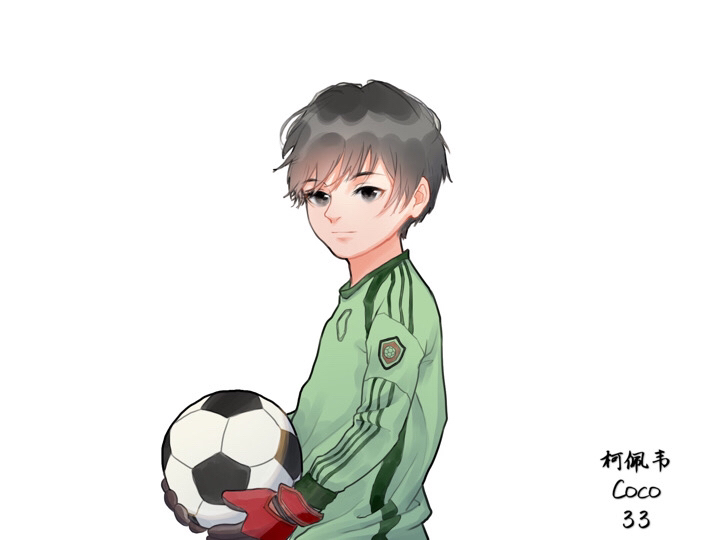
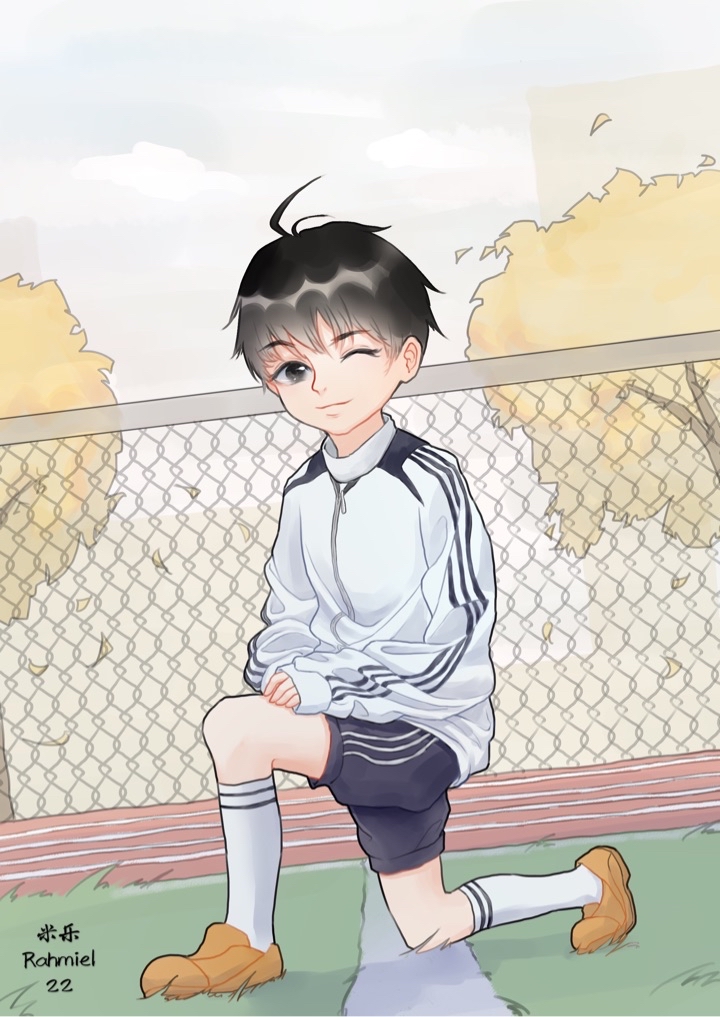
Character painting is here
Ke Ke and Mi Le ~ I wonder if they are similar to everyone's imagination? I'm thinking about who will be next, probably Mu Dan or Xuexue hhhhhhh
Excerpts of good sentences
Continue to update good sentences and paragraphs in the novel! Chapter 1 The old people and children who burned the paper have left, and unburned and burned ashes are floating in the air. After all, burning is a short-lived thing, and ashes are lasting. The reeds will die, the fire will cool down, and only the sun will rise in the east and set in the west, always moving. For us, the only thing we can be sure of is that we are moving non-stop in the direction where the sun sinks, and eventually become the name Ashes is looking for in another world. Chapter 2 In fact, art can also make people strong, and sports can also teach people warmth. I always believe that education is about letting people learn how to discover themselves and express themselves. Whether literature, football, science, art, or sports, they are all ways of exploration and expression. And it is these things that connect countless people who do not know each other. Chapter 3 When children are alone outside, they usually report good news but not bad news to the family. If you tell them, your parents may not be able to help solve it. Instead, they will double the same troubles and add them to them. Most sensible children don't want to complain to their parents, and most often talk to their friends.
Does youth equal rebellion?
As a parent, I have been accustomed to believe that children will inevitably enter a rebellious period or adolescence after entering junior high school. They will not listen to adults and will oppose their parents in everything. This situation also exists objectively. But now that I think about it, children no longer obey their parents as they did when they were young. Perhaps, as the novel says, they have discovered themselves and found that they can do many things according to their hearts, so it is inevitable that they will have differences with their parents. In the book, Xiaoye's classmate does not have a harmonious relationship with his father, but judging from the description of the protagonist, this child is still very conscious, very diligent, has good academic performance, can also play football, and always has a solution when encountering problems. He is like the little eldest among the children, and he is also very good to his mother. Perhaps parents should truly respect such a child and listen patiently to his ideas instead of using words like rebellion or adolescence to shape their own authority. Of course, when you encounter an unconscious child, you still need to take care of it. Most of the children in the book are very good, sunny and energetic, and have all-round development. Parents are most at ease with a child who has a full understanding and plan for himself and knows what he should do. But there are certain problems with this. For example, Xiaomi seems to be under too much pressure. Besides playing football, he always thinks about studying and getting good grades. We do have many children and parents falling into this pattern now. The parents are responsible for making money and providing logistics, and the children are responsible for studying. There is a lack of communication. Although they all think about each other, it may not be happy in the long run. But what can be done? Social competition is becoming more and more fierce, and everyone has to work hard to live.
Check in at the Internet Literature Department
Support from the Literary Department of Ningmu. Com! Love Miller! Keke, stop being autistic!
Wall - blood of others - plague
Friends who are familiar with French literature or existentialism will probably be familiar with the three works in the title. Sartre, Beauvoir, Camus, to this day, these figures who were active in the last century still have a great influence on the literature, art and thought of the current world, and they are not limited to literary creation. Although classmates in the philosophy department may make fun of them a little when talking about them, this influence cannot be denied. And when reading Chapter 35 today, friends who know existentialism should not find it difficult to find that this novel not only has a strong brand of existentialism, but at some moments it even interprets Sartre or Beauvoir. Previously, Ke Ke and Mi Le had a night chat (just after visiting the Memorial Hall of the Victims on National Day). Mi Le believes that others are the most terrifying, while Ke Ke believes that he is the most terrifying person. Obviously, the concepts of "others are hell" and "others' blood" are thrown out. It is not just philosophical talk, it actually appears in the lives of children. Miller's problem is that he inevitably has to accept the scrutiny of others and doesn't know how to protect and maintain himself in the process. Relatively speaking, this problem is "light" and can be solved in a "light way". It is possible to transcend. Ke Ke's problem is "heavy" and "an unbearable weight in life." Although the novel is unfinished, it can be said that all of Keke's problems are the recurrence of that nightmare, and are all problems conveyed at the end of Sartre's "Wall". People's existence and choices not only affect themselves, but also affect others. Xianxian's death is proof. The choices Ke Ke made under the control of his emotions when he was too young left him unable to make up for the consequences for the rest of his life. This tragic story made Ke Ke realize the existence of human beings. The feeling at this moment is probably the title of another Sartre novel: nausea. So we can see that Ke Ke is a bit like the protagonist in Beauvoir's "The Blood of Others", who lacks the ability to move after the death of his friend. In "The Blood of Others", the protagonist regains his mobility when resisting the invasion, but Keke will not have such a chance. He was just a kid, a thirteen-year-old kid. So playing football is probably the only thing he can think of doing, because his younger brother likes football. So, is it possible to change this situation through football or literature? A chance appearance of Camus in a performance at a theater festival may be the answer. Susan Sontag said, "I am talking here, of course, of Albert Camus, the ideal husband of contemporary literature. As a contemporary, he had to traffic in the themes of madmen: suicide, apathy, guilt, absolute terror. But in doing so, he With an air of sophistication, moderation, ease, geniality and coolness that sets him apart from the rest, he starts from the prevailing nihilistic premises and then - solely by the power of his calm voice and tone - takes his readers along. This illogical leap out from the abyss of nihilism, towards humanistic and humanist conclusions which could not in any case be deduced from its premises, was Camus's genius, for which readers are indebted. Why do they evoke feelings of love on the part of the reader? Kafka evoked pity and fear, Joyce evoked admiration, Proust and Gide evoked respect, but apart from Camus, I can't think of any other modern writer who evokes love." Sisyphus never stops pushing the stone ball up the mountain. Perhaps the self-blame that Keke bears is also eternal, irreversible and irreversible. But is happiness possible? When Ke Ke discusses history and literature, he inevitably feels a sense of emptiness. But humanism and humanitarianism exist, just like his teachers and classmates. Ke Ke himself is also a very kind child. Maybe there will be an answer at the end of the novel. Although many of the moments are dark and depressing, I don't doubt that literature can evoke love and happiness at some point.
Rating
Community(0)
Official(75)Scraped 1mo ago
Intertextuality and tribute, dialogue with literary classics
"The text of any work is composed like a mosaic of many texts, and any text is the absorption and transformation of other texts." - Julia Kristeva Although it is not possible to know the major that the author studied, judging from the content of the novel, he must have participated in the school literary club and had a certain understanding of literature. The best examples are classic texts that appear profusely in novels. The poems of Mu Dan (including such a character in the novel) and Georges Perec appear in the first chapter, and Proust appears in the second chapter. Later, Wen Tianxiang, Cao Yu, Zhang Ailing, Su Shi, Lu Xun, Cervantes, Stendhal, Balzac, and Plato are mentioned. The list of banned books in the second half is more interesting. Most of the contents of the works are indeed as Miller said, involving the issue of suicide (but from Keke's self-report, I don't think he is a suicidal child), as well as a lot of family discord and childhood trauma. There is no doubt that the sister created this book list to protect her younger brother (as a person who loves literature very much, she is banning books. This is also a bit ironic and playful. The world of daily life and the world of literature are different after all), even though this method may not be appropriate. Ke Ke's biggest dilemma is the death of his younger brother, or the responsibility he should bear in this devastating event. It's not clear what the responsibility is, and even if it were, it would be difficult to bear because the brother is gone forever. Therefore, he lives in a hazy and muddle-headed way, and as he grows older, he becomes less and less willing to interact with others. Getting along with Mi Le was just as he thought during the midterm exam. He was pushed to this position and happened to bump into Mi Le who was in need of comfort. In fact, this kind of problem is exactly related to the blood of others, and it is an existential problem. Ke Ke is not a very active person. The most decisive moment for him is when he is a goalkeeper and wants to make a save in the game. The personality on the court is not the same as in daily life. But Keke's decisiveness on the court may be the key to his ultimate solution to the problem. Proust and Perec are writers of two styles. The former recalls the past, while the latter's childhood is fragmented and incomplete. Ke Ke seems to be somewhere in between the two. He had wonderful childhood memories, but they were suddenly shattered. He recalled the past many times and imagined his brother's face, but it became increasingly difficult for him. The dream in Chapter 10 is very exciting. It is a maze of mirrors and a lake of death. The deeper you sink, the less you can see the vast world outside. The historical issues discussed by Ke Ke and Teacher Huang also originated from Plato's theory of imitation, the mirror image of mirror. Ke Ke wants to pursue the truth, but it can never be completely restored. This is a long-discussed literary and philosophical issue. Maybe there is no need to completely "restore" it, just like in the last chapter, Keke stood in the midfield position and rushed to the penalty area. He had no time to think about what his younger brother would do, and chose to pass the ball instead of shooting based on his own judgment. I think Keke can just be himself and don't have to imitate his younger brother. Allowing yourself to be yourself is the best memorial to your brother. But what does this "self" mean? Freedom of movement and acceptance of responsibility. Whether it is Ke Ke or Milo, if they want to become a man from a boy, this is the only way.
Summarize the pitfalls of the first 20 chapters!
1. The final dialogue in Chapter 20 is undoubtedly the biggest pitfall of the book. It's scary if you think about it carefully (it turns into a detective novel). What was the reason for his brother's death? Since there was no heart attack, something else must have happened. What kind of responsibility does Ke Ke have for this matter? Why did the whole family keep lying to him? (Maybe to protect him?) 2. Ke Ke. As mentioned in that very high-end existential book review, Ke Ke's thinking about self-existence and his gradual growth are the basic clues. What Keke needs is to reconcile with his past self. The dream in Chapter 10 seems to reveal his situation. He is lost in the maze of life, and with his current muddled life, it is difficult to see the wider and more wonderful world. 3. Miller. As the second male lead, Mi Le has a very strong sense of empathy, is very sunny and very motivated. I believe he is a character that everyone will like. He occasionally loves to play and be lazy like an ordinary child. He is more suitable than Keke as the protagonist in children's works. Rather than saying that Ke Ke takes good care of him as an outsider, it is better to say that he has been taking care of Ke Ke. But he seems to be more of a companion, and he is still getting closer to Ke Ke, believing that Ke Ke will open himself to him in the future. He is not only Keke's new brother, he also has his own story. Growing up under the gaze of others, he still needs to find more things of his own and maintain them. 4. String string. I think the deceased brother is one of the most important characters in the novel, and may be consistent with Mi Le's status. A large amount of space is dedicated to Ke Ke's memories of his younger brother, but Ke Ke constantly questions the reliability of his memories, and it is difficult for readers to understand Xianxian through other means other than Ke Ke: there is not even a photo of him. In addition to the reason for his death, what kind of person Xianxian was is also a matter of suspense. In addition to reminiscing about him, Ke Ke seems to be trying to become like him (the spirit when playing football, the choice of jersey numbers, etc.), He seems to be the mirror in front of Ke Ke. Mirroring is a recurring image in the novel. Ke Ke's image is a bit mixed with that of his younger brother. Very interesting. 5. Sister. My cousin feels a bit strong, has good grades, and is a bit mysterious. She is the only one of the main characters with only half of her name (if you don't count Meimei, she has only appeared twice, once in a dream), and she is still engaged in "underground work." It makes no sense that she wants to protect Ke Ke, although the method may not be reasonable. She probably knows the truth behind Xianxian's death. Also, I feel like Ke Ke is a bit sisterly. 6. Zhao Rui. It may not be very reasonable to put him in this position, but judging from the existing content, Zhao Rui is a very important character, even if he has always been disliked by the protagonist (and Ke Ke's assumptions about him are biased or even malicious). In fact, we should be able to find that the only thing Ke Ke is better than Zhao Rui is playing football. Zhao Rui is actually better in terms of performance and conduct, and has a very good personality. He should also be one of the insiders and may be a witness to the incident. 7. Ye Ruiyang. Ke Ke's deskmate is a young basketball player, a very typical junior high school boy, very capable, but very reliable in doing things, and his actual life ability is better than both Ke Ke and Mi Le. The only thing that can be seen now is that he and his father are not getting along well, and there should be other plots later. His cp Brother Chuan plot is even less. 8. He Mingming. Mainly due to technical issues, I feel that he is the most mentally healthy among all the children. 9. Zhang Taotao. It reminds me a bit of Hinata Kojiro, but he is too taciturn and has a thin sense of presence. There seems to be no strong character in this novel. His mother asked Miller about his score line. Maybe his score was not ideal. 10. Huang Minxue. His style of play was very controversial, and there was a wave of hatred at the beginning, and he felt like a character who was at odds with him. To be unfolded, maybe it will change later, or Keke will accept him. 11. Mu Dan. The football champion that appears in every story? Very polite, he's someone else's child, his story line hasn't appeared yet. 12. Yan Xi. Completely different from Mu Dan's style. In fact, he scored a lot of goals in the class, but it seemed that no one paid much attention to him. The strength should be very strong. 13. Yue Yin. The image is still very thin right now, so I hope the girls won't be too stereotyped. 14. Xu Mu. A band line besides literature and football? Vocalist Mu Dan, guitarist Huang Minxue, and drummer Xu Mu happened to be classmates in elementary school, and they were missing a bassist. 15. Meimei. Does this person really exist? Don't tell me it was Keke's split personality... 16. Adults. I feel like Teacher Zhou, Coach Wang, Teacher Huang, parents... I feel like they have nothing to say. 17. Jiangyuan and Nanjing! As a Nanjing native, I can find a lot of content related to my hometown in the novel, such as Nanjing Foreign Language School, Xinjiekou, Nanjing North Railway Station, Yanziji, and the Memorial Hall of the Victims... But the author keeps saying that Jiangyuan is not Nanjing. In addition to avoiding corresponding schools and specific people, is there any other purpose?
An exploration of existential children's literature
Have you finished reading Perec's W or Memories of Childhood? If it is regarded as serious literature, it can be seen that the thinking on ontology has the meaning of existential literature to a certain extent. Some passages remind people of Heidegger, Beauvoir or Camus. Most of the current children's literature creations in our country have not been able to get rid of the "lower age", and many works can only be said to be stories, not literature. It is an attempt to adopt the attitude of literary creation to write for children. The biggest highlight is the protagonist's discovery and thinking of "self", which is extremely inspiring. But the question is, can children understand? In order to prevent the novel from becoming an obscure philosophical speculation, the presence of a large amount of dialogue reduces the literary quality of the text. Nor can the novel truly reproduce Perec's experimental writing. The intended readers of this work should be at least junior high school students.
cute boys
A book filled with vitality~ The young ladies are so cute! Although I don't know much about football, this cute and cute painting style is still very attractive. It would be great if it could be adapted into a comic! Miller is the cutest character in the book. I went to check the number on his back, Rahmiel, the love angel Ramiel. Sure enough, Miller is the little angel🦆He has the attribute of scoring goals when he comes on the field. He is really lucky! Many small gestures off the field are also very warm and considerate! But my destiny is to learn! A super cool guitar boy. He blushed in the locker room after winning the experiment. I really wish someone could draw a picture of him. He is actually a very sunny kid at ordinary times. Even when he is bad, he is also lovable. Especially when he is injured, he does not say a word. I really love him. The third one is very difficult to arrange, Ke Ke Xianxian and Mu Dan are both good, even Boss Ye occasionally pokes me! The current cp of this book is as follows! Cola! Official cp! Wei Xian! Forever twins 😭 Weiwei + sister (?) Are you really not going to give your sister a name? Sister + Zhao Rui, sister seems to be named Zhao too? Is Zhao Rui related to them? Sister + Yue Yin, hahahahahaha, it's really interesting for girls to quarrel over football. On the contrary, Brother Chuan has never quarreled with Ye Ruiyang over football games. Yangchuan, locked together! Mu Xue, locked +1! Xu Mu should be with Mu Dan~ But the part where she and Xue Xue quarreled was really interesting~ The band still lacks a bassist Ruixian, I can't seem to forget this. As other book reviews said, Zhao Rui must have his role. Obviously she seems to be compatible with Ke Ke's sister Yue Yin. Let's raise a dog with Yue Yin~ Taotao and Yan Xi don't seem to have CP yet! What follows is a cult! Science! Ke Ke and Xue Xue seem to have completely different painting styles, but I always feel that there will be a story in the future Mu Ke, hahahahahahaha, it's a drama, I think of Mu Guiying~ Ye Ke, deskmate ~ Ye Ruiyang actually cares about Ke Ke! Mi Yang, at the end of the first volume, the interaction between Mi Le and Ye Ruiyang increased, but they still stood firmly on Coke🥤 Mi Le + Sister, a spy combination? Mi Xian, Mi Le calls Xianxian very special. He will call him brother, but he has never called him Ke Ke like that. Happy to learn, the cutest in the book! (The old face turns red
Delicate writing style, sincere feelings, profound literary skills, and focus on reading and learning
My children like football, are obsessed with football, and follow suit
Character painting is here
Ke Ke and Mi Le ~ I wonder if they are similar to everyone's imagination? I'm thinking about who will be next, probably Mu Dan or Xuexue hhhhhhh
Excerpts of good sentences
Continue to update good sentences and paragraphs in the novel! Chapter 1 The old people and children who burned the paper have left, and unburned and burned ashes are floating in the air. After all, burning is a short-lived thing, and ashes are lasting. The reeds will die, the fire will cool down, and only the sun will rise in the east and set in the west, always moving. For us, the only thing we can be sure of is that we are moving non-stop in the direction where the sun sinks, and eventually become the name Ashes is looking for in another world. Chapter 2 In fact, art can also make people strong, and sports can also teach people warmth. I always believe that education is about letting people learn how to discover themselves and express themselves. Whether literature, football, science, art, or sports, they are all ways of exploration and expression. And it is these things that connect countless people who do not know each other. Chapter 3 When children are alone outside, they usually report good news but not bad news to the family. If you tell them, your parents may not be able to help solve it. Instead, they will double the same troubles and add them to them. Most sensible children don't want to complain to their parents, and most often talk to their friends.
Does youth equal rebellion?
As a parent, I have been accustomed to believe that children will inevitably enter a rebellious period or adolescence after entering junior high school. They will not listen to adults and will oppose their parents in everything. This situation also exists objectively. But now that I think about it, children no longer obey their parents as they did when they were young. Perhaps, as the novel says, they have discovered themselves and found that they can do many things according to their hearts, so it is inevitable that they will have differences with their parents. In the book, Xiaoye's classmate does not have a harmonious relationship with his father, but judging from the description of the protagonist, this child is still very conscious, very diligent, has good academic performance, can also play football, and always has a solution when encountering problems. He is like the little eldest among the children, and he is also very good to his mother. Perhaps parents should truly respect such a child and listen patiently to his ideas instead of using words like rebellion or adolescence to shape their own authority. Of course, when you encounter an unconscious child, you still need to take care of it. Most of the children in the book are very good, sunny and energetic, and have all-round development. Parents are most at ease with a child who has a full understanding and plan for himself and knows what he should do. But there are certain problems with this. For example, Xiaomi seems to be under too much pressure. Besides playing football, he always thinks about studying and getting good grades. We do have many children and parents falling into this pattern now. The parents are responsible for making money and providing logistics, and the children are responsible for studying. There is a lack of communication. Although they all think about each other, it may not be happy in the long run. But what can be done? Social competition is becoming more and more fierce, and everyone has to work hard to live.
Check in at the Internet Literature Department
Support from the Literary Department of Ningmu. Com! Love Miller! Keke, stop being autistic!
Wall - blood of others - plague
Friends who are familiar with French literature or existentialism will probably be familiar with the three works in the title. Sartre, Beauvoir, Camus, to this day, these figures who were active in the last century still have a great influence on the literature, art and thought of the current world, and they are not limited to literary creation. Although classmates in the philosophy department may make fun of them a little when talking about them, this influence cannot be denied. And when reading Chapter 35 today, friends who know existentialism should not find it difficult to find that this novel not only has a strong brand of existentialism, but at some moments it even interprets Sartre or Beauvoir. Previously, Ke Ke and Mi Le had a night chat (just after visiting the Memorial Hall of the Victims on National Day). Mi Le believes that others are the most terrifying, while Ke Ke believes that he is the most terrifying person. Obviously, the concepts of "others are hell" and "others' blood" are thrown out. It is not just philosophical talk, it actually appears in the lives of children. Miller's problem is that he inevitably has to accept the scrutiny of others and doesn't know how to protect and maintain himself in the process. Relatively speaking, this problem is "light" and can be solved in a "light way". It is possible to transcend. Ke Ke's problem is "heavy" and "an unbearable weight in life." Although the novel is unfinished, it can be said that all of Keke's problems are the recurrence of that nightmare, and are all problems conveyed at the end of Sartre's "Wall". People's existence and choices not only affect themselves, but also affect others. Xianxian's death is proof. The choices Ke Ke made under the control of his emotions when he was too young left him unable to make up for the consequences for the rest of his life. This tragic story made Ke Ke realize the existence of human beings. The feeling at this moment is probably the title of another Sartre novel: nausea. So we can see that Ke Ke is a bit like the protagonist in Beauvoir's "The Blood of Others", who lacks the ability to move after the death of his friend. In "The Blood of Others", the protagonist regains his mobility when resisting the invasion, but Keke will not have such a chance. He was just a kid, a thirteen-year-old kid. So playing football is probably the only thing he can think of doing, because his younger brother likes football. So, is it possible to change this situation through football or literature? A chance appearance of Camus in a performance at a theater festival may be the answer. Susan Sontag said, "I am talking here, of course, of Albert Camus, the ideal husband of contemporary literature. As a contemporary, he had to traffic in the themes of madmen: suicide, apathy, guilt, absolute terror. But in doing so, he With an air of sophistication, moderation, ease, geniality and coolness that sets him apart from the rest, he starts from the prevailing nihilistic premises and then - solely by the power of his calm voice and tone - takes his readers along. This illogical leap out from the abyss of nihilism, towards humanistic and humanist conclusions which could not in any case be deduced from its premises, was Camus's genius, for which readers are indebted. Why do they evoke feelings of love on the part of the reader? Kafka evoked pity and fear, Joyce evoked admiration, Proust and Gide evoked respect, but apart from Camus, I can't think of any other modern writer who evokes love." Sisyphus never stops pushing the stone ball up the mountain. Perhaps the self-blame that Keke bears is also eternal, irreversible and irreversible. But is happiness possible? When Ke Ke discusses history and literature, he inevitably feels a sense of emptiness. But humanism and humanitarianism exist, just like his teachers and classmates. Ke Ke himself is also a very kind child. Maybe there will be an answer at the end of the novel. Although many of the moments are dark and depressing, I don't doubt that literature can evoke love and happiness at some point.
Featured in 2 Booklists
Official(2)
The book published by China Welfare Society Press in 2021 won the Silver Award for Digital Communication of Children's Literature, which is very standard children's literature. Probably no one will read this book through this book list, but it is obviously very, very inappropriate not to include it.
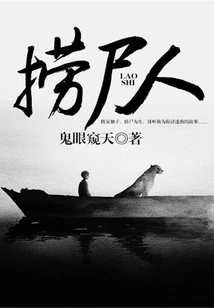
It is an amazing campus life novel in the physical book style, and it also won a children's literature award. It is a pity that the author followed the bad example and went to Bilibili to do live broadcasts and stopped writing new works.