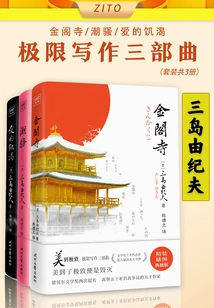
Purple Picture Classic Library: Yukio Mishima's Extreme Writing Trilogy (set of 3 Volumes in Total)
by H
About This Novel
Twice nominated for the Nobel Prize, the genius writer who brought Japanese literature into the top position in the world literary world, and the god of young literary and artistic people - Mishima Yukio's extreme writing trilogy: the extremely beautiful "The Temple of the Golden Pavilion", the extremely pure "Chao Sao", and the extremely loving "Hunger of Love". The latest fine proofreading of the authoritative Chinese translation, the first to be upgraded in 2021, a collector's edition with purple illustrations and hardcover illustrations. "The Temple of the Golden Pavilion": The ultimate beauty is destruction. The pinnacle of Mishima's aesthetics, a benchmark classic novel that is both perfect and original. Anyone can easily feel ashamed when facing the beauty of the Golden Temple. Mizoguchi, a young monk who stutters, is particularly sensitive. Mishima follows Mizoguchi's story, showing one by one the joy, awe, surrender, rebellion, hatred, and even desperate behaviors of defective people in response to "ultimate beauty". It logically completes the functional reversal of "ultimate beauty" from pleasing people to suppressing people. It is shocking to see a young man's relaxed aesthetic activity turn into a tragedy of fighting for his life. This shocking work pushed Japanese literature to a more prominent position in the world literary world upon its debut, and later became a benchmark literary classic that is both perfect and original. "Chao Sao": Only pure love can make the body pure. Mishima's unique work "against himself". 1954 Xinchaoshe Literary Award. Mishima said: "I want to write something that is completely opposite to myself." He changed the tragic concept that all characters have a dark side, and love and beauty to the extreme will inevitably turn into violence and death, and set pure characters and pure love in an Eden-like environment. Only pure love can make the body pure, and thus determine the human body to have the highest aesthetic value. He blended Japanese and Greek classical aesthetics to write this pastoral novel of pure love that can make people feel happy. As soon as the novel was published, it triggered a "name-changing craze". Thousands of Japanese girls changed their names to the name of the character in the novel - Hatsue. "Hunger of Love": If love cannot eliminate loneliness, it will eliminate the lover. A perfect work of Mishima narrative. After the death of Etsuko's husband, she relied on her father-in-law's manor to survive. She seeks a sense of security from her ambiguous relationship with her father-in-law, and longs for pure and dynamic love from the young hired worker Saburo. Etsuko's hunger for love cannot be satisfied after all, and that's because her intimate relationships are established in a twisted way. Many times I try to eliminate loneliness with love, but I end up getting even more lonely. With astonishing insight, Mishima once again exposed the tragic truth of modern people's spiritual level to our eyes with his "extreme writing". The overall structure of "The Hunger of Love" maintains the rigorous pattern of Japanese classical tradition. It is meticulous and exquisite, and the changes in time and space are neatly superimposed. It was highly praised by critics and praised as "the most rigorous work among Yukio Mishima's works."
Official Sources
What Readers Think
Rating
Community(0)
Rating
Community(0)
