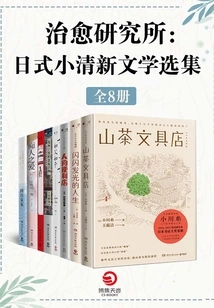
Healing Research Institute: Anthology of Japanese Fresh Literature (8 Volumes in Total)
by (japan) Ogawa Ito, Sayaka Murata, Etc.
About This Novel
"Camellia Stationery Store": Re-recommended by Japan's "Bookstore Award" for two consecutive years! Japanese best-selling author Ogawa Ito's highly acclaimed and heart-warming work has set off a nostalgic trend of the "letter age"! In Kamakura, there is a stationery shop that helps people write for others. Every generation of shop owners are women. They will accept any entrustment, even if it is a restaurant menu. Each ghostwritten letter is the realistic life of the guests, and it is also a lesson in life. "Sparkling Life": Hatoko Amamiya inherited the Shancha Stationery Store as the eleventh generation, delivering the unspeakable words hidden in the heart to customers. Letters written by an invisible boy to his mother, letters written by a deceased husband to his wife, letters written by parents who lost their young son to relatives and friends... Hatoko always uses the most complicated but also most sincere way to help guests solve their doubts. "Like Father, Like Son": When you realize that your child is also watching you, at that moment, you understand what it means to be like father, like son. The original novel that won the Jury Prize at the Cannes Film Festival, the Japanese film master Hirokazu Kore-eda's true feelings, and the tender story that connects millions of families! "Human Convenience Store": This book is a self-reflective realist novel. Having lived in a convenience store for 18 years, facing all kinds of people, this kind of stability can make her feel at ease. He suddenly broke into other people's lives, faced her strange life, and made sarcastic questions based on public standards. "Someone Must Be Praying": Infants and young children aged between zero and two who cannot be with their parents for various reasons live in a nursery - Futaba House. Before the baby reaches its second birthday, Futaba Home will find suitable adoptive parents for the baby, and then the baby will be forever separated from the caregiver who once took care of him. Shimamoto Atsuko, who has worked at Futaba House for twelve years, accidentally learned that the first baby she was responsible for, Taki, had been in a car accident and her life or death was uncertain. Her adoptive parents had already passed away due to the car accident. Atsuko could no longer suppress the emotions that had accumulated in her heart for many years. Regardless of the objections of those around her, she resolutely began to look for Taki, whom she had not seen for nine years... "Idiot's Love": a long masterpiece by the master of aesthetic literature Junichiro Tanizaki. It was adapted from his own experience and can be called a classic of Japanese love aesthetics. It is a story about an out-of-control nurturing love, a story about a trainer being trained instead, and its ultimate description of human sexual desires, which makes people find it difficult to describe and can only sigh. "What Happened Later": explores the confrontation between survival and life, and also reflects Natsume Soseki's ultimate pursuit of "conforming to nature". Only after facing the struggle of life can we truly walk on the natural path without repression and live earnestly and truly for freedom. "Maimoto Sanbu's Favorite Things": Don't think about the vast world, just live for yourself. Being able to be yourself is really a rare and happy thing!
Official Sources
What Readers Think
Rating
Community(0)
Rating
Community(0)