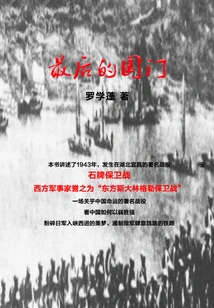
The Last National Gate
by Luo Xuepeng
About This Novel
"The Last Gate" is the key work of the Chinese Writers Association in 2014. The work describes how after the fall of Wuhan in October 1938, the arrogant Japanese army adjusted its strategy towards China and attempted to solve the China problem through military offensive and political surrender. At the same time, Japan launched the Suizao Battle and Zaoyi Battle to sweep the outskirts of Chongqing in 1939 and 1940 respectively, and carried out indiscriminate bombing of Chongqing, its capital during the war, to undermine the Chinese government's will to resist the war. At a time when the survival of the Chinese nation was at stake, the Kuomintang and the Communist Party achieved their second cooperation. In 1943, Chen Cheng commanded the Battle of Western Hubei and inflicted heavy damage on the Japanese army. It shattered the Japanese military's strategic attempt to induce political surrender through military offensive and greatly boosted the morale of the anti-Japanese war. Known as China's "Battle of Stalingrad" in the summer of 1943, the Battle of Shipai to defend China's wartime capital Chongqing finally ended in victory when the Japanese army was defeated and the Chinese army annihilated more than 20,000 Japanese troops.
Official Sources
What Readers Think
Rating
Community(0)
Rating
Community(0)