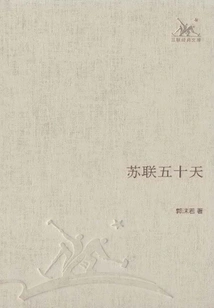
Fifty Days in Soviet Union
by Guo Moruo
About This Novel
In June 1945, Guo Moruo, who had just been appointed director of the Research Committee of the Sino-Soviet Cultural Association, was invited to visit the Soviet Union, which lasted more than two months. After returning to China, he wrote the book "Journey to the Soviet Union" about his experiences in the Soviet Union, which was first published by Shanghai Chinese and Foreign Publishing House in March 1946. Later, the author deleted the part of the book that passed through India and Iran, and renamed it "Fifty Days in the Soviet Union". It was republished by New China Book Company in August 1949. This publication is based on this edition.
Official Sources
What Readers Think
Rating
Community(0)
Official(44)Scraped 1mo ago
The origin of literature is collective creation, collective enjoyment, and collective preservation. Since there have been divisions within society, literature has also been divided. Generally speaking, the so-called orthodox literature takes the path of the upper class, becoming more narrow and rigid as it goes, while collective creation, collective enjoyment, and collective holders remain among the people and follow the path of the lower class. These works are often looked down upon by orthodox literature and are considered not worthy of elegance. But when orthodox literature reaches its dead end, it always relies on those who are not worthy enough to reach the hall of elegance for blood transfusion. And when those who are not worthy enough to reach the hall of elegance ascend to the hall of elegance, it will become more and more narrow and rigid. Chinese literature has repeatedly taken this circuitous road. Our efforts are to make our literature the people's literature and always follow its original path.
I reported on "Literary Activities in Wartime China". I read the original manuscript, and Mr. Qi read the translated manuscript. We each read a section, and the scene was completed in about an hour. Mr. Qi continued to report on "Literary Activities in Wartime China", which also took an hour. Mr. Qi's speech was very clear, his voice was loud, and his report was very impressive.
In ten hours, we went back to the History Museum to dig out the tiles that read "Long Live the Emperor and May He be Still Young". There are three pieces in total, with two rubbings each, one of which is given to the museum.
It seems that our Chinese poets and writers have not yet fully liberated themselves from the literati habits of the past scientific examination era. They write poems and compositions for their own fame, and the target audience is readers who can bring them fame or fortune. Who will care about you ordinary people, let alone your ordinary yellow-mouthed children? Chinese children are worth less than chickens and ducks. They are thrown around alive. How can we write poetry or literature for them? But I am still a "patriot" after all, and I have not "publicized" these "family scandals".
Visit the Revolution Museum
Most of the contents are the same as those displayed in the Lenin Museum. Lenin and revolution are inseparable. The cultural relics after Lenin's death were mostly concentrated on Stalin, and Stalin was inseparable from the revolution.
If you drive eastward, you can reach Silver Pine Forest in about an hour. The village hall is an old-style farmhouse in the pine forest. There are many flowers and plants in the garden, including Jessamine, which is in bloom, but its fragrance is very faint. Mishu Yun, there are few fragrant flowers in the Soviet Union. I thought the same was true in Japan. Japanese orchids are not fragrant, and plum blossoms have little fragrance. This is undoubtedly due to a lack of something in the geology.
The origin of literature is collective creation, collective enjoyment, and collective preservation. Since there have been divisions within society, literature has also been divided. Generally speaking, the so-called orthodox literature takes the path of the upper class, becoming more narrow and rigid as it goes, while collective creation, collective enjoyment, and collective holders remain among the people and follow the path of the lower class.
The person who really loves you can't tell you the reason why he really loves you, and only knows that he can't pay attention to others; the person who really loves you always makes you angry, but you can't find out what he has done wrong; the person who really loves you will only cry in front of you alone; the person who really loves you will scold you when you forget to reply to his text message; the person who really loves you rarely praises you in person, but in his heart he is sure that you are the best.
I have gained more than I can digest. You can return home with a full load. There is always something you can do when you go back to China. Speaking of sightseeing in Britain and the United States, unfortunately my finances do not allow it and I cannot go sightseeing.
The Academy of Sciences was established in 1937. It was originally a local branch of the Soviet Academy of Sciences. In 1943, it was changed to the National Academy of the Republic of Uzbekistan. It is divided into three parts: the first part is technical sciences, the second part is cultural sciences, and the third part is meteorology and mathematics. There are more than 300 researchers engaged in it, 150 of them are Uzbek people.
Rating
Community(0)
Official(44)Scraped 1mo ago
The origin of literature is collective creation, collective enjoyment, and collective preservation. Since there have been divisions within society, literature has also been divided. Generally speaking, the so-called orthodox literature takes the path of the upper class, becoming more narrow and rigid as it goes, while collective creation, collective enjoyment, and collective holders remain among the people and follow the path of the lower class. These works are often looked down upon by orthodox literature and are considered not worthy of elegance. But when orthodox literature reaches its dead end, it always relies on those who are not worthy enough to reach the hall of elegance for blood transfusion. And when those who are not worthy enough to reach the hall of elegance ascend to the hall of elegance, it will become more and more narrow and rigid. Chinese literature has repeatedly taken this circuitous road. Our efforts are to make our literature the people's literature and always follow its original path.
I reported on "Literary Activities in Wartime China". I read the original manuscript, and Mr. Qi read the translated manuscript. We each read a section, and the scene was completed in about an hour. Mr. Qi continued to report on "Literary Activities in Wartime China", which also took an hour. Mr. Qi's speech was very clear, his voice was loud, and his report was very impressive.
In ten hours, we went back to the History Museum to dig out the tiles that read "Long Live the Emperor and May He be Still Young". There are three pieces in total, with two rubbings each, one of which is given to the museum.
It seems that our Chinese poets and writers have not yet fully liberated themselves from the literati habits of the past scientific examination era. They write poems and compositions for their own fame, and the target audience is readers who can bring them fame or fortune. Who will care about you ordinary people, let alone your ordinary yellow-mouthed children? Chinese children are worth less than chickens and ducks. They are thrown around alive. How can we write poetry or literature for them? But I am still a "patriot" after all, and I have not "publicized" these "family scandals".
Visit the Revolution Museum
Most of the contents are the same as those displayed in the Lenin Museum. Lenin and revolution are inseparable. The cultural relics after Lenin's death were mostly concentrated on Stalin, and Stalin was inseparable from the revolution.
If you drive eastward, you can reach Silver Pine Forest in about an hour. The village hall is an old-style farmhouse in the pine forest. There are many flowers and plants in the garden, including Jessamine, which is in bloom, but its fragrance is very faint. Mishu Yun, there are few fragrant flowers in the Soviet Union. I thought the same was true in Japan. Japanese orchids are not fragrant, and plum blossoms have little fragrance. This is undoubtedly due to a lack of something in the geology.
The origin of literature is collective creation, collective enjoyment, and collective preservation. Since there have been divisions within society, literature has also been divided. Generally speaking, the so-called orthodox literature takes the path of the upper class, becoming more narrow and rigid as it goes, while collective creation, collective enjoyment, and collective holders remain among the people and follow the path of the lower class.
The person who really loves you can't tell you the reason why he really loves you, and only knows that he can't pay attention to others; the person who really loves you always makes you angry, but you can't find out what he has done wrong; the person who really loves you will only cry in front of you alone; the person who really loves you will scold you when you forget to reply to his text message; the person who really loves you rarely praises you in person, but in his heart he is sure that you are the best.
I have gained more than I can digest. You can return home with a full load. There is always something you can do when you go back to China. Speaking of sightseeing in Britain and the United States, unfortunately my finances do not allow it and I cannot go sightseeing.
The Academy of Sciences was established in 1937. It was originally a local branch of the Soviet Academy of Sciences. In 1943, it was changed to the National Academy of the Republic of Uzbekistan. It is divided into three parts: the first part is technical sciences, the second part is cultural sciences, and the third part is meteorology and mathematics. There are more than 300 researchers engaged in it, 150 of them are Uzbek people.
