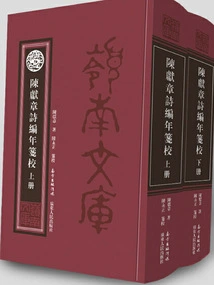
Chronological and Proofreading of Chen Xianzhang's Poems
About This Novel
Chen Xianzhang (1428:1500), named Gongfu and Shizhai. A native of Baishali, Xinhui, he is known as Mr. Baisha in the world. He was a thinker, educator, calligrapher, and poet in the Ming Dynasty. He was the only Ming Dynasty Confucian scholar in Guangdong who worshiped Confucius Temple. He advocated learning, knowing doubts, and independent thinking, and advocated a relatively free and open style of study, which gradually formed the Jiangmen School. Learned from Wu Yubi. In the twelfth year of Zhengtong (1447), people were elected. Later, he gave up his intention to take the imperial examination and was recommended to the Hanlin Academy for review, hoping that he would eventually be raised. I can't recommend him again and again. He gave lectures in his hometown and founded the Baisha School. Cultivation mainly involves sitting in meditation, so as to achieve the state of quiet enlightenment and self-satisfaction, which is the forerunner of enlightened mind learning in the modern era. There is a biography in Volume 283 of "History of the Ming Dynasty". This book is intended to collect all Chen Xianzhang's poems handed down from generation to generation in a chronological manner. It is based on the six-volume version of "The Complete Works of Bai Sha" engraved by He Jiuchou in the 49th year of Emperor Kangxi's reign in the Qing Dynasty (collected in the Library of Sun Yat-sen University). The ten-volume version of "Recent Drafts of Mr. Bai Sha's Poems" engraved by Wu Tingju in the ninth year of Hongzhi in the Ming Dynasty (referred to as the Wu version, collected by the Academia Sinica in History and Language, Taiwan) Research Institute); twenty-one volumes of "The Complete Works of Mr. Baisha" were engraved by He Ziming in the first year of Wanli in the Ming Dynasty (in the collection of the Institute of History and Philology, Academia Sinica, Taiwan); nine volumes of "The Complete Works of Baisha" were engraved by He Shangxin in the ninth year of Wanli in the Ming Dynasty (in the library of Sun Yat-sen University); Huang Zhizheng's original edition in the twelfth year of Shunzhi in the Qing Dynasty (referred to as the Huang version, is in the library of Sun Yat-sen University). Also refer to the collation records of Luo Qiao, Lin Qi, Gao Jian, Xiao Shiyan, He Xiongxiang, and Wang Anshun recorded in "Chen Xian Zhang Ji" edited by Sun Tonghai (referred to as Sun Jiao). In addition, twenty-nine poems outside the collection were transcribed from "Supplement to Chen Xianzhang's Poems and Prose", and several poems outside the collection were compiled from other books and are attached at the end of the volume. There are many editions of Mr. Baisha's collection. The author presided over the compilation work of "Quan Yue Poetry" and was responsible for sorting out Bai Sha's poems. He carefully searched for Mr. Bai Sha's collection and obtained the earliest Wu Tingju published version, "Recent Draft of Mr. Bai Sha's Poems" (referred to as the Wu version). Wu's "Recent Draft of Mr. Baisha's Poems" is a ten-volume edition written by Mr. Chen Baisha in his later years. It collects poems from Jiachen (1484), the 20th year of Chenghua, to Jiayin (1494), the seventh year of Hongzhi. In addition to being the earliest collection of Chen Baisha's poems handed down to the world, Wu Benzhong's chronicle poems provide a large amount of first-hand data for research on Bai Sha's life and contacts, and are of great value for the future compilation of Mr. Bai Sha's chronology. They are also of great value in collation. Some misspelled words and different texts in each edition can be corrected according to the Wu edition. Some of the Wu edition's self-notes have been deleted in each edition. In addition, there are still some poems in the Wu edition that are not available in each edition and can be compiled and lost.
Official Sources
What Readers Think
Rating
Community(0)
Rating
Community(0)