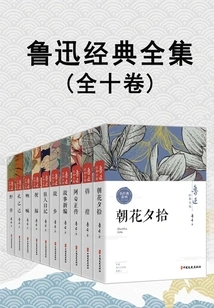
The Complete Works of Lu Xun's Classics (ten Volumes)
by Lu Xun
About This Novel
Lu Xun (September 25, 1881 - October 19, 1936), a famous writer, thinker, educator, democratic activist, important participant in the May Fourth New Culture Movement, and the founder of modern Chinese literature. Comrade Lu Xun is known as "the main general of China's cultural revolution. Lu Xun's direction is the direction of the new culture of the Chinese nation. This series of books is "The Complete Works of Lu Xun's Classics", which contains ten volumes, including The True Story of Ah Q, Gathering Flowers at Dusk, New Stories, Hometown, Kong Yiji, Diary of a Madman, Scream, Wandering, Weeds, and Blessings. "The True Story of Ah Q" was created at the end of 1921, around the time of the Revolution of 1911. Set against the backdrop of rural China, it describes the story of Ah Q, a wandering farmhand in Weihuang, who, although he is "really capable" of working, has nothing, and even his name has been forgotten. "Reminiscences of Memories" reflects the author Lu Xun's teenage life in many aspects, and vividly reflects the formation of his character and interests. The first seven chapters reflect his childhood life in his family and private school in Shaoxing, and the last three chapters describe his journey from his hometown to Nanjing, and then to Japan to study. The experience of returning to China to teach later exposed all kinds of ugly and irrational phenomena in semi-feudal and semi-colonial society. It also reflected the difficult journey of aspiring young intellectuals to brave the dangers and search for light in the vast darkness of old China. It also expressed the author's nostalgia for his former relatives, friends and teachers. "New Stories" is a collection of short stories written by Mr. Lu Xun based on ancient myths and historical legends. It is Lu Xun's last innovative work. Five of the eight stories were written in the last period of Lu Xun's life. Facing the threat of death, he was in internal and external difficulties, and suffered from physical and mental exhaustion. "New Stories" is the entire collection. The overall style shows unprecedented calmness, richness, humor and freedom. Mr. Lu Xun himself believes that this is a collection of myths, legends and historical facts. "Hometown" takes "my" return to hometown as a clue, and is arranged according to the plot of "returning to hometown" - "being in hometown" and "leaving hometown". Pai, based on what "I" saw, heard, remembered and felt, focused on describing the characters of Runtu and Yang Ersao, thus reflecting the reality of rural bankruptcy and the miserable life of farmers before and after the Revolution of 1911; at the same time, it profoundly pointed out the spiritual suffering of the working people due to the influence of traditional concepts in feudal society. "Kong Yiji" is Lu Xun's second vernacular novel after "Diary of a Madman" on the eve of the May 4th Movement. The novel describes the tragic image of Kong Yiji, who was poisoned by the decadent feudal ideology and the imperial examination system, became mentally pedantic and insensitive, lived in industriousness, and lived in poverty. He spent his days in people's ridicule and banter, and was finally swallowed up by the feudal landlord class. It is not long, but it deeply reveals the tragic image. At that time, the imperial examination system poisoned the spirit of intellectuals and the "cannibalistic" nature of the feudal system had a strong anti-feudal significance. "Diary of a Madman" was the first short vernacular diary novel written by Lu Xun and the first modern vernacular novel in China. The novel uses the image of the persecuted "madman". The self-narrative description of the phenomenon and the "madman" reveals the "cannibalistic" nature of feudal ethics and expresses the author's resistance to Chinese feudal culture with feudal ethics as its main connotation; it also shows the author's profound sense of repentance towards Chinese culture from a thorough "revolutionary democratic" stance. "The Scream" truly depicts the social life from the Revolution of 1911 to the May 4th Movement. Starting from revolutionary democracy, with the purpose of enlightenment and the spirit of humanitarianism, "The Scream" reveals all kinds of profound problems. It deeply analyzes and relatively completely denies the old Chinese system and some obsolete traditional concepts, showing a strong awareness of national survival and a strong hope for social change. "The Scream" is the beginning and maturity of modern Chinese novels. The novel "Wandering" expresses the author's uncompromising spirit of opposing feudalism and is a mirror of China's revolutionary thoughts. The whole collection of novels mainly covers peasants and intellectuals who live under the heavy pressure of feudal forces. The collection of poems "Weeds" truly describes the author's continued fighting after the division of the New Culture United Front, but he still felt lonely and hesitant. The collection of poems is diverse in content, rich in imagination, unique in conception, rich in lyricism and musicality, and has a strong artistic appeal in the form of monologue lyric prose, deepening the poetic imagination and sublimation. The art and ideological conception of Chinese prose poetry. The work tells the story of an intellectual "I" who left his hometown and stayed at the house of his fourth uncle (Master Lu) at the end of the lunar calendar to prepare for a "blessing". The tragic life of Sister Xianglin shows the author's sympathy for oppressed women and his ruthless exposure of feudal ideology and ethics. It also illustrates the indifference and confusion of enlightened intellectuals like "me" in the article to the selfishness of people and the harsh social status quo at that time.
Official Sources
What Readers Think
Rating
Community(0)
Rating
Community(0)
